





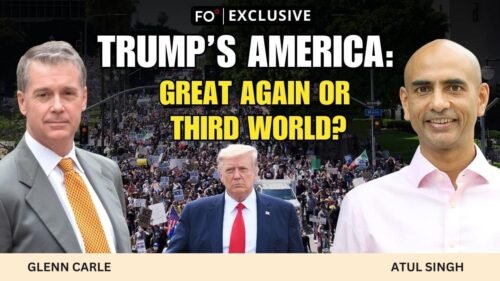
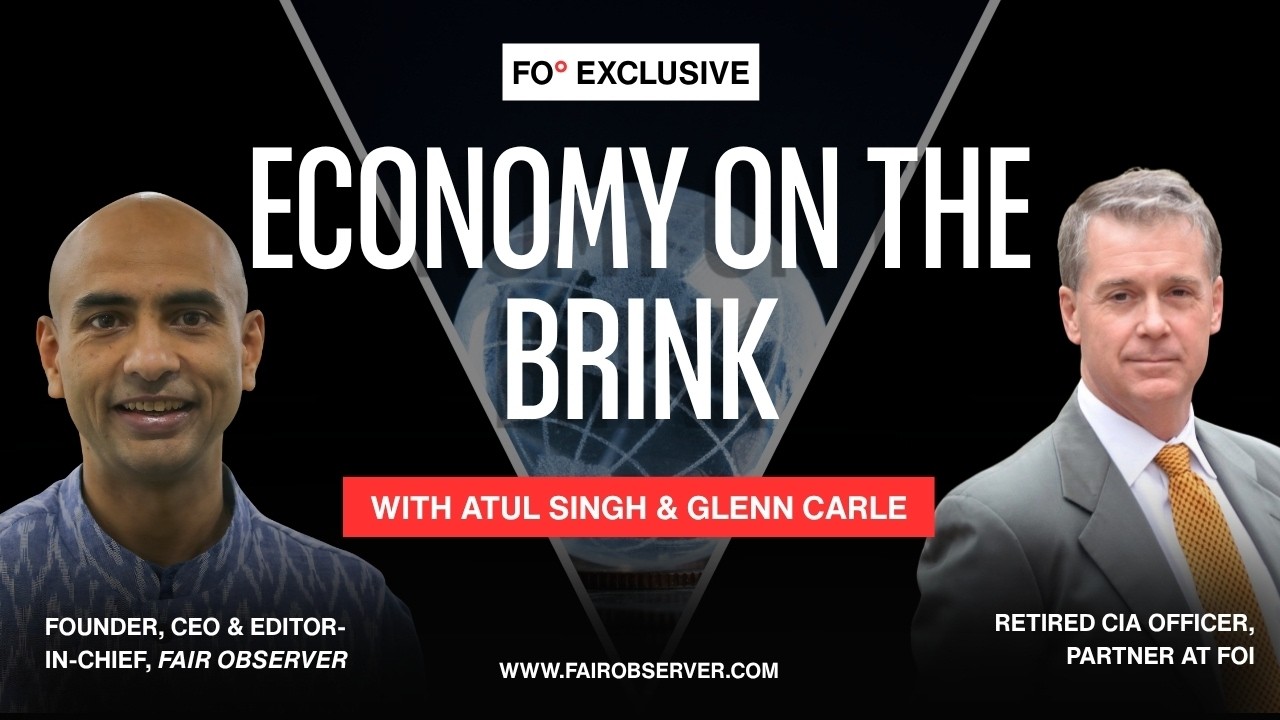
June was an eventful month in 2025. Fair Observer Founder, CEO & Editor-in-Chief Atul Singh and retired CIA Officer Glenn Carle look back at the key developments, from the US budget stalling in the Senate to a Boeing plane crashing in India. They then announce the two main topics of this episode of FO° Exclusive: the intensifying confrontation involving Iran, Israel and the United States, and the ongoing breakdown of US political and cultural norms.
US budget gridlock and domestic crisis
The US budget is at an impasse. While May brought economic uncertainty, the current situation has worsened. The federal budget remains stuck in the Senate, and a debt crisis now brews. This stalemate adds to the perception of dysfunction in Washington, DC, with fiscal paralysis threatening broader economic stability at home and abroad.
Ukraine’s deep strike into Russia
A dramatic escalation in the Ukraine conflict made global headlines. Ukrainian forces reportedly smuggled 117 drones deep into Russian territory — reaching as far as Eastern Siberia — and struck multiple airfields. According to the program, the operation damaged 41 Russian aircraft, including strategic bombers. Atul likens this unprecedented strike to the covert missions of the United Kingdom’s Special Air Service during World War II. Russia responded with retaliatory airstrikes on Ukrainian territory, further intensifying the war and underscoring Ukraine’s growing reach and resolve.
Poland’s presidential election and political clash
In a closely contested runoff, Karol Nawrocki of the right-wing Law and Justice Party defeated government-backed centrist Rafał Trzaskowski with 50.9% of the vote. The result introduces serious friction into Poland’s government, which operates under a parliamentary system with a separately elected president. Prime Minister Donald Tusk, a centrist, must now navigate governing alongside a hard-right president from a hostile political camp.
Atul explains that Poland is a very young democracy, having only shed communist rule in 1991. Political divisions within Poland mirror broader ideological splits across the West.
Europe’s spending crisis and NATO commitments
Across Europe, signs of economic and political strain mount. The UK reversed several policy commitments and announced new spending cuts, signaling deeper fiscal retrenchment. Meanwhile, NATO member states have reportedly agreed to increase their defense spending to 5% of GDP by 2035 — caving, as Atul puts it, to US President Donald Trump’s demands.
Atul questions the feasibility of this pledge, given the already high debt levels in many of these countries. He suggests that the resulting budget pressures could lead to reduced social services, diminished support for immigrants, and higher taxes, particularly for middle-income earners.
Colombian assassination attempt
A shocking incident occurred in Colombia, where an unseen attacker shot conservative senator and presidential candidate Miguel Uribe Turbay in the head. The senator survived, however. This assassination attempt underscored the country’s volatile political climate and ongoing security concerns. The hit on Urbe Turbe added to a growing list of violent political episodes in Latin America in recent years.
Deadly plane crash in India and regulatory failures
A tragic aviation disaster struck India when a Boeing plane crashed shortly after departing from Ahmedabad airport. The craft failed to properly take off, gradually descending and hitting several buildings. The crash killed not only the hundreds of passengers but also civilians in those buildings. Preliminary investigations pointed to an electrical failure as the cause.
Atul criticizes Boeing for the plane’s technical issues while Glenn blames the crew who maintained the craft. Public criticism quickly focused on the Indian Director General of Civil Aviation, Faiz Ahmed Kidwai, who was formerly in charge of farmer welfare.
The incident reignited broader concerns about the Indian Administrative Service, which routinely places generalist bureaucrats into technical leadership roles. This practice raises serious questions about domain expertise and regulatory competence.
Vietnam’s partial repeal of the death penalty
Amid the grim headlines, Vietnam made a notable reform by eliminating the death penalty for eight crimes, including embezzlement. Atul views this move as a step in the right direction for human rights, although Glenn opines that it might have been partially self-serving — intended to shield government officials from harsh legal consequences. Nevertheless, the decision was recognized as a progressive shift within Southeast Asia.
Trump and Musk’s public falling out
Trump and former Special Government Employee Elon Musk experienced what Atul describes as a “spectacular falling out,” attracting widespread public attention. The dispute reflects the fracturing alliances among powerful conservative and libertarian figures. It also reinforces the blending of politics and celebrity culture in contemporary media.
Nippon Steel’s takeover of US Steel
In a major economic development, Trump approved Japanese steelmaker Nippon Steel’s acquisition of American steel manufacturer US Steel. The move was framed as a diplomatic win for Japan and a sign of strengthening economic ties between the US and Japan. It also signaled a potential shift in Republican trade posture, showing a willingness to allow foreign takeovers under certain geopolitical circumstances.
[Lee Thompson-Kolar edited this piece.]
The views expressed in this article/video are the author’s own and do not necessarily reflect Fair Observer’s editorial policy.



































Comment