

Get Our Free ePublication Now
We publish monthlies, yearbooks and more to inform and educate our global community. Escape algorithms driving you to echo chambers and see through the eyes of our 3,000+ authors from 90+ countries. Make sense of the world one perspective at a time.
Complete the form below to download your free copy of Fair Observer Monthly: April 2026 now.
What We Cover in This ePublication
Our e-magazine, Fair Observer Monthly, enables you to take stock of our ever-changing world one month at a time. We compile 15 of our best original articles from the past month for you. In keeping with our ethos, we bring you insights from diverse voices around the world on a multitude of subjects. Our goal is to give our FO° Community a snapshot of the past month. The perspectives in our monthly will inform and educate you. They will take you away from echo chambers, and you will disagree with some. For the discerning reader, Fair Observer Monthly is a good way to make sense of the world at a time of polarization, sensationalism and fake news. So, download our monthly now.
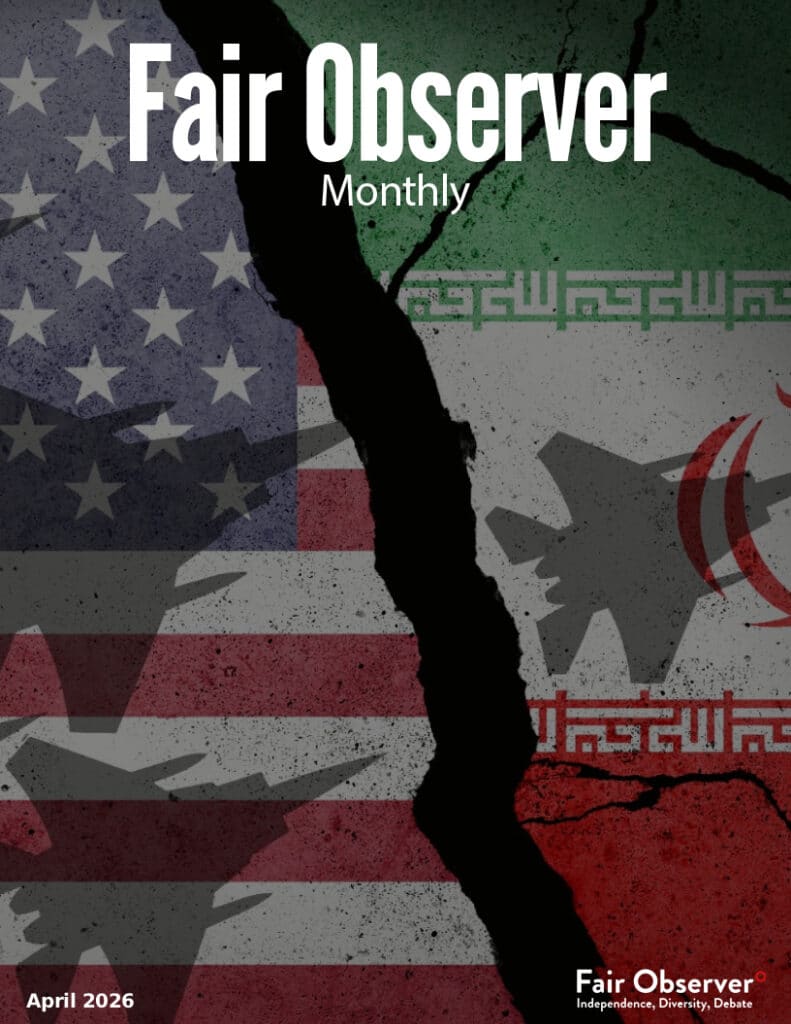
The April Fair Observer Monthly offers a wide-ranging examination of geopolitical tension, economic fragility and cultural reflection in an increasingly fragmented world. Economic fault lines and systemic risk take center stage. Japanese economist Masaaki Yoshimori warns that overlooked structural dependencies, such as global fertilizer supply chains, could trigger cascading crises that threaten food security and political stability. In a separate analysis, he paints a picture of how the US dollar acts as an instrument of geopolitical influence. Yoshimori has been prolific this month and a piece he has penned together with attorney John F. Halbleib reflects on capitalism’s long-term legitimacy, arguing that its future depends on restoring a balance between market efficiency and social trust.
Political, cultural and technological transformations
The exploration of power dynamics forms another core thread. American public health analyst Nikia Crollard critiques the donor-driven model of global health, suggesting a shift toward more equitable, locally led systems. Retired CIA officer Glenn Carle and Editor-in-Chief Atul Singh analyze how historical legacies and strategic ambiguity shape the rising tensions between China and Taiwan. Meanwhile, assistant professor Nawzad Shukri explores US efforts to leverage Kurdish groups to pressure Iran, revealing the complexities and risks of proxy strategies in the Middle East.
Regional political developments further illustrate a world in flux. Bangladeshi academician Md. Himel Rahman examines the limits of compartmentalizing cooperation amid underlying tensions in Indo-Bangladeshi relations. Spanish academic Laura Pavón considers Cuba’s uncertain future, pointing to economic hardship as the island navigates a potential political transition. In Europe, professor of European intellectual history Elliot Neaman evaluates the significance of Viktor Orbán’s political defeat and argues that Germany’s reconsideration of conscription reflects a necessary response to shifting security realities. Sebastian Schäffer, director of a regional think tank based in Vienna, offers a contrasting view, arguing that new conscription laws are a symptom of deeper structural issues within Europe’s security architecture.
Broader cultural and societal questions about diplomacy, technology and the future of conflict are also prominent this month. Chief Strategy Officer Peter Isackson questions whether traditional negotiation remains relevant in an era of performative diplomacy and entrenched positions. Eminent Venezuelan diplomat and scholar Alfredo Toro Hardy invokes the symbolism of the Doomsday Clock to underscore the urgency of governance in the age of AI acceleration. Resident sociologist Ellis Cashmore revisits the legacy of Michael Jackson, questioning how contemporary social movements like #MeToo might have reshaped his career and public perception. Finally, leader, scholar and cultural advocate in Nagaland, Charles Chasie, interviews with Communications Officer Roberta Artemisia Campani, highlighting the Khonoma reconciliation process, offering a localized but powerful example of conflict resolution grounded in community engagement.
But before you read on, we must ask: Do you value independent journalism, free of billionaire owners filtering the news through their agendas? Do you appreciate Fair Observer’s mission to keep dialogue and debate free and uncensored? Do you want benefits that make our site a better user experience?
If yes, please consider donating below. For a one-time or, ideally, recurring payment, you can keep free, fair and independent Fair Observer chugging along. By becoming a sustaining member, you will be able to bookmark pieces, leave comments, engage in discussions and more. So, sign up today.
Note: We are a section 501(c)(3) nonprofit registered in California, and our EIN is 46-4070943. If you pay taxes in the US, your donation is tax-deductible.
Content of Publication
FO Interview: The Khonoma Reconciliation Process – Charles Chasie, Roberta Artemisia Campani
The Agenbite of Diplomacy: Are Negotiations Still a Thing? – Peter Isackson
China–Taiwan Tensions — Civil War Legacies and Geopolitical Chess – Glenn Carle, Atul Singh
Capitalism at 250: Freedom, Legitimacy and the Renewal of the Market Order – John F. Halbleib, Masaaki Yoshimori
All Eyes Are on Cuba, and No One Knows How Its Future Could Play Out – Laura Pavon
Would Michael Jackson Have Survived in the #MeToo Era? – Ellis Cashmore
Germany’s Conscription Misstep Exposes a Deeper European Problem – Sebastian Schäffer
Germany’s Return to Conscription Is Not a Mistake; It’s an Obligation. – Elliot Neaman
Why Viktor Orbán’s Defeat Matters – Elliot Neaman
Leveraging the Kurds: Inside US Plans to Pressure Tehran – Nawzad Shukri
Full Compartmentalization in Indo–Bangladeshi Relations? – Md. Himel Rahman
Singularity and the Doomsday Clock – Alfredo Toro Hardy
Rebalancing Power in Global Health: The End Of Donor-Driven Models – Nikia Crollard
The Dollar as a River of Power – Masaaki Yoshimori
The Fertilizer Fault Line: The Hidden System That Could Trigger the Next Global Crisis – Masaaki Yoshimori




