



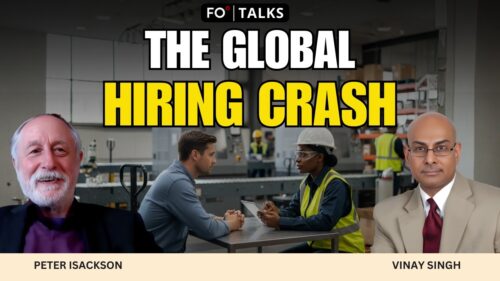
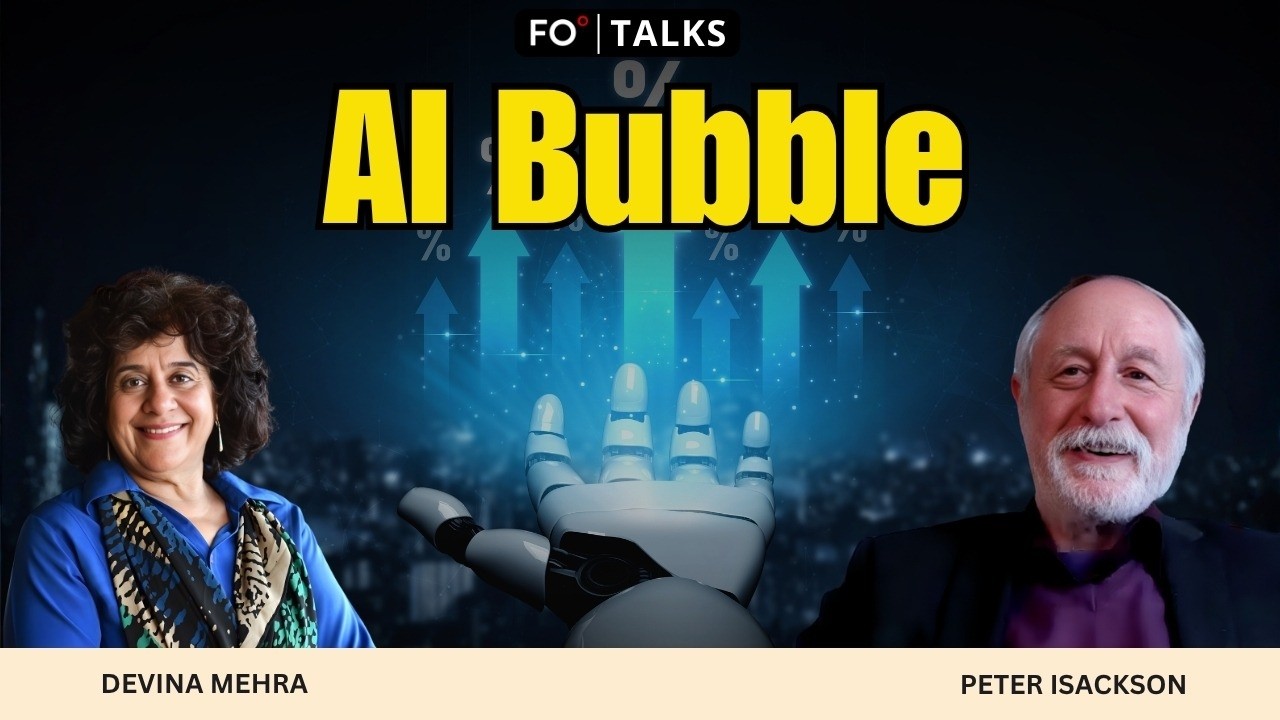
Fair Observer’s Chief Strategy Officer Peter Isackson and Global Civilization Dynamics Founder Vinay Singh discuss a labor crisis that reaches beyond layoffs and automation into something more destabilizing: the slow collapse of the assumptions that once gave work its meaning. As artificial intelligence spreads, salaries stagnate and career paths fragment, the two examine how economic insecurity is reshaping identity, education and trust. This disruption may force a deeper rethink of how societies organize learning, work and collective life.
Work, identity and a culture of anxiety
Singh opens by mentioning two films, No Other Choice (2025) and Send Help (2026), which he sees as cultural reflections of mounting workplace stress. He suggests that stories mixing comedy, horror and desperation resonate because they mirror a real social mood: the sense that stable employment has become elusive even for qualified people. In his view, such films offer a kind of emotional release for audiences who feel trapped in a labor market they cannot control.
Isackson argues that the issue is not just employment in a narrow sense, but the broader role of productive activity in human identity. For over a century, modern societies assumed that a job anchored a person’s place in the world. But the rise of gig work, precarious contracts and unstable income has weakened that link. Simultaneously, wealth has become more concentrated since the 2008 financial crisis, leaving many people with a growing sense of instability and anguish.
Security hollowed out
Singh turns to the economics of the middle class. He cites reporting from institutions such as The Wall Street Journal and RAND that shows wealth moving upward while ordinary workers lose ground. His example is the information technology sector: an Oracle database administrator earning around $120,000 in the early 2000s might earn roughly the same nominal salary today, even though housing, food and other essentials now cost far more. The salary appears stable, but purchasing power has eroded sharply.
That stagnation grows even more unsettling when paired with layoffs. Isackson points to job cuts at major technology firms such as Oracle, Microsoft and Amazon as evidence that insecurity now affects even workers once seen as safely positioned inside the knowledge economy. The problem is not only current income. It is also intergenerational. Parents who once believed they had found a secure place in the system now wonder whether their children will find any comparable path at all.
Degrees, skills and the educational reckoning
A major fault line in the discussion concerns higher education. Singh pushes back against claims that college degrees have broadly lost their value. He sees that argument as exaggerated and short-sighted. Education remains an investment in the mind itself, not just a ticket to a first job. As he puts it, a degree helps turn a young person into a “multidisciplinary thinking machine.” He argues that this broader intellectual formation still matters, and may matter even more as societies confront complex technological and economic change.
Isackson is less convinced that the existing model can survive intact. Traditional educational systems were built for job categories that are now disappearing or being transformed. In that sense, the problem is not learning itself but the institutional structure around it. He is skeptical of fashionable promises around both e-learning and AI, saying much of that enthusiasm is overhyped. Even so, he believes AI could become useful if education is rebuilt around critical thinking rather than credential production.
AI, layoffs and “functional unemployment”
Singh goes on to reference Anthropic CEO Dario Amodei, who has suggested that AI could eventually contribute to unemployment on a massive scale. Singh is struck by how quickly societies are embracing systems that may disrupt millions of livelihoods without any serious collective effort to slow the process or manage its consequences. He insists that individual workers are not to blame for the confusion and instability around them.
Singh also draws attention to a less visible measure of labor distress: functional unemployment. This includes not only people unable to find work, but also those employed full-time while earning below a poverty threshold. Someone who once held a skilled position but now survives through Uber, DoorDash or other low-paid work is still counted as employed, even though their economic life has been fundamentally downgraded. Singh calls attention to the ripple effects of that decline, from cutbacks in daily life to mounting family strain and financial stress.
From private struggle to collective rethink
To conclude the discussion, Isackson states that the crisis extends beyond jobs into a wider collapse of trust in institutions, from government to education to business leadership. Yet he also sees in that crisis the possibility of renewal. If the old framework no longer works, societies may be forced to imagine new forms of human activity, cooperation and value.
Singh ends on a similar note. “The whole house has been brought down,” he says, describing a system whose failures can no longer be hidden. Still, he urges viewers to resist isolation and self-blame. The confusion is real, the disruption is shared and the next model of work will not be shaped by individuals acting alone, but by people learning again how to think and act together.
[Lee Thompson-Kolar edited this piece.]
The views expressed in this article/video are the author’s own and do not necessarily reflect Fair Observer’s editorial policy.



































Join the conversation
Share your perspective
Log in to share your thoughts and take part in the discussion.