





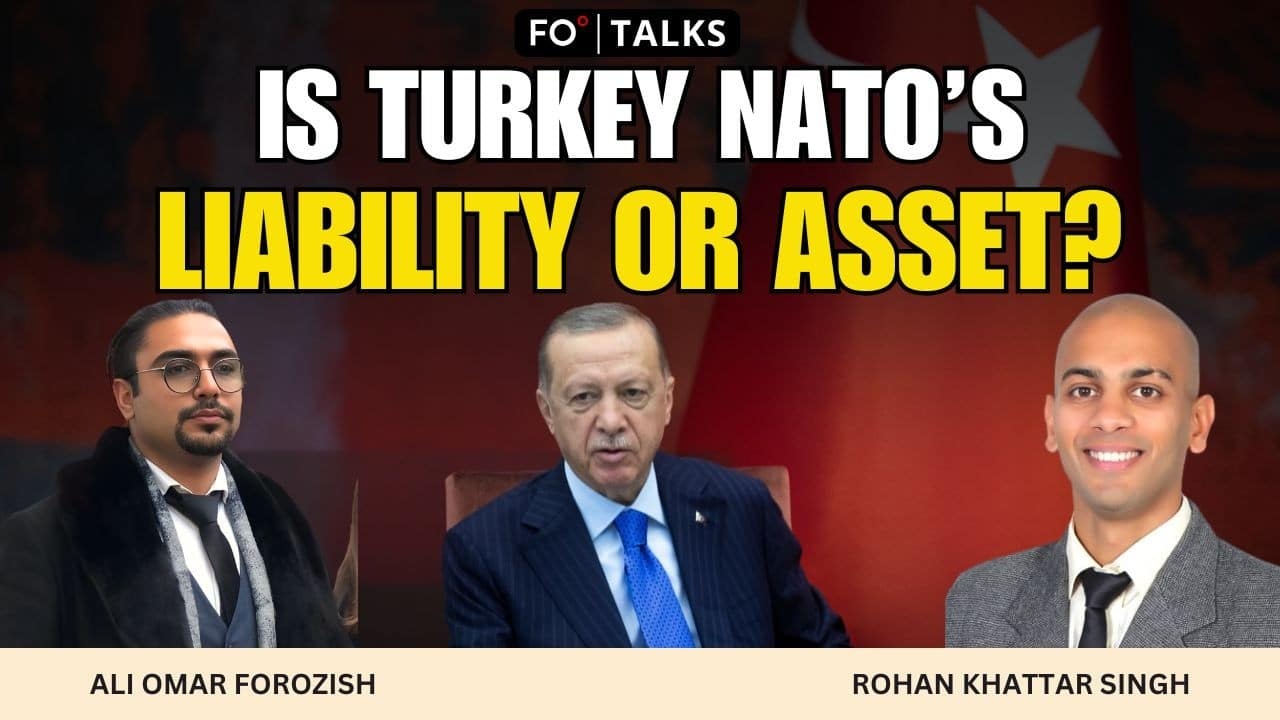
Fair Observer’s Video Producer Rohan Khattar Singh speaks with author Ali Omar Forozish about Turkey’s attempt to navigate an increasingly fragmented world order without fully committing to either East or West. Under Turkish President Recep Tayyip Erdoğan, the Turkish capital of Ankara is expanding ties with Russia- and China-led institutions while remaining embedded within NATO and the broader Western security system. Forozish believes this balancing act reflects both Turkey’s geopolitical realities and its growing desire for strategic autonomy. Yet the discussion also raises a central question: Can a middle power sustain a position between rival blocs without eventually being forced to choose?
Turkey’s search for its own center of gravity
Forozish frames Turkey’s geopolitical strategy through political scientist Samuel Huntington’s “Clash of Civilizations” thesis rather than political scientist Francis Fukuyama’s “End of History.” In his view, the contemporary world is increasingly divided into competing civilizational and geopolitical blocs, leaving countries such as Turkey searching for a distinct position between them.
He says Turkey occupies a “liminal space” shaped simultaneously by the Islamic and Ottoman past and the secular, Western-oriented republic created in the 20th century. Ankara’s frustrations with both camps have reinforced this ambiguity. Turkey spent decades attempting to join the European Union without success, while its NATO membership has also generated suspicion among non-Western powers.
As a result, Forozish believes Ankara no longer seeks full integration into either side. “Turkey believes its role identity is not to be a side, but to be [the] center of gravity,” he states.
Domestic politics reinforce this orientation. Erdoğan’s alliance with politician Devlet Bahçeli’s Nationalist Movement Party has strengthened nationalist narratives that portray the West as hostile to Turkish sovereignty and Islamic civilization. Forozish links this outlook to the long-standing “Sèvres Syndrome,” a belief among Turkish nationalists that foreign powers continue to seek Turkey’s fragmentation and subordination.
Hedging between NATO and Eurasia
Khattar Singh and Forozish describe Turkey’s strategy as one of institutional hedging rather than outright realignment. Ankara is deepening engagement with non-Western organizations while avoiding a complete break with NATO.
Turkey formally applied for BRICS membership in 2024, although it ultimately received partner status rather than full accession. At the same time, Turkey has maintained dialogue-partner status within the Shanghai Cooperation Organization since 2013, making it the only NATO member connected to the group.
Forozish argues these moves are pragmatic rather than ideological. “It’s not a complete shift to the Eastern Bloc,” he says. “It’s just a complementary act for them.”
Geography remains central to Ankara’s calculations. Turkey seeks to position itself as a logistical bridge between Europe and Asia through the so-called Middle Corridor, a trans-Caspian trade route connecting China and Europe while bypassing Russia. The corridor has gained importance following disruptions tied to the war in Ukraine and wider instability across Eurasia.
Under optimal conditions, delivery times along this route could reportedly fall to around 15 days. Ankara therefore sees infrastructure and transit connectivity as tools for expanding both economic influence and geopolitical leverage.
An “unholy alliance” of convenience
Despite Turkey’s growing engagement with Russia and China, Forozish rejects the idea that a coherent Eurasian bloc is emerging. Instead, he characterizes the relationship as an “unholy alliance” built on mutual convenience rather than shared values or long-term trust.
The three states continue to compete across multiple arenas. Turkey and Russia back opposing actors in conflicts such as Syria and Libya, while Ankara’s push to expand influence among Turkic states in Central Asia challenges Moscow’s historic dominance in the region. China, meanwhile, remains economically dominant within the relationship.
Trade figures illustrate the imbalance. Turkey runs trade deficits of roughly $40–50 billion with China and approximately $16 billion with Russia. According to Forozish, this leaves Turkey functioning more as a transit and consumer economy than an equal strategic partner.
Tensions also persist over the treatment of Uyghurs in China. Forozish warns that Ankara’s silence on the issue could generate domestic backlash inside Turkey, where many nationalists and Islamists identify closely with Turkic Muslim communities.
For him, the partnership ultimately reflects transactional realpolitik rather than ideological solidarity. Russia gains opportunities to weaken NATO cohesion, China expands access to European markets and Turkey acquires leverage against the West.
The danger of “double isolation”
Khattar Singh presses Forozish on the risks of Turkey’s balancing strategy failing. If Ankara drifts too far from the West without securing meaningful alternatives from Russia or China, it could find itself isolated from both camps at once.
Forozish describes this possibility as “double isolation” or “strategic homelessness.” Turkey could become too Eastern for Western allies to fully trust while remaining too connected to NATO for Russia and China to treat as a dependable partner.
Such a scenario would create economic as well as geopolitical vulnerabilities. Turkey remains deeply integrated with Western capital markets and trade networks. A decisive rupture with Europe and the United States could intensify inflation, weaken the lira and trigger capital flight.
Forozish also warns that strategic isolation could deepen domestic radicalization. “Turkey will be the hub for the radical Islamists,” he says, describing what he views as the most dangerous possible outcome of a failed balancing strategy.
The conversation ultimately presents Turkey’s Eurasian pivot as a high-risk effort to maximize flexibility in a multipolar world. Ankara may gain short-term leverage from balancing rival powers, but the structural tensions within the strategy place clear limits on how far that balancing act can go.
[Lee Thompson-Kolar edited this piece.]
The views expressed in this article/video are the author’s own and do not necessarily reflect Fair Observer’s editorial policy.























Comment