
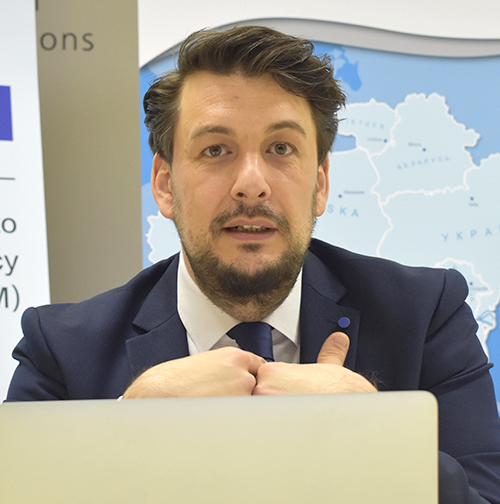



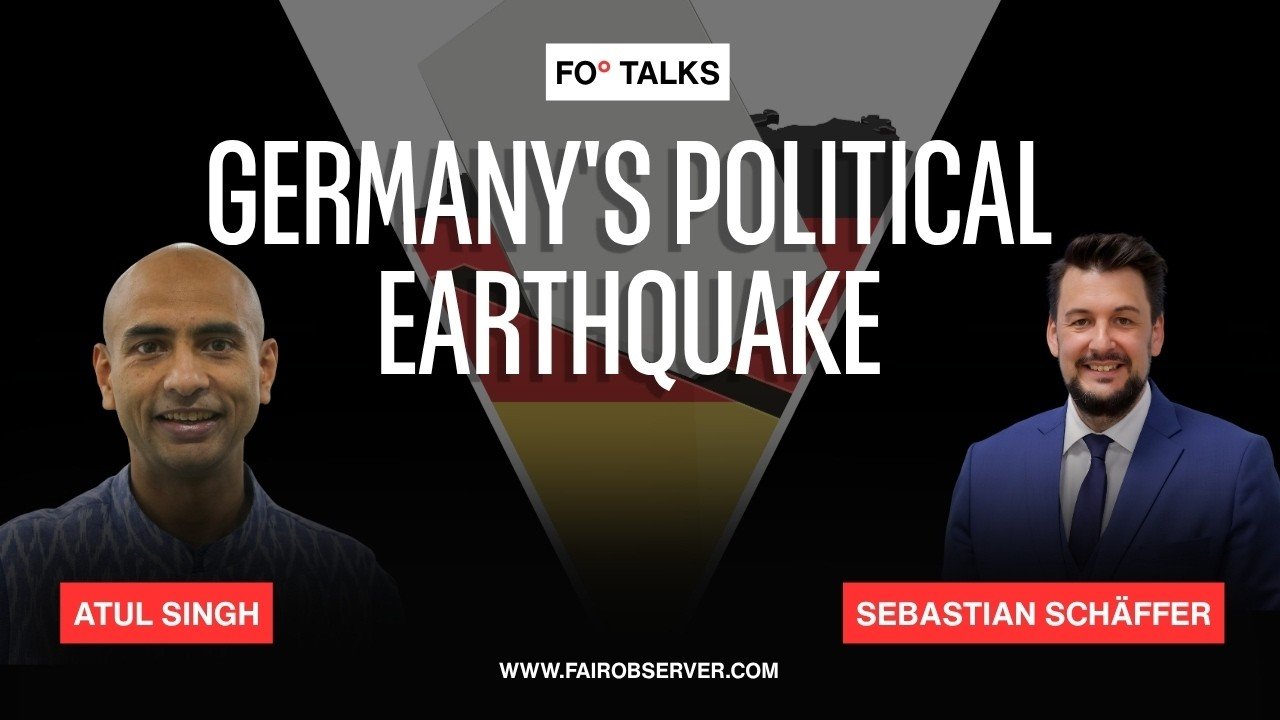
Fair Observer’s Video Producer Rohan Khattar Singh and Sebastian Schäffer, Director of the Institute for the Danube Region and Central Europe, discuss how the Iran war and the blockade of the Strait of Hormuz are reshaping Europe’s energy security and strategic outlook. As conflict in the Middle East unfolds alongside Russia’s war in Ukraine, a core question arises: Can Europe withstand a second major energy shock while maintaining unity, supporting Ukraine and navigating an increasingly unstable global order? Khattar Singh and Schäffer explore energy vulnerability, alliance tensions and the possibility that a new geopolitical architecture is already emerging.
Energy shock and Europe’s fragile recovery
The conversation opens with the immediate economic implications of the Strait of Hormuz blockade. Roughly 20% of global oil passes through this chokepoint, and about 10% of Europe’s oil supply depends on that route. For a continent still adjusting after cutting ties with Russian fossil fuels following Moscow’s 2022 invasion of Ukraine, the disruption arrives at a precarious moment.
Schäffer says Europe is “running from one catastrophe into another.” Yet he also stresses that the continent is not as vulnerable as it was in 2022. European states have largely phased out Russian oil and are gradually reducing dependence on Russian gas. Alternative suppliers, particularly Norway, have already become crucial. New sources, such as Romania’s Neptune Deep gas reservoir, could further diversify supply.
The crisis also revives debates over energy strategy. Schäffer argues that using existing nuclear capacity may make sense, but he questions investments in new plants, suggesting that renewable energy expansion offers a more sustainable path. Europe’s long-term resilience depends not only on diversification but on accelerating structural energy transformation. Even so, the timing of the new shock exposes the limits on Europe’s margin for error.
Rising oil prices and the Ukraine war
Khattar Singh shifts the discussion to the geopolitical consequences of higher energy prices. Russia, which previously sold oil at discounted rates to countries such as India and China, now benefits from tighter supply conditions. Rising prices strengthen Moscow’s fiscal capacity and indirectly support its war effort in Ukraine.
Schäffer acknowledges that Europe must respond, but argues for indirect involvement in the Middle Eastern conflict. After all, the two wars are linked. Cooperation between Russia and Iran, including drone technology transfers and intelligence sharing, means that instability in one theater reverberates in the other. Higher oil revenues for Russia translate into more resources for continued military operations.
Shifting US priorities compound this concern. Khattar Singh notes that American resources, including air defense systems, are increasingly deployed in the Middle East. Schäffer points to reports that the United States used as many Patriot missiles defending allies there in a few days as it had used in Ukraine over an entire year. This imbalance, he warns, risks weakening Kyiv’s position. Europe has increased financial and military support, but it is not enough.
NATO tensions and transactional politics
The Iran war also exposes divisions within NATO. While Washington calls for allied naval deployments to secure the Strait of Hormuz, several European leaders have resisted involvement, arguing that the conflict does not directly concern them. The resulting friction reflects deeper uncertainty about alliance priorities.
Schäffer attributes part of this tension to unpredictable US policymaking. He argues that the current approach complicates long-term planning and leaves European governments unsure how to coordinate responses. The challenge lies in adapting to a more transactional environment in which support in one theater may be linked to concessions in another. Europe, he believes, missed an opportunity to leverage this dynamic by conditioning Middle East cooperation on sustained backing for Ukraine.
At the same time, differences among European states further complicate decision-making. Some governments favor alignment with Washington, others resist deeper involvement. These divergences highlight structural limitations in NATO and raise questions about how cohesive the alliance can remain under simultaneous crises.
Strategic autonomy and Europe’s internal constraints
Faced with uncertainty in Washington, Europe has increasingly pursued partnerships beyond the transatlantic relationship. Khattar Singh notes new trade agreements with India and the South American Mercosur bloc, reflecting a broader effort to diversify diplomatic and economic ties.
Schäffer agrees that Europe possesses significant soft-power potential but argues that internal fragmentation undermines its effectiveness. Decision-making rules requiring unanimity in foreign policy allow individual member states to block collective action. This institutional constraint, combined with diverging national interests, slows Europe’s response to rapidly evolving crises.
Despite these challenges, Schäffer maintains that Europe retains substantial advantages. It remains economically stable, technologically innovative and institutionally resilient. These strengths, he argues, position the continent to play a leadership role in shaping the emerging global order — provided it can overcome internal divisions and coordinate policy more effectively.
Nuclear risks and a changing global order
The discussion concludes with a broader reflection on nuclear proliferation and strategic instability. Rising tensions in both Ukraine and the Middle East increase fears of escalation. Khattar Singh cites polling indicating strong support within Iran for developing nuclear weapons as a deterrent.
Schäffer links this sentiment to the perceived failure of security guarantees such as the 1994 Budapest Memorandum. If countries conclude that external assurances are unreliable, they may seek nuclear capabilities of their own. Such a trend could trigger a wider arms race and erode existing nonproliferation frameworks.
The world may be entering a more fragmented and volatile era. The multilateral security architecture that shaped the post-Cold War period, Schäffer suggests, is unlikely to return. Instead, overlapping conflicts, energy competition and shifting alliances are redefining global power dynamics. For Europe, the challenge is to navigate this transition while managing immediate crises — a test that will determine whether it emerges as a strategic actor or remains reactive to events beyond its control.
[Lee Thompson-Kolar edited this piece.]
The views expressed in this article/video are the author’s own and do not necessarily reflect Fair Observer’s editorial policy.
























Join the conversation
Share your perspective
Log in to share your thoughts and take part in the discussion.