




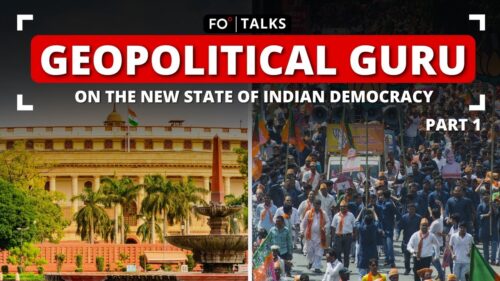
Fair Observer’s Video Producer Rohan Khattar Singh speaks with FOI Partner and geopolitical analyst Manu Sharma about the 2026 Indian state elections, which reshaped the country’s political map from the northeast to the deep south. They examine the Bharatiya Janata Party (BJP)’s breakthrough in West Bengal and Assam, the collapse of Communist influence in Kerala and the rise of actor Vijay’s Tamilaga Vettri Kazhagam (TVK) party in Tamil Nadu. Indian elections are increasingly driven by infrastructure delivery, aspirational politics and long-term demographic shifts rather than ideology alone.
Rohan and Manu also explore how these regional outcomes could influence neighboring Bangladesh and Sri Lanka as India’s political center of gravity continues to evolve.
A tectonic shift in eastern India
The conversation opens with West Bengal, a state long associated with communist politics and later dominated by Chief Minister Mamata Banerjee’s Trinamool Congress. Manu describes the BJP’s victory as a historic transformation, noting the ideological leap from decades of left-wing politics to a party rooted in Hindutva nationalism. He compares it to “a hardcore atheist communist state” in Europe suddenly aligning with a church-backed movement.
For Manu, the result reflects more than identity politics. He believes the BJP succeeded because voters increasingly judge governments through economic performance and infrastructure delivery rather than ideological loyalty. “The fate is not decided on the battlefield or the ballot box, but on the balance sheet,” he says, pointing to roads, electricity and public services as decisive factors.
Rohan notes the irony that West Bengal produced some of India’s most influential economists and intellectuals while struggling economically for decades. Manu responds that Bengal excelled at theory but failed at implementation. The BJP’s rise represents a broader shift in eastern India’s political and economic center of gravity toward a more development-focused model.
Rohan and Manu also discuss the election’s unusually peaceful polling process. For the first time since Indian independence, no voters were killed during voting in West Bengal, though violence erupted after the results. Manu attributes this to the region’s historically “high-pitched” political culture rather than flaws in the constitutional process itself.
Assam’s stability dividend
In the northeastern state of Assam, the BJP returned to power with an even larger mandate. Rohan highlights two major changes: sweeping infrastructure development and the decline of insurgent violence. Massive bridges over the Brahmaputra River have dramatically reduced travel times, while former militant groups have increasingly entered mainstream politics.
Manu describes Assam’s strategic significance as the meeting point between the Indian and Tibetan-Sinic spheres of influence. The state’s geography, heavy rainfall and vast river systems historically made development difficult, leaving communities isolated from one another. Infrastructure therefore became politically transformative.
He argues that Assam is now benefiting from a “virtuous cycle” in which political stability improves economic performance, which in turn reinforces stability. Former insurgent movements have largely been pacified, and the state increasingly functions as the political and logistical nucleus of India’s northeast.
Rohan notes that the BJP’s next challenge will be employment. Assam’s population is exceptionally young, with nearly two-thirds under the age of 28. The election victory therefore creates expectations that economic development must now translate into jobs and rising living standards.
South India’s political divergence
The speakers contrast the BJP’s northeastern success with its weak performance in southern India. Despite extensive campaigning by Prime Minister Narendra Modi, the party performed poorly in both Tamil Nadu and Kerala.
Manu explains this through the bandwagon effect, arguing that voters in low-trust societies tend to support parties already viewed as viable contenders. In states where the BJP has not yet achieved critical mass, many voters instead choose among established regional players.
Tamil Nadu produced the election’s biggest surprise. Actor Vijay’s TVK party shattered the longstanding duopoly of the Dravida Munnetra Kazhagam and All India Anna Dravida Munnetra Kazhagam parties, emerging as a dominant new force. Rohan says that Vijay successfully captured younger voters through social media, satire and celebrity appeal.
Manu places this within Tamil Nadu’s distinct political culture, where cinema and literature have long shaped leadership. He compares the state to France within the European Union: culturally self-confident, linguistically distinct and deeply attached to its own icons. Actors and writers have historically wielded enormous political influence there.
Simultaneously, Manu praises outgoing Chief Minister MK Stalin for delivering exceptional economic growth. Tamil Nadu achieved some of India’s strongest industrial and manufacturing performance, yet voters still demanded political change. He posits that India’s elections often reveal a disconnect between macroeconomic growth and voter satisfaction because rapid expansion does not always generate broad wage growth or social mobility.
The decline of Indian communism
In Keralam, the Congress-led alliance defeated the Communist Party of India (Marxist), dealing another blow to a movement that once dominated Indian left-wing politics. Rohan jokes that communists now survive mainly in universities, reflecting a broader perception of ideological decline.
Manu argues that Indian communists failed to modernize in the way their Chinese or Vietnamese counterparts did. Rather than adapting to aspirational politics and economic transformation, they remained attached to older Soviet-era frameworks. “They failed to address the core question of human aspirations,” he says.
The result is significant for the Congress Party as well. After weak performances elsewhere, Keralam prevented the party from being completely marginalized nationally. Yet the broader story is less about Congress revival and more about the fading relevance of traditional communist politics in India.
Regional consequences beyond India
Rohan and Manu conclude by examining how the elections affect neighboring countries. Bangladesh closely monitored the outcomes in West Bengal and Assam because both states share borders, cultural and linguistic ties with it.
Manu says that Kolkata’s decisive “rightward turn” could reshape regional dynamics. A stronger and more economically assertive West Bengal may begin pulling economic influence back from Dhaka, while future governments in Kolkata could adopt a tougher stance regarding the treatment of religious minorities in Bangladesh.
Sri Lanka also watched developments in Tamil Nadu carefully because of the island’s long and complicated history with Tamil separatist movements. While Manu does not see any immediate revival of militant politics, he says Colombo will closely observe the rise of Vijay’s new political movement and its potential regional implications.
[Lee Thompson-Kolar edited this piece.]
The views expressed in this article/video are the author’s own and do not necessarily reflect Fair Observer’s editorial policy.




































Comment