





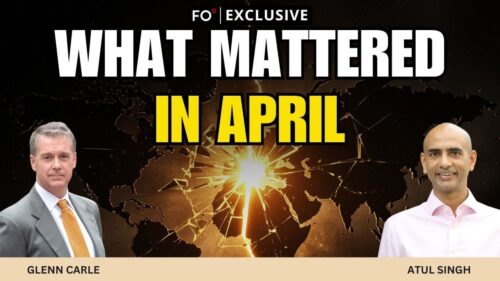
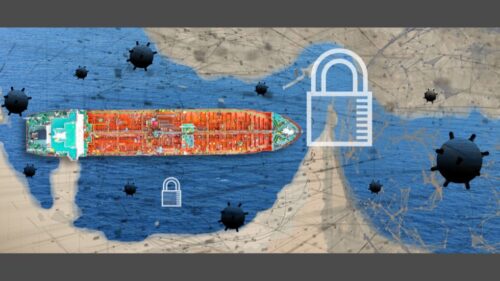
Editor-in-Chief Atul Singh and FOI Senior Partner Glenn Carle, a retired CIA officer who now advises companies, governments and organizations on geopolitical risk, examine a conflict that has spilled far beyond the battlefield. The US–Israel–Iran war, anchored in a “double blockade” of the Strait of Hormuz, has ruptured the global resource, financial and security architecture. Crucially, this disruption extends beyond Hormuz to a second chokepoint at Bab al-Mandab, where Houthi threats have compounded shipping risks and insurance costs, effectively turning a regional crisis into a multi-node global supply shock.
An unwinnable standoff
The US and Iran are now in a military and diplomatic impasse. Iran blocked the Strait of Hormuz while the US Navy countered by restricting access to Iranian ports. The result has become an economic war of attrition rather than a decisive military contest. Negotiations continued intermittently in Pakistan, which is painting itself as a new neutral Switzerland for peace negotiations. However, both Iran and the US treat the negotiations as positioning exercises rather than genuine attempts at resolution.
Glenn argues that the structure of the conflict makes escalation unlikely. Neither a US invasion nor a prolonged Iranian blockade is sustainable. Economic pressures constrain both sides: Tehran cannot endure extended isolation, while Washington cannot justify the political and financial costs of indefinite deployment. A negotiated outcome is therefore likely, even if neither side formally acknowledges this.
Glenn expects a settlement resembling a diluted version of the 2015 nuclear agreement, with Iran accepting inspections while retaining its right to nuclear technology, and the strait reopening under conditions that implicitly increase Iranian influence. Both sides, he suggests, will declare victory. The underlying reality, however, is less ambiguous: The balance of leverage in the Gulf has shifted.
The supply shock that breaks the system
For Atul, the deeper story lies in the economic consequences. He calls the crisis the most severe supply-side shock since the 1970s, which has disrupted energy flows, industrial inputs and shipping routes. Hormuz’s closure has constrained not only oil and gas exports but also critical materials such as helium, aluminum and fertilizers. This has created a ripple effect across many supply chains, from semiconductors to agriculture.
The crisis has caused a breakdown between financial pricing and physical reality. Industry sources report that actual delivery prices exceeded benchmark prices by 20% or more, revealing a failure in market price discovery. This disconnect, Atul suggests, reflects a deeper structural flaw: Financial “screen prices” are increasingly driven by algorithms and interest rate expectations, while real-world scarcity is determined by physical delivery constraints.
War-risk insurance for transit through the Persian Gulf (if available), the extra costs of diverting around the African continent, port congestion, sanctions, variable freight rates, and differing grades of crude mean that European or Asian buyers may pay substantially more per barrel than North American buyers.
Similar price differentials are now in place for refined products. For instance, at over $200 per barrel, the average price of jet fuel is ~$40 higher in Asia than in North America. Jet fuel in Asia was, on average, cheaper than in the US before the war. Already, almost every one of the world’s major airlines has canceled flights due to the shortage and rising costs of jet fuel. In turn, this has led to a decrease in tourism, particularly to places like Thailand and Japan, because of the increase in air ticket prices.
At the household level, shortages of liquefied petroleum gas have caused restaurants and bakeries to shut down across South Asia. Aluminum shortages have caused cola cans to disappear. Supply chains for consumer goods are in disarray. Helium shortages have begun to affect semiconductor production. Across South, Southeast and East Asia, rising input costs have driven inflation and not only suppressed but also destroyed demand. Stagflation, the combination of stagnation and inflation, has already hit Asia.
A ceasefire will not end the supply shock. It will continue and cause much pain. There are silver linings, though. The supply shock is accelerating structural change, pushing the global economy to be less reliant on oil and gas for its energy needs. Solar panels, batteries and electric vehicles already have a higher demand.
The reverse flow of capital
Importantly, the Hormuz Crisis has led to what Atul terms the “Reverse Gulf Stream.” For decades, countries of the Persian Gulf sold oil, gas, fertilizers and other commodities denominated in dollars. These Gulf states invested this money in the West. In a nutshell, capital flowed from the Persian Gulf to the West, boosting financial markets and other asset prices. Now, that flow of capital has stopped.
Gulf states run generous welfare states. They now face revenue shortfalls and rising domestic costs. Some have requested dollar swap lines from the US, a move Atul describes as a “canary in the coal mine,” signaling stress even among the most financially resilient states like the UAE. This is a signal of financial stress even among historically wealthy states. There is a chance that they might sell assets they hold in the West to tide them over hard times.
The Gulf’s sovereign wealth funds, managing an estimated $5–6 trillion in assets, may be forced into large-scale liquidations. These pressures operate through multiple channels: equity sell-offs in Western markets, reduced investment in AI and technology sectors, declining purchases of US Treasuries and feedback loops in which falling asset prices force further liquidation.
In addition, Gulf countries are no longer pricing and paying everything in dollars. Alternative payment systems such as China’s CIPS have gained traction. Iran has charged transit fees in yuan, euros and cryptocurrencies, while many countries have purchased energy using non-dollar currencies. The implications of these developments extend far beyond the Persian Gulf. Reduced demand for dollars has weakened the foundations of the petrodollar system itself.
Experienced investors in our circle argue that bond markets are starting to recognize increased financial risks. Market yields on ten-year US Treasury securities have increased from 3.97% on February 27 to 4.35% on April 28. These investors expect bond yields to rise further. The US is spending a lot of money on the Iran war at a time when American debt has crossed $39 trillion. The “exorbitant privilege” that allows the US to borrow money at lower interest rates will become less exorbitant because of the growing loss of trust in the competence of the American government and the strength of the US. Furthermore, neither the Gulf countries nor America’s East Asian allies can keep buying US debt when their earnings drop. Our investor sources are convinced that bond yields will rise because of the war. Some even expect a 15-20% correction in equity markets within a few weeks.
Financial markets, long buoyed by liquidity, have begun to confront the constraints of the real economy. Atul warns that a “reverse contagion” could emerge, in which shortages in the physical economy trigger corrections in the prices of financial assets. The adjustment, delayed but inevitable, would reshape global capital flows. A “Reverse Gulf Stream” could emerge where capital does not flow from the Persian Gulf to the West but reverses direction and goes back to the Gulf countries.
A fractured security order
The conflict has also accelerated the fragmentation of global alliances. Glenn describes the United States as a “strategic loser,” noting that Iran has emerged with greater regional influence despite sustaining military damage. The regime has consolidated into what he characterizes as a garrison state dominated by the Islamic Revolutionary Guard Corps (IRGC), strengthening its capacity to extract leverage from control of the strait.
Confidence in US security guarantees has eroded. European leaders have openly criticized Washington’s strategy, while countries such as Spain and Italy have distanced themselves from the conflict. Note that Italy is led by Giorgia Meloni, a leader of the right who had good relations with US President Donald Trump. NATO, already strained, is further strained by the rift between Europe and the US, calling its long-term viability into question. For this reason, Europe has increased defense spending and coordination, signaling a shift toward greater autonomy from the US and a preparation for a post-NATO future.
A similar pattern has unfolded in East Asia. Japan, South Korea and Taiwan have deepened cooperation. These countries question US reliability after American forces and military equipment in the region have been redeployed to the Middle East. They regard Barack Obama’s Asia Pivot and Trump’s China focus as aspirational efforts by a superpower that is still fundamentally mired in the Middle East.
The Gulf states themselves are increasingly looking to external partners such as Pakistan for both diplomatic mediation and potential security support. Not only do these states face a threat from Iran but they also fear popular unrest at home. Hence, they are diversifying away from exclusive reliance on the US.
Across regions, allies have begun to hedge, investing in their own capabilities rather than relying on American protection. This realignment reflects a broader transformation. The US role as guarantor of global trade routes — central to its post-World War II dominance — has appeared less certain. As Atul notes, the inability to secure key chokepoints challenges the very foundation of American hegemony. At its heyday, the UK was able to keep the Strait of Gibraltar, the Suez Canal, the Bab al-Mandeb, the Strait of Hormuz and the Strait of Malacca open. That is the standard for a global superpower and that is the standard the US is failing to meet.
The Hormuz Crisis of 2026 is for the US what the Suez Crisis of 1956 was for the UK. Just as Suez demonstrated the limits of British power, Hormuz is revealing the limits of American might.
Technology, energy and the new balance of power
Amid these disruptions, structural shifts have accelerated. The transition to renewable energy has gained momentum as countries seek to reduce dependence on vulnerable supply chains. Glenn estimates that the timeline for renewables to dominate global electricity production could advance by five to six years.
China has stood out as a primary beneficiary. Its leadership in electric vehicles, solar technology and battery production puts Chinese companies in pole position to capitalize on this transition. Even in the US, electric vehicle sales have already gone up because of higher gas prices.
The war has also showcased the ongoing revolution in military technology. Cheap drones, costing tens of thousands of dollars, have threatened assets worth billions. This asymmetry has undermined traditional power projection, reducing the effectiveness of aircraft carriers and other capital-intensive systems. As Glenn illustrates, even highly effective defense systems can be overwhelmed by asymmetric warfare. Destroying 98 out of 100 incoming drones still leaves two capable of inflicting catastrophic damage at a fraction of the cost of the systems they target. The result has been a leveling effect. Regional actors have gained relative strength while superpowers have faced higher costs and greater vulnerability.
In a nutshell, the old order is now dead. The resource, financial and security architectures that shaped the post-World War II world are crumbling. What is emerging is not yet a coherent new system, but a world in transition — more fragmented, more competitive and less predictable than the one it is replacing.
[Lee Thompson-Kolar edited this piece.]
The views expressed in this article/video are the author’s own and do not necessarily reflect Fair Observer’s editorial policy.































Comment