



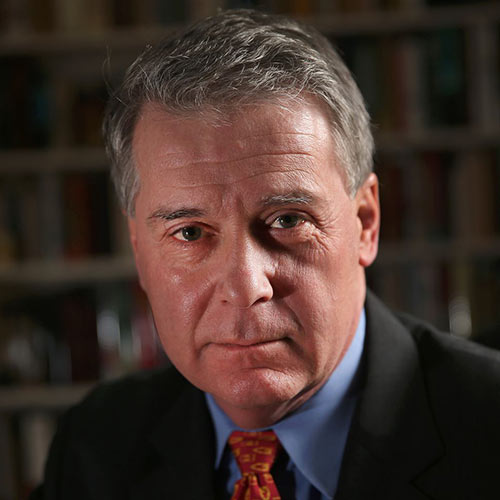
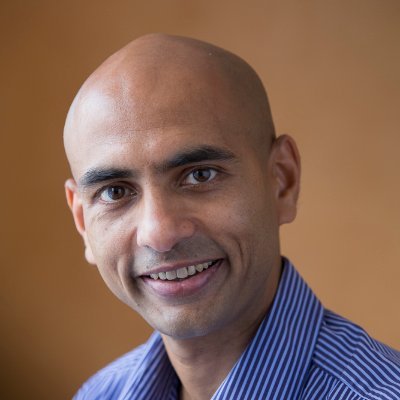
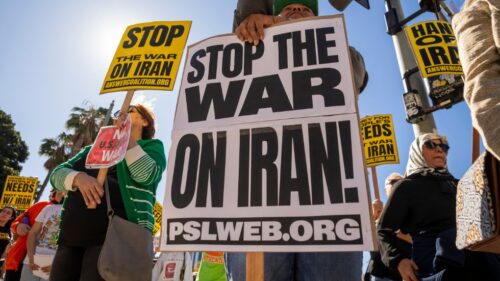
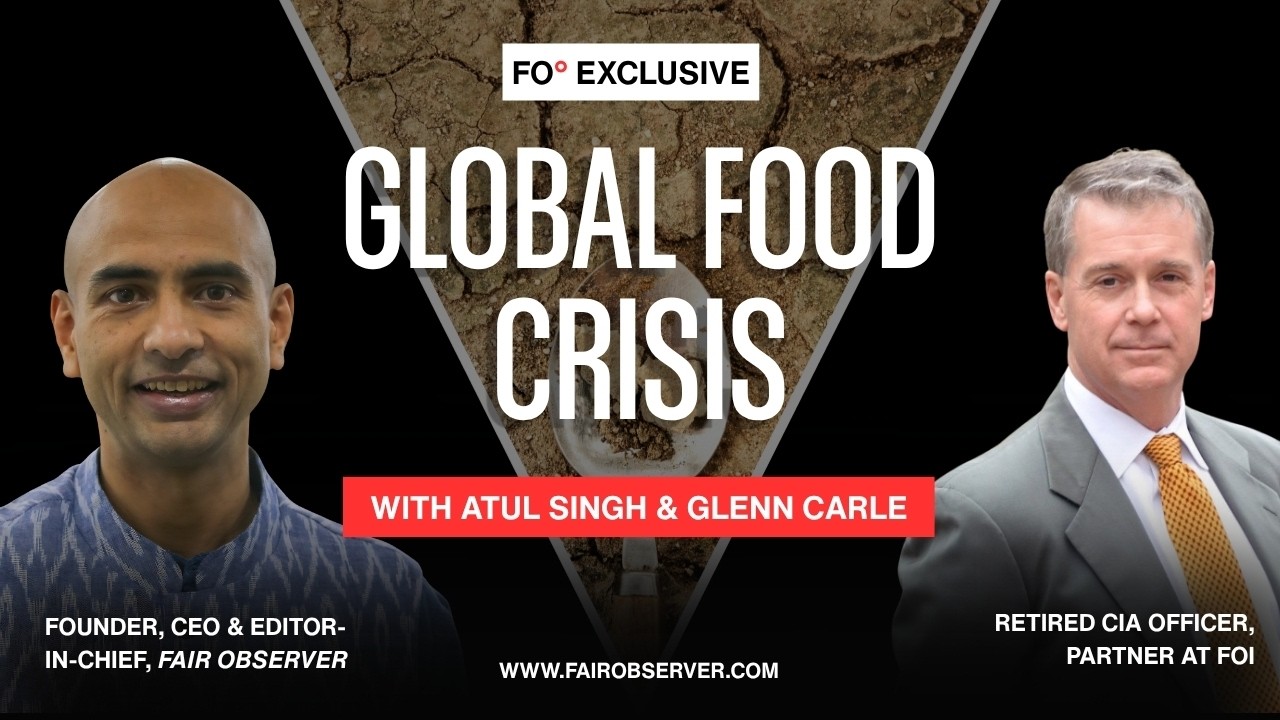
Editor-in-Chief Atul Singh and FOI Senior Partner Glenn Carle, a retired CIA officer who now advises companies, governments and organizations on geopolitical risk, survey a month in which disparate events point in a single direction: a global order under strain. The US–Israel–Iran war anchors their analysis, but the surrounding developments — from space exploration to European politics — reveal deeper structural shifts. As Atul puts it, the aim is to “sift signal from noise” in a moment when American primacy appears less certain and states are recalibrating accordingly.
A brief moment of optimism
Atul and Glenn begin with the Artemis II mission. Astronauts orbited around the moon and returned, marking humanity’s first departure from Earth’s orbit in 54 years. For Glenn, the mission signals more than symbolic progress. It expands “the range of human capabilities” and promises technological spillovers that will boost economies for decades.
Yet even here, not all is rosy. Glenn notes that the current NASA architecture may prove financially unsustainable, with private-sector systems such as SpaceX’s Starship likely to dominate future exploration. Even in space, state-led models are giving way to hybrid or commercial ones, mirroring broader economic trends.
Israel, Europe and the politics of rupture
Atul and Glenn soon turn sombre and shine the light on Israel. The country was in the news for passing a law that, in effect, makes it mandatory for Palestinians to receive a death sentence if they are convicted by a military court of deadly terrorist acts. Those convicted have no right to appeal. Israeli civil and human rights groups say the law is racist. The language of the law implies that it could be applied to Israeli Arabs, for example, but not to Jewish citizens. This means they could be becoming second-class citizens in their own country.
The Israeli parliament has also passed a record $271 billion budget. This huge defense spending suggests the country is evolving into even more of a “Spartan state.” Israel is now the dominant military power in the region.
Israel is also increasingly losing international support. Italian Prime Minister Giorgia Meloni suspended defense cooperation despite her prior alignment with both Israel and US President Donald Trump. Meloni’s changed position reflects mounting domestic opposition in Italy to the war. Therefore, her government has denied US aircraft access to bases in Sicily. In Spain, Prime Minister Pedro Sánchez has been very vocal in opposing the war and attracted American ire.
Sánchez has also made a sweeping change to Spain’s immigration policy. His government has offered residency to 500,000 undocumented migrants, provided they have lived in Spain for at least five months and have no criminal record. This is an unconventional immigration policy at a time when other European countries are tightening, not opening, borders to immigrants.
The tensions over immigration in the US, Europe and elsewhere point to a deeper dilemma across advanced economies: demographic decline versus social cohesion. Immigration sustains growth but can lead to a clash of cultures. It can also cause political backlash, fueling the rise of far-right movements. Tensions in Europe over immigration are triggered by structural changes and are here to stay.
Britain and the crisis of governance
British Prime Minister Sir Keir Starmer is in increasingly hot soup. His decision to appoint Lord Peter Mandelson as ambassador to America has come back to haunt him. Mandelson was one of the architects of New Labour who brought Tony Blair and Gordon Brown to power. In the UK, Mandelson is known as “the Dark Lord” and “the Prince of Darkness,” because he has too many dodgy friends. These include folks in China and Russia and a certain Jeffrey Epstein.
After facing mounting criticism for appointing Mandelson, the Starmer government sacked Sir Oliver Robbins. Starmer blamed the Foreign Office for not telling him that Mandelson had failed security clearances. Robbins told a parliamentary committee there was a “very, very strong expectation” from the prime minister’s office to rush the process. Talk of Labour members of parliament defenestrating Starmer is now rife in London.
This political instability in the UK is worsening economic fragility. The broader picture is one of eroding confidence not only in the government but also in the country. Inflation, increasing debt and bond yields are pushing the country into a crisis.
Defense has also been in the news in the UK. Lord George Robertson said that Britain is in “peril” because of the Starmer government's “corrosive complacency.” The former NATO secretary-general blamed the UK Treasury for its failure to fund the review’s recommendations.
Antisemitism is on the rise
In April, Britain’s chief rabbi, Ephraim Mirvis, warned that “a sustained campaign of violence” against Jews was gathering momentum. Nine people were arrested for planning an attack on an unknown Jewish target in one of the recent incidents.
Not only the UK but also the US is experiencing rising antisemitism. In fact, antisemitism is experiencing a dramatic, record-high surge globally. After the October 7, 2023, terror attacks on Israel and the subsequent Israeli conflict with Hamas in Gaza, antisemitic sentiment has increased. Data shows a nearly 350% increase in US incidents over the past five years, with over 9,300 incidents reported in 2024 alone. American Jewish Committee’s report, The State of Antisemitism in America 2025, chronicles rising physical attacks and online vitriol against Jews. One highlight from the report says, “In The Two Years Since October 7, An Overwhelming Number Of American Jews Feel Less Safe.”
In Europe, antisemitism is coming from two sources: the traditional far-right, as well as many recent Muslim immigrants. The nativist nationalist right has fanned prejudice against Jews, who have historically been the other. Many immigrants identify with the Palestinian cause. They believe that Jews oppress their fellow Muslims in an apartheid state and, often fanned by radical mosques, come to believe that attacks on Jews are justified.
Many Muslims come from societies where non-Muslims have few rights. So, they carry their prejudices to their new homes. French and British intelligence have been worried about many radical mosques preaching a toxic brew. For decades, Saudi money propagated an extreme form of Islam that was highly antisemitic. For years, the CIA focused on the Saudi promotion of puritanical and fanatical Wahhabi Islam, promoting both antisemitism and jihadism. The flames that have been fanned for years continue to burn.
Key developments in India, Canada, Japan and Hungary
In India, the Narendra Modi government suffered a politically embarrassing defeat. For the first time, a government bill was voted out by parliament. This has occurred only twice this century, the last time was in 2002. The government tabled amendments that would have increased the number of seats in the lower house of parliament from 543 to 850. This would have weakened India’s southern states, which duly voted against the bill. In addition to religion, language and region form the other two faultlines. Both faultlines have now returned to the forefront in Indian politics.
Canadian Prime Minister Mark Carney’s Liberal Party secured a small majority in the House of Commons after winning special elections, also called by-elections, to three constituencies. Under Carney and his predecessor, Justin Trudeau, the Liberals ran a minority government with coalition partners. Now, they have a majority in parliament and have strengthened Carney’s position.
In an important move, the Carney government has created a Canada Strong Fund, a sovereign wealth fund, to invest in energy, infrastructure, mining, agriculture and technology. This is a first for the country. The fund will have an initial corpus of $25 billion Canadian dollars, i.e. $18.4 billion. This is part of a broader strategy by Carney to boost Canada's economy in the face of US tariff threats.
In combination with the private sector, the government will invest in “nation-building projects” such as port upgrades and natural resource development. The opposition has criticised the move. They make the argument that, unlike Norway, Canada is in debt, meaning its sovereign wealth fund will not be paid for by revenues but by borrowed money. Conservative leader Pierre Poilievre has called it a “sovereign debt fund.” In an innovative move, the Carney government will allow Canadians to directly pay into the new fund. This practice doesn't exist in other countries with similar funds and might be a clever way to reduce reliance on Wall Street and Washington. Carney is taking a step to protect Canada from America’s capriciousness.
Japanese Prime Minister Takaichi Sanae announced a relaxation of restrictions on weapons exports to open up the defence industry’s trade with foreign countries. Sanae said, “No single country can now protect its own peace and security alone.” Last year, Sanae sparked a row with China last year by suggesting Japan would respond if Taiwan was invaded. Beijing said it would resist Japan’s “new form of militarism.” Glenn takes the view that this marks Japan’s emergence as a fully independent strategic actor, no longer relying entirely on the American security umbrella. Both Japan and Canada are similar in taking steps to rely less on the US and more on themselves.
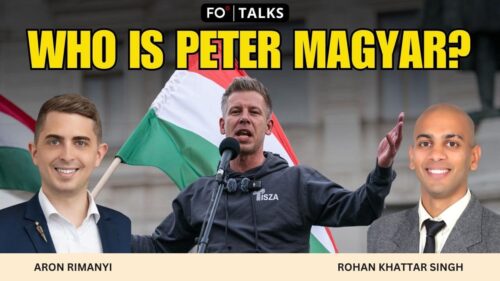
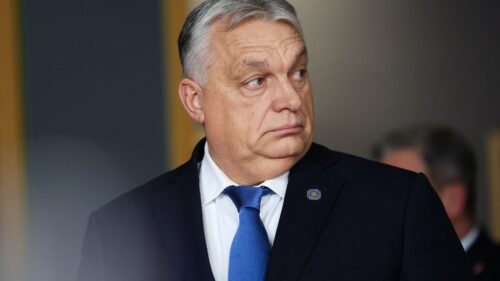
In Hungary, the centrist Tisza party won around two-thirds of the seats in Hungary’s election, booting Viktor Orbán and his populist-right Fidesz party out of office after 16 years in power. Péter Magyar will be the new prime minister. He once belonged to Orban’s party and began to campaign against corruption and for the rule of law. Magyar won on competence and governance issues, overcoming apathy and energizing voters.
Magyar’s victory was shaped by late-campaign events that weakened Orbán. A leaked telephone call between Hungarian Foreign Minister Péter Szijjártó and Russian Minister of Foreign Affairs Sergey Lavrov reinforced perceptions of the government’s subservience to Moscow. Also, US Vice President JD Vance’s visit to support Orbán did not cut much ice with Hungarian voters.
For Glenn, Orbán was a pawn of Moscow who ran an “authoritarian and corrupt regime” aligned with Moscow. Atul offers a more qualified view, noting that Magyar was able to run a grassroots campaign, win handsomely and also that Orbán conceded defeat quickly.
On an important note, Magyar has made improving relations with the EU a priority. Now, Brussels is likely to release not only previously frozen funds for Hungary but also an aid package for Hungary that had so far been blocked by Orbán. Now, we have a completely new political landscape in Hungary and in Europe.
[Lee Thompson-Kolar edited this piece.]
The views expressed in this article/video are the author’s own and do not necessarily reflect Fair Observer’s editorial policy.




























Comment