





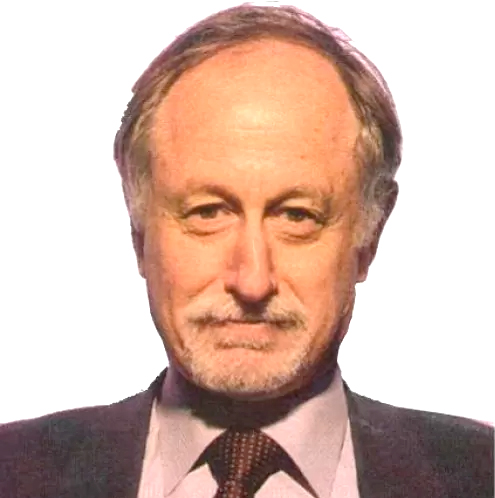
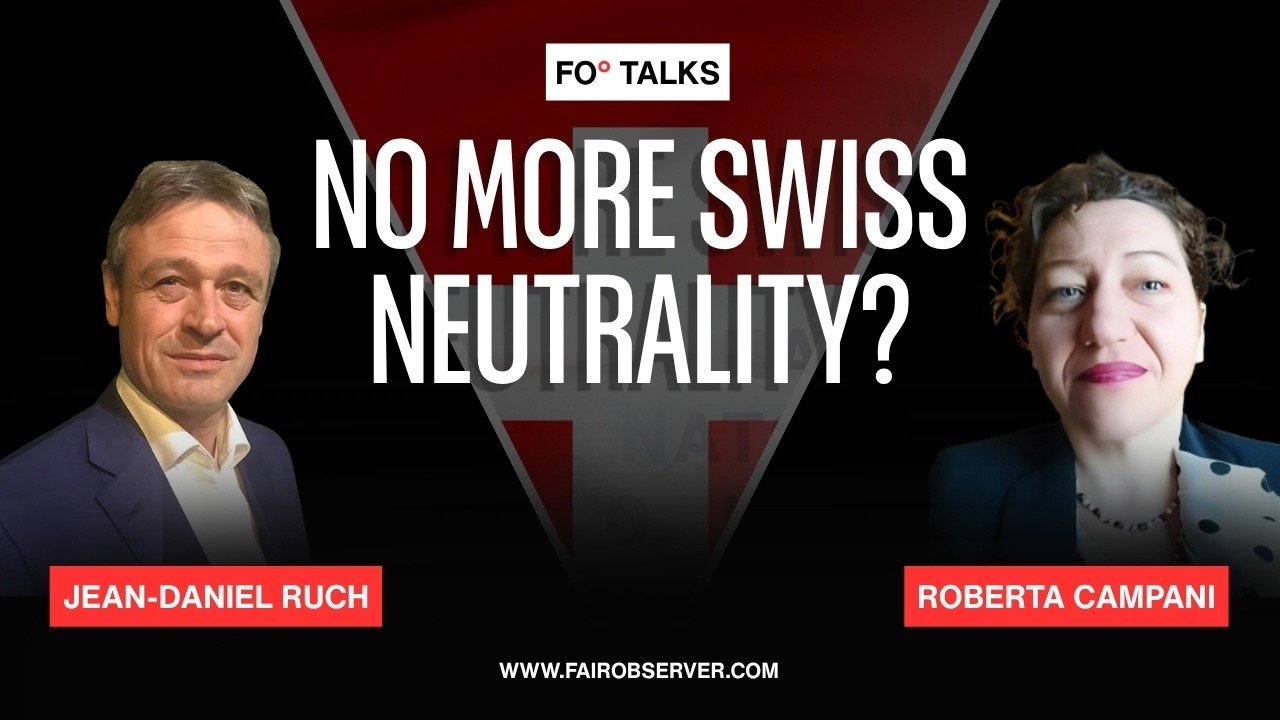
Fair Observer’s Chief Strategy Officer Peter Isackson speaks with former Swiss diplomat Jean-Daniel Ruch and former NATO policy officer Peter Hoskins about Europe’s place in a world growing more dangerous by the month. They ask a sharp question: Is Europe preparing for a harsher strategic environment, or is it spending more on defense without deciding what that defense is for? Europe faces not only external threats from war and instability but also an internal problem of political confusion, institutional fragmentation and diplomatic drift.
Two wars, two public reactions
Ruch begins by drawing a distinction between how Europeans see the war in Ukraine and the conflict involving Israel, Iran and the United States. Many Europeans still regard Russia’s invasion of Ukraine as a direct threat to the continent, even if support varies by geography and weakens farther from Russia’s borders. That perception helps explain why many governments have justified higher military spending despite the economic burden of inflation and energy costs.
The Middle East conflict produces a different response. Ruch argues that much of the European public does not see that war through the same moral or strategic lens. Polling shows broad opposition and suggests that many citizens regard it less as a necessary response to aggression than as a discretionary intervention. Europe is not responding to a single, coherent public mood; its leaders are navigating two overlapping crises with two different levels of public legitimacy.
More military spending with no clear strategy
Hoskins approaches the issue from the military side. He argues that European states, especially leading powers such as Britain and France, spent too many years preparing for counterinsurgency and overseas operations while neglecting the capabilities needed for a major conventional war in Europe. The result is a continent that talks more seriously about defense than it did a decade ago but is still not fully prepared for the kind of conflict it now fears.
Ruch takes the point further. For him, the real weakness is not just underprepared armed forces but the absence of a guiding political framework. Europe may be spending more, but it still lacks a clear security strategy linking military means to foreign-policy ends. He says Europe continues to run on “old software,” meaning the post-1945 habit of assuming that the US will provide both strategic direction and military backing. That dependency, he suggests, has outlived the world that produced it.
Hoskins broadly agrees. He sees Europe as too reliant on American protection and believes it must start preparing for a future in which Washington is less willing, or less able, to carry the burden.
The loss of diplomacy
Isackson returns to a deeper problem: the decline of diplomacy itself. Ruch and Hoskins agree that military planning cannot substitute for political engagement. Ruch argues that despite its dangers, the Cold War was in some ways safer because it had guardrails. Arms-control treaties, confidence-building measures and structured dialogue created habits of communication that reduced the risk of catastrophic miscalculation. With the expiration of the last major bilateral agreements and the weakening of diplomatic channels, that safety net has largely disappeared.
Ruch also argues that policymaking has shifted away from diplomatic institutions toward intelligence and military bureaucracies. That change matters because diplomats are trained to search for workable settlements, while security institutions are trained to identify and counter threats. The result, he says, is a world more inclined to manage crises through force than through negotiation.
Hoskins is more cautious but sympathetic to the point. He recalls periods when military officers from rival states could still work together and build trust. In his view, those opportunities mattered because professional contact often reduced suspicion. He laments that many of those openings were allowed to fade.
Russia, NATO and Europe’s political confusion
The conversation then turns to Russia and the larger structure of European security. Hoskins maintains that, whatever opportunities may have been missed in the past, Russia remains Europe’s primary strategic threat. Ruch is less convinced by the more alarmist versions of that argument. He points to a long history of what he sees as exaggerated or sometimes irrational fear of Russia and argues that Europe never developed a serious long-term vision for how to live with Russia as a permanent neighbor.
That debate leads into NATO and the European Union. Hoskins argues that NATO remains the most credible framework for defense, even if Europe must start thinking about how it would function with a diminished American role. Ruch responds that Europe still needs its own strategic culture and institutions if it wants genuine autonomy. Both men agree that Europe cannot drift indefinitely between dependence on Washington and vague talk of independence.
US President Donald Trump’s return to power sharpens that dilemma. Ruch thinks the “divorce” between Europe and the US may now be too obvious to ignore, while Hoskins argues that Europe should assume life “without the United States” is becoming a real strategic possibility.
A dangerous year without a settled order
By the end of the discussion, neither Ruch nor Hoskins offers much comfort. Ruch calls 2026 “the most dangerous year” he has ever lived through, citing the erosion of diplomatic norms, the risk of wider war and even the possibility that nuclear escalation can no longer be dismissed as fantasy. Hoskins echoes the warning. He sees a clear gap between publics and leaders, but he also insists that leadership still matters. Europe’s problem is that its leaders are weak, divided and often unable to sustain a common line.
Europe knows the world is changing. But can it define its own interests before major world events do?
[Lee Thompson-Kolar edited this piece.]
The views expressed in this article/video are the author’s own and do not necessarily reflect Fair Observer’s editorial policy.






















Comment