





[Though this video is not recent, the authors’ discussion remains relevant today.]
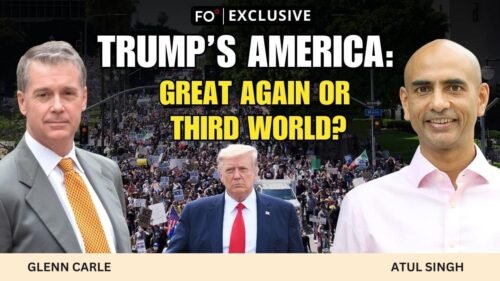
Fair Observer Founder, CEO & Editor-in-Chief Atul Singh and retired CIA Officer Glenn Carle dissect the question: “Donald Trump 2.0: Are lunatics now running the asylum?” Speaking from his experience in intelligence and analysis, Glenn delivers a sobering assessment of US President Donald Trump’s movement, the myth of the “deep state,” and the dangers of Project 2025.
The Trump phenomenon and the sincerity of supporters
Glenn begins by questioning the phrase “lunatics running the asylum.” Calling Trump’s allies lunatics, he says, is too generous, since lunatics are not necessarily duplicitous. The real danger, Glenn insists, is the sincerity of Trump’s supporters.
Polls show that around 40% of Americans are indifferent to democracy and the rule of law. Many openly prefer a strongman who can “get things done” regardless of constitutional limits. For these Americans, politics feels distant, even irrelevant, compared to everyday issues like potholes, taxes or classroom sizes.
Glenn argues that ordinary people, even those who consider themselves honorable, fall in line with authority. He recalls colleagues at the CIA rationalizing torture because “our boss said it’s okay.”
Atul extends the point to history: Countless “good people” served Joseph Stalin, Indira Gandhi or Adolf Hitler not out of villainy, but because they went along with inherited systems. Human nature explains the willingness to comply.
Human nature and historical blind spots
Glenn pushes back against the American belief in exceptionalism. After World War II, many assumed Germans must have been “intrinsically different” to have committed atrocities, while Americans told themselves, “We would never do that.” Glenn rejects this as a blind assumption. Faced with the choice to kill or be killed, he argues, ordinary citizens anywhere can become executioners.
This perspective shapes how he evaluates Trump and his allies. US Director of National Intelligence Tulsi Gabbard, FBI Director Kash Patel, US Secretary of Defense Pete Hegseth and Trump himself, he says, combine true belief, ambition, opportunism and lack of principle. He highlights something especially troubling: Trump’s statements often repeat Kremlin talking points verbatim.
Glenn poses a rhetorical question: “Have you ever met someone who agrees with you on every single political issue?” Since the answer is no, perfect alignment with Russia’s messaging should alarm Americans.
The CIA, independence and the deep state
Glenn then turns to the intelligence community. The CIA’s mission, he stresses, is to deliver independent, objective analysis — often inconvenient for presidents. The agency warned against escalation in Vietnam, questioned false claims about weapons of mass destruction and provided fact-based views that cut against political narratives.
Glenn recalls one moment vividly: A secretary of defense staffer once glared at him and told him, “You [the CIA] are the enemy.” That hostility, he says, now fuels Trump’s push to “clean house,” eliminating intelligence officials not loyal to him. While all presidents try to steer the CIA, Glenn views Trump’s vendetta as part of a much darker campaign.
Project 2025: a blueprint for authoritarianism
Glenn warns most urgently about Project 2025, a conservative blueprint for the second Trump administration. He calls it “frankly lunatic” and “profoundly dangerous.” Its pages describe civil servants as “cultural Marxists,” depict bureaucracies as proof of totalitarianism and demand loyalty over expertise.
The CIA, Glenn argues, reflects America’s political diversity. Analysts skew toward evidence-based centrism, not ideology. Yet when fact-driven analysis contradicts right-wing preferences — such as skepticism toward Israeli hardline policies — Republicans brand it “biased” or “Marxist.”
For Glenn, the very idea of a deep state is a fascist myth. He traces it back not only to Turkey but to Italian dictator Benito Mussolini and German Führer Adolf Hitler. In this view, the government was cast as oppressive, bureaucrats as conspirators, and only a single strong leader could defend the people. This narrative, Glenn says, resurfaces in modern America through the far-right QAnon movement and the Trump administration.
Bureaucracy, regulation and social frustration
Glenn concedes there is a grain of truth: Bureaucracies can be slow, cautious and resistant to change. Yet this is far from sabotage. Instead, he sees tension in the complexity of modern societies. Democracies need regulation to balance competing interests, but rules often feel burdensome. Citizens lash out at the bureaucrat enforcing them, blaming individuals for systemic problems.
The real challenge is balance. Too much regulation stifles freedom, but unregulated capitalism produces monopoly, exploitation and oligarchy. Glenn believes the United States achieved its best balance between 1933 and 1980, with a regulated market economy under democratic oversight. Since 1980, he says, deregulation has gone too far.
Demographic change and the politics of belonging
Glenn also links Trump’s rise to demographic shifts. In 1956, the US was 89% white. By 2030, the figure will drop below half. Diversity brings enormous benefits, he notes, but it also stresses social cohesion. Sociologists show that when minorities exceed 10% of a population, unrest tends to rise. Integration typically takes three generations. Today’s backlash, Glenn suggests, comes from Americans overwhelmed by change and searching for scapegoats.
DOGE and the erosion of accountability
The proposed Department of Governmental Efficiency (DOGE) becomes Glenn’s case study in authoritarian governance. Marketed as an anti-waste reform, it actually dismantles oversight offices and suspends anti-corruption measures like the Foreign Corrupt Practices Act. Having spent his career in government, Glenn insists fraud is rare. DOGE, he warns, creates more corruption, not less.
He argues that while reducing government size is not inherently harmful, DOGE’s cuts are “extra-legal,” meaning illegal. The true purpose is not efficiency but to impose orthodoxy, silence dissent and centralize power. Such moves, Glenn concludes, lead to cronyism, corruption and “the loss of democracy and individual rights.”
Rejecting the strongman narrative
Atul asks if Trump could be a Julius Caesar-like figure rescuing America from dysfunction. Glenn strongly disagrees. Caesar destroyed the Roman Republic, while French General Napoleon Bonaparte left tens of millions dead. America’s crisis, he says, is different. The nation has always harbored authoritarian, isolationist and racist currents, but never before have they dominated the entire system.
Still, Glenn emphasizes the progress of the American experiment. Over centuries, the definition of who counts as fully human has expanded — a triumph of US history. Today’s effort to roll back these rights, he argues, contradicts American ideals and undermines the possibility of a pluralistic society.
Facts, lies and the corrosion of truth
Glenn closes with a blunt message: “There are objective facts.” Policy debates are legitimate, but persisting in falsehoods is not disagreement — it is lying. He accuses Trump allies, including Patel and Gabbard, of spreading claims proven false. He concludes that Project 2025 rests on lies, and repeating untruths is willful corruption — corrosive, dangerous and profoundly authoritarian.
[Lee Thompson-Kolar edited this piece.]
The views expressed in this article/video are the author’s own and do not necessarily reflect Fair Observer’s editorial policy.





































Comment