





[Editor’s note: This video was recorded prior to Péter Magyar’s victory in the April 12 Hungarian parliamentary election.]
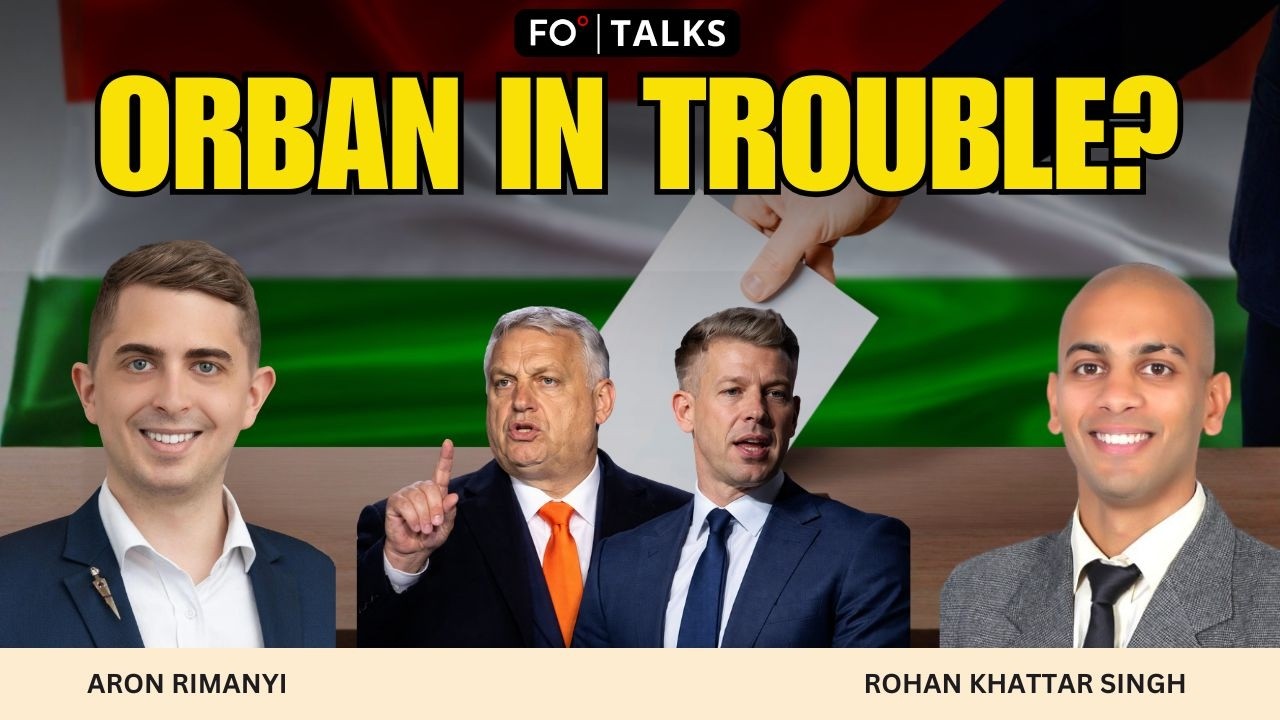
Fair Observer’s Video Producer Rohan Khattar Singh speaks with Aron Rimanyi, an associate at Training The Street, about the political, economic and geopolitical dynamics that shaped the contest between incumbent Hungarian Prime Minister Viktor Orbán and challenger Péter Magyar. Uncertainty dominated the leadup to Hungary’s parliamentary election, with polls and betting markets suggesting the strongest opposition challenge in 16 years.
A system under pressure
Khattar Singh opens by providing historic context for this election. Since 2010, Orbán and his right-wing Fidesz party have maintained consistent two-thirds parliamentary control. Rimanyi emphasizes the significance of this moment, noting that “this will be the first time in 16 years… that an opposition will actually take the lead and gain a parliamentary majority.” That possibility alone marks a break from Hungary’s recent past.
The structure of Hungary’s parliament adds another layer of importance. With 199 seats determining executive power, even small shifts in vote distribution can have outsized consequences. Thus, this election is not just a routine democratic exercise, but a test of whether a long-dominant political system can be meaningfully challenged.
Magyar’s rise
At the center of this challenge is Magyar and his center-right Tisza party, or the Tisztelet és Szabadság Párt. A former Fidesz insider, Magyar entered the political arena only recently, breaking with the ruling party in early 2024 amid a broader scandal. His rapid ascent reflects both organizational momentum and public appetite for change.
Rimanyi describes Tisza as a significant disruption to Hungary’s political landscape, pointing to its strong performance in the 2024 European parliamentary elections, where it secured roughly 30% of the vote. He characterizes the movement as “a new opposition party… that was actually a kind of major upstart,” highlighting its unexpected strength.
Ideologically, Tisza positions itself as conservative and patriotic. This allows it to compete directly with Fidesz on national identity while shifting the focus toward governance and accountability. Its messaging blends familiar themes with a critique of the status quo, appealing to voters dissatisfied with both economic outcomes and political continuity.
Economic discontent and political messaging
Economic conditions play a central role in the election. Hungary has faced high inflation in recent years, particularly in 2022 and 2023, alongside stagnating wages and slowing growth. The freezing or withdrawal of approximately €18 billion in EU funds has further constrained the economy, exposing structural weaknesses.
Rimanyi explains how these pressures have reshaped political perceptions. While earlier years of Orbán’s rule coincided with rising living standards and steady growth, the post-2019 period has been marked by disruption — from the Covid-19 pandemic to declining external support. Growth has slowed to below 1%, and affordability, particularly in housing, has deteriorated.
Tisza translates these macroeconomic trends into political messaging. Rather than relying on technical economic arguments, the party emphasizes perceived corruption and inequality. Rimanyi notes that their approach draws a clear contrast: “While your wages are stagnating… look at all these people who are quite close to Prime Minister Viktor Orbán who have gotten extremely rich.”
Foreign policy and campaign narratives
Hungary’s position on Russia and Ukraine adds another dimension to the campaign. Orbán is often portrayed as pro-Russian, but Rimanyi points out that, in practice, Hungary has largely aligned with EU policy since the 2022 invasion. “If you actually look at the voting record… Mr. Orbán and his government is much more towing the European line than actually the rhetoric would suggest,” he explains.
Despite this, campaign rhetoric tells a different story. Fidesz has framed Ukraine as a direct security threat, emphasizing risks to Hungary’s energy supplies and sovereignty. This narrative resonates with a significant portion of the electorate and places Tisza in a delicate position.
Magyar’s response reflects a balancing act. He avoids endorsing strong pro-Ukraine positions while also distancing himself from overtly pro-Russian narratives. Rimanyi suggests that even in the event of a Tisza victory, policy continuity is likely, though tone may change. A shift in rhetoric — particularly greater criticism of Russia — could emerge without fundamentally altering Hungary’s strategic posture.
The electoral system and uncertain outcomes
The complexity of Hungary’s electoral system makes the outcome difficult to predict. Voters cast two ballots — one for a local representative and one for a party list — and the system redistributes surplus and losing votes into national totals. This “winner” and “loser” compensation mechanism complicates straightforward projections.
“This makes it extremely difficult to actually forecast the seat allocations in the Hungarian Parliament,” Rimanyi points out. Even if polling suggests a lead for one party, translating that into parliamentary seats involves multiple layers of calculation.
For Tisza, the stakes are particularly high. The party aims not just for victory but for a two-thirds constitutional majority, which would allow it to reshape institutions built during Orbán’s tenure. However, Rimanyi views such an outcome as unlikely given the electoral mechanics.
As Khattar Singh and Rimanyi conclude, the election’s significance lies as much in its uncertainty as in its potential consequences. At the time of the discussion, Hungary stands at a political inflection point — one where economic strain, shifting alliances and institutional complexity converge to shape a deeply consequential vote.
Ultimately, Magyar would go on to win Hungary’s parliamentary election, and his Tisza party would secure 141 seats in the 199-seat parliament with 55.3% of the vote, while Orbán’s Fidesz party would take just 52 seats with 36.7%.
[Lee Thompson-Kolar edited this piece.]
The views expressed in this article/video are the author’s own and do not necessarily reflect Fair Observer’s editorial policy.







































Comment