





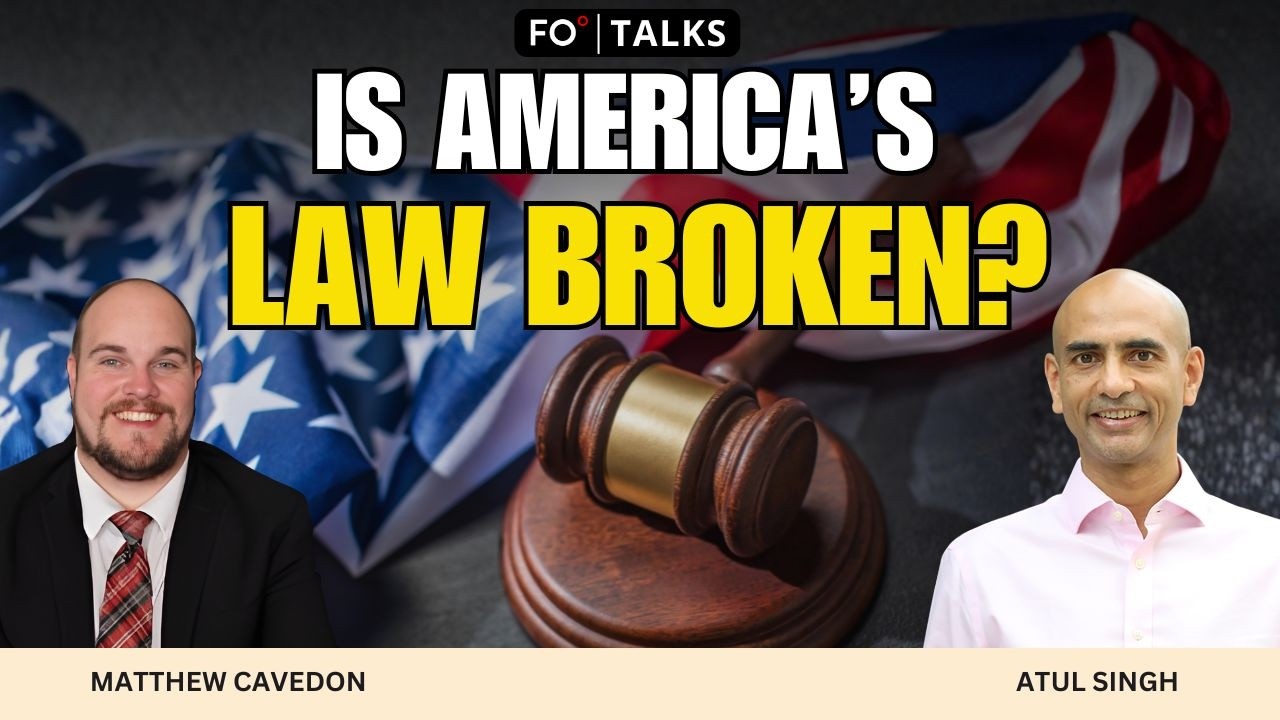
Editor-in-Chief Atul Singh and speaks with legal scholar Matthew Cavedon of the Cato Institute about the evolution and erosion of the American jury system. What began as a cornerstone of democratic participation has, they argue, become a marginal feature of a highly bureaucratized legal process. They trace how juries once embodied community judgment and ask whether that role can still be reclaimed in a system dominated by prosecutors, plea deals and legal complexity.
From citizen judgment to constitutional right
Cavedon traces the jury’s origins to ancient Athens, where ordinary citizens collectively judged disputes as part of direct democracy. That tradition carried into medieval England, culminating in Magna Carta’s guarantee that no free person could lose liberty or property except “by a jury of their peers.” Over time, this principle hardened into a defining feature of common law.
By the 18th century, legal scholar William Blackstone had formalized the idea that a criminal conviction required the agreement of 12 peers. This tradition crossed the Atlantic, where American colonists embraced jury trials not only as a legal safeguard but as a political right. The Constitution enshrined this protection twice, in Article III and the Sixth Amendment, reflecting its centrality to the new republic.
Cavedon emphasizes that juries were never meant to be passive fact-checkers. Historically, they evaluated both facts and the justice of the law itself, exercising what some have termed “jury nullification.”
Revolution, resistance and jury autonomy
The American Revolution reinforced the importance of juries. Singh and Cavedon note that British attempts to bypass colonial juries — by shifting trials to admiralty courts or even to London — provoked widespread alarm. Cavedon describes this as an “absolute panic,” as colonists feared the loss of local accountability and community judgment.
Two landmark cases illustrate the power juries once wielded. In 1670, a jury acquitted Quaker leader William Penn despite judicial pressure; their case established that jurors could not be punished for their verdicts. In 1735, a New York jury acquitted publisher John Peter Zenger of seditious libel, even though the law offered no defense for truthful criticism of the government. In both cases, juries asserted their authority to interpret justice beyond strict legal instructions.
Singh contrasts this tradition with civil law systems, where judges and legal professionals dominate decision-making. In the Anglo-American system, by contrast, juries historically acted as a democratic check on state power.
The rise of the modern “assembly line”
Cavedon states that over the past century, the criminal justice system has transformed into what he calls a “utilitarian… assembly line to produce convictions.” He traces this shift to Prohibition in the 1920s and 1930s, which expanded federal enforcement mechanisms that persisted long after alcohol bans ended.
Today, the overwhelming majority of cases never reach a jury. Roughly 97% of federal convictions and 94–95% of state convictions result from plea deals. Prosecutors wield significant leverage through what is often called the “trial penalty” — the threat of much harsher sentences if defendants refuse a plea and lose at trial.
Cavedon also points to structural incentives that reinforce this system. Many judges are former prosecutors, and law enforcement funding can be tied to arrest and conviction rates. Grand juries, once intended as a safeguard, have largely become procedural formalities. As Cavedon notes, they are often seen as “rubber stamps” for prosecutorial decisions.
The cumulative effect, he says, is a system that sidelines ordinary citizens and concentrates power in legal institutions.
Blinding juries to context
Even when jury trials occur, Singh and Cavedon argue that jurors are often constrained in ways that limit meaningful judgment. Courts typically instruct juries to focus narrowly on factual questions while ignoring broader context, legal interpretation and consequences.
Cavedon highlights cases where this restriction leads to troubling outcomes. In one federal trial in California, jurors convicted a man for growing marijuana without being told he was part of a city-authorized medical program. In another case, a juror later learned that a defendant he helped convict received a 40-year mandatory sentence, prompting deep regret.
For Cavedon, such examples illustrate a broader problem: Jurors are excluded from considering the full moral and social implications of their decisions. He believes that this undermines both fairness and the democratic purpose of the jury system. “If people do not have confidence that ultimately it will be their neighbors and their peers who will make judgments,” he says, “then I think we have lost a significant amount of personal liberty.”
Can the jury system be reclaimed?
Singh and Cavedon conclude with a question: Can the jury’s original role be restored? Cavedon believes it can, but only through a cultural and educational shift. He describes the forthcoming Cato Institute initiative, “Your Verdict Counts,” as an effort to reframe jury duty as an active form of citizenship rather than a burdensome obligation.
He feels that jurors should see themselves as participants in a democratic process, bringing “their conscience and their values” into deliberations. This could revive the jury’s function as a check on state power and a protector of individual liberty.
Singh closes by considering the stakes. If juries no longer serve as a meaningful counterbalance within the justice system, then a key pillar of democratic accountability may already be eroding. The question is not just how the system functions today, but whether citizens are willing to reclaim the role it once gave them.
[Lee Thompson-Kolar edited this piece.]
The views expressed in this article/video are the author’s own and do not necessarily reflect Fair Observer’s editorial policy.












































Comment