




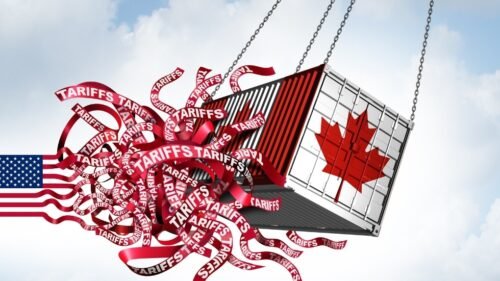
Editor-in-Chief Atul Singh and FOI Senior Partner Glenn Carle, a retired CIA officer who now advises companies, governments and organizations on geopolitical risk, discuss the growing breach between Canada and the United States. US President Donald Trump’s protectionist policies have prompted Canadian retaliation and encouraged Ottawa to pursue closer ties with Europe. Atul and Glenn explore whether this signals a lasting historic shift, even as Canada struggles to escape the economic pull of its southern neighbor.
Since returning to the White House in January 2025, Trump has implemented aggressive protectionist policies, aiming to pull manufacturing back to the US and address trade deficits. Has it worked? No. Manufacturing as a percentage of the economy declined through 2025 and early 2026 before recovering to 9.7% in the second quarter, the same share as in late 2024. The US goods trade deficit rose in 2025, although the combined goods-and-services deficit edged down.
2025: Initial escalations and legal hurdles
Broad tariffs and Canadian countermeasures
On February 1, 2025, the US administration announced broad protectionist measures, initially setting a 25% tariff on most Canadian imports and 10% on energy. Following a postponement, these tariffs took effect on March 4. Canada responded with countertariffs. From March 7, USMCA-compliant goods received an exemption, while the tariff on noncompliant potash fell from 25% to 10%.
During spring 2025, tariffs on specific sectors shifted dynamically. Steel and aluminum duties jumped to 50% on June 4, while automotive products and other goods faced additional US duties through the year. Lumber also became a target of sectoral tariffs later in 2025.
The Supreme Court limits emergency tariff powers
On February 20, 2026, the US Supreme Court ruled that the 1977 International Emergency Economic Powers Act did not authorize the president to impose tariffs. It invalidated the emergency-law basis for the initial sweeping duties, rather than striking down the law’s emergency powers generally.
The Trump administration quickly pivoted toward alternative duties under Section 122 of the 1974 Trade Act. Sectoral tariffs imposed under Section 232 of the 1962 Trade Expansion Act, including those on metals, remained in place. The legal setback changed Washington’s instruments without ending its protectionist approach.
Mid-2026: Breakdown in talks and severe escalation
Washington declines to extend its own agreement
On July 1, 2026, the first six-year joint review of the United States–Mexico–Canada Agreement (USMCA) took place. The US declined to extend the agreement for a new 16-year term, shifting the framework to mandatory annual reviews. The agreement remains in force and is scheduled to expire in 2036 unless the three countries agree to extend it.
For Atul and Glenn, the irony is clear. Trump is rejecting the continuation of the agreement he insisted on negotiating and touted as an exceptional trade deal. Glenn views this as a repudiation of Trump’s own achievement. Atul connects it to Trump’s habit of reopening commitments in pursuit of a supposedly better deal.
Section 338 brings 50% tariffs
On July 20, citing discriminatory treatment, Trump signed proclamations under Section 338 of the 1930 Tariff Act to impose 50% tariffs on a wide variety of Canadian goods. The measures responded to disputes involving vehicles, alcohol and dairy, but covered a broader range of products and provided no exemption for goods qualifying for USMCA preferential treatment.
On August 22, following a brief three-day suspension for last-ditch negotiations, the 50% American tariffs officially took effect after bilateral talks collapsed. Their original August 19 start date had been postponed by a proclamation issued on August 18.
Fall 2026: Retaliation and import bans
Canada targets American political pressure points
On September 8, Canada fired back with major dollar-for-dollar countertariffs ranging from 15% to 50% on approximately C$27.6 billion ($19.44 billion) worth of US exports. The measures affected sectors including steel, appliances, electronics, agricultural equipment, dairy and pulp and paper. Provincial restrictions on US alcohol added another source of pressure.
Atul interprets Canada’s approach as strategic targeting of local businesses, farmers and manufacturers where it hurts. The Canadian goal, he assesses, is to get Americans to lobby their legislators to put pressure on the White House.
Illinois faces pressure through agricultural and construction equipment, including sectors associated with John Deere. Pennsylvania’s large-engine motorcycle industry, including Harley-Davidson production, represents another pressure point in a crucial electoral state. Ohio and Michigan face countermeasures affecting steel, machinery and manufactured goods. Iowa’s agricultural machinery and Maine’s forest products offer further opportunities to generate local economic friction.
Canadian Prime Minister Mark Carney’s background helps explain this combination of political calculation and economic pressure. A former governor of both the Bank of Canada and the Bank of England, he understands numbers. Carney played ice hockey for Harvard and did his PhD in economics at Oxford. He is clearly a sharp chap who has sharp elbows as well.
Washington escalates beyond duties
On September 29, US import bans took effect on nearly $1 billion worth of select Canadian products, specifically alcoholic beverages, certain motorcycles and dairy derivatives such as whey. Washington announced the restrictions on September 8, distinguishing the announcement from their implementation three weeks later.
The restrictions deepen a dispute that now extends beyond tariff rates to whether some Canadian products can enter the American market at all.
Canada turns toward Europe
Carney calls for solidarity among intermediate powers
On January 20, 2026, Carney gave a speech at the World Economic Forum in Davos, Switzerland, on the rupture in the world order. He called for solidarity among intermediate powers, arguing that cooperation could help countries preserve sovereignty when great powers used economic integration as a weapon.
Atul connects this argument to Dutch-born investor Antoine van Agtmael, known for introducing the term emerging markets. He points out that van Agtmael is now advocating a third pole: intermediate powers coming together to create another center of power in addition to the US and China.
The EU proposes associate membership
On September 16, European Commission President Ursula von der Leyen invited Canada to work toward becoming the EU’s first associate member. The proposal did not establish membership or a defined new legal status. Neither side had yet settled what the arrangement would mean, and its realization would require agreement beyond the Commission president’s announcement.
On September 17, Carney welcomed the ambition in a speech to the European Parliament in Strasbourg, France. He called for closer cooperation on defense, critical minerals and energy security. Canada has resources and commodities it can share with the EU, while Europe offers advanced manufacturing, processing capabilities and clean energy technology.
Trump called the idea "laughable" and threatened "very serious tariffs" on Europe if the EU moved forward with its Canada plan. He considered the initiative a hostile act. The prospect of closer Canada–EU ties has now become another point of transatlantic tension between the US and Europe.
Escaping America’s economic gravity
Infrastructure limits Canada’s options
Glenn considers Canada’s efforts rational, but emphasizes the practical constraints. In his analogy, the US is Planet Earth and Canada is but a small satellite orbiting around the planet. Escaping American gravity is exceptionally difficult for Canada.
Importantly, Canada lacks the processing and port facilities needed to redirect energy exports toward Europe on a substantially larger scale. Glenn estimates that building the necessary infrastructure would require at least a decade of concerted national effort. Closer European ties, therefore, cannot rapidly detach Canada from the American economy. Geography, infrastructure and deeply integrated commercial relationships limit how far and how fast Ottawa can move.
A historic shift with political risks
Even so, Glenn sees the possibility of a lasting historic shift in effort and trajectory. He compares closer Canada–EU ties to China’s growing influence in the Middle East. American missteps have created openings for other powers without immediately eliminating American dominance.
Trump’s pressure on Canada may encourage a slow structural realignment as in the Middle East. For Glenn, this is a needless rupture that harms all concerned and weakens longstanding Western cooperation.
Atul also acknowledges the flies in the ointment. Carney’s critics point to Europe’s own crises and the rise of the far right, which could threaten EU cohesion. Prolonged economic pain in Canada could also undermine Carney’s political future.
Carney’s supporters counter that a country facing a bully cannot constantly take the pressure lying down. Pushing back may improve the chances of obtaining a better deal, while repeated submission would only invite further demands from Trump.
Atul suggests that Canada’s drift toward Europe could be an embryonic form of a third pole, a loose grouping capable of resisting domination by the US and China. Carney himself explicitly rejected the idea of building a third bloc to become another great-power rival. His stated objective is collective resilience: enough strength and diversity of partnerships to prevent others from dictating Canada’s choices.
[Lee Thompson-Kolar edited this piece.]
The views expressed in this article/video are the author’s own and do not necessarily reflect Fair Observer’s editorial policy.








































Join the conversation
Share your perspective
Log in to share your thoughts and take part in the discussion.