



The causes that have put Donald Trump so close to the White House must be addressed.
I am not worried about Donald Trump winning the US presidential election on November 8. He won’t, the experts keep telling us. And right-thinking people all over the world want to hear that.
But I do worry that Donald Trump, the phenomenon, is bigger than Donald Trump, the candidate. And that his impact will last long after he concedes defeat—or plays the poor loser—on election night.
DONALD TRUMP, THE CANDIDATE
It’s easy to fault candidate Trump. We have never seen such a mean-spirited, self-serving candidate running for president. Enough can’t be said about the ways he’s broken not just political norms, but the rules of common decency.
With Trump, there is no longer any honest disagreement between honorable rivals. He impugns the motives, and slanders the character, of anyone who gets in his way. He speaks in falsehoods and exploits fears to build himself up.
Claiming the first black president isn’t American born. Saying he’s smart for not paying taxes, and for stiffing the contractors who built his empire. The awful way he treats women. The idea of imprisoning political opponents. Trump is a child, a bully, a slanderer.
And I don’t buy the argument that loyal Republicans should vote for him because he represents—in bits and pieces—the party philosophy. In reality, he believes only in his own self-advancement. There is no Trumpism without Trump. Look what he’s done to his own party—he’ll do that to the country and the world.
DONALD TRUMP, THE PHENOMENON
But while he will lose, Trump the phenomenon has already won, in many respects. He has transformed political dialogue. He made it OK to hate minorities, to espouse violence, to embrace torture. White nationalism, sexism and racism are back into mainstream thinking, thanks to Trump. He has done his best to undermine belief in American ideals, traditions and institutions.
Trump has dumbed-down the level of public dialogue. He has robbed us of the opportunity for informed debate and brought us down to his gutter-level. He has let the genie out of the bottle that won’t go easily back in. He has brought the country to new lows in how debased and uncivil political discourse can be. Make America hate again—that he has accomplished.
Once Trump loses, and the world wakes up the morning of November 9 from one dizzying hangover, we will need to start recovering. Two things need to happen.
First, the Republican Party needs to rebuild itself. After the defeats of Republican presidential hopefuls John McCain in 2008 and Mitt Romney in 2012, Republican strategists pledged to build a base beyond the shrinking demographic of the aging white voter and reflect the growing diversity of the US. Trump’s race-baiting complicates the party’s efforts to put together a winning coalition that takes into account the country’s changing demographics, but at least there is proof that the party must now reach out.
Trump represents a historic low point for the party of Abraham Lincoln, but not its end. The pendulum is always swinging back and forth in US politics, and traditionally, two years after losing a presidential election, the minority party makes gains in midterm elections. There is also some evidence that split ticket voting will take place to put a check on a Hillary Clinton presidency.
And historically, it’s unusual for a single party to have a lock on the White House for more than three terms. The Republican terms of Richard Nixon, Nixon again and Gerald Ford were followed by Democrat Jimmy Carter. The Republican terms of Ronald Reagan, Reagan again and George H.W. Bush were followed by Democrat Bill Clinton. Long runs of single-party dominance over the White House and Congress are rare in modern US politics.
Second, we must look at the causes that put Trump so close to the White House. Both Donald Trump and Hillary Clinton have remarkably high negative polling numbers, and they are deeply disliked by voters, many of whom are holding their noses to vote for them. Clinton is seen as a career politician and very untrustworthy. Trump is seen as stunningly ill-prepared to be commander-in-chief and a dangerous demagogue. Many Americans are feeling left out and the country feels divided.
But beyond their personal baggage, we must look at why the US party system is troubled—for example, the sense that the political elite is out of touch, as has been argued in the United Kingdom with the Brexit vote or Europe with the rise of the far-right. The same simmering discontent and economic angst can be seen elsewhere.
Yet serious plans for the election’s most important issues, such as the economy, income inequality and unemployment, have received scant attention.
DEINDUSTRIALIZATION AND GLOBALIZATION
The US is paying the price for not addressing the impacts of deindustrialization and globalization: the displacement and loss of jobs that have happened over the past several decades. Technology and innovation have changed work and employment, benefitting the incomes of educated workers at a cost to middle-income jobs and economic mobility. Globalization has meant winners and losers, and those who are left out understandably have had it with a political system they feel has done little to help them.
 Fair Observer provides you deep and diverse insights for free. Remember that we still have to pay for servers, website maintenance and much more. So, donate now to keep us free, fair and independent.
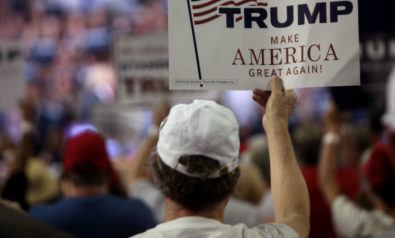
Trump would not have been able to demonize free trade and revive nationalism on his own. He has been enabled and empowered by a large number of Republican Party voters desperately trying to send a message.
Those who feel left behind aren’t buying someone else’s idea of progress, and they feel like they’re being heard when politicians point the finger of blame at international trade and immigration.
How do we help them?
For a start, workforce training can better equip displaced workers for 21st century jobs. Better access to affordable, quality education is an overdue part in finally addressing the rich-school, poor-school disparity in the US. Revitalization efforts and assistance can help the regions hardest hits by trade deals and global economic trends.
Much more needs to be done to address the impacts of globalization so that its benefits are shared and sustainable. Or we can build a wall and try to solve our problems that way.
The views expressed in this article are the author’s own and do not necessarily reflect Fair Observer’s editorial policy.
Photo Credit: ShutterWorx
Support Fair Observer
We rely on your support for our independence, diversity and quality.
For more than 10 years, Fair Observer has been free, fair and independent. No billionaire owns us, no advertisers control us. We are a reader-supported nonprofit. Unlike many other publications, we keep our content free for readers regardless of where they live or whether they can afford to pay. We have no paywalls and no ads.
In the post-truth era of fake news, echo chambers and filter bubbles, we publish a plurality of perspectives from around the world. Anyone can publish with us, but everyone goes through a rigorous editorial process. So, you get fact-checked, well-reasoned content instead of noise.
We publish 3,000+ voices from 90+ countries. We also conduct education and training programs
on subjects ranging from digital media and journalism to writing and critical thinking. This
doesn’t come cheap. Servers, editors, trainers and web developers cost
money.
Please consider supporting us on a regular basis as a recurring donor or a
sustaining member.
Will you support FO’s journalism?
We rely on your support for our independence, diversity and quality.







































Commenting Guidelines
Please read our commenting guidelines before commenting.
1. Be Respectful: Please be polite to the author. Avoid hostility. The whole point of Fair Observer is openness to different perspectives from perspectives from around the world.
2. Comment Thoughtfully: Please be relevant and constructive. We do not allow personal attacks, disinformation or trolling. We will remove hate speech or incitement.
3. Contribute Usefully: Add something of value — a point of view, an argument, a personal experience or a relevant link if you are citing statistics and key facts.
Please agree to the guidelines before proceeding.