


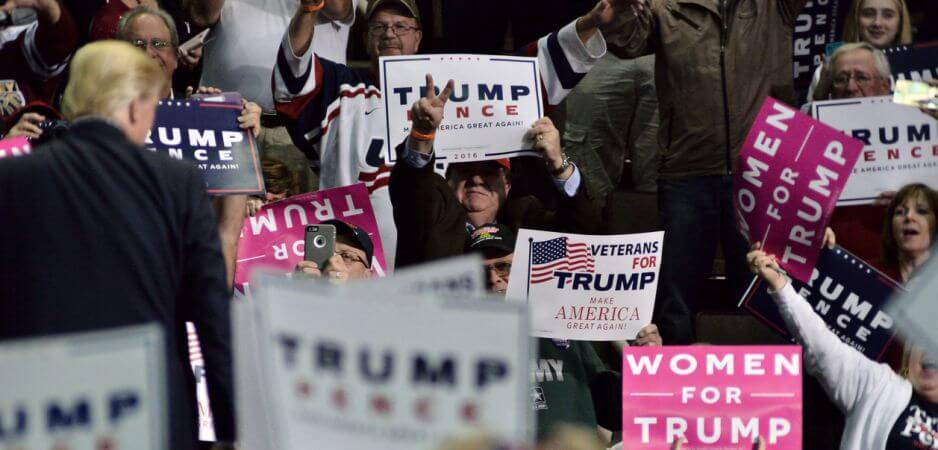


If Americans do not engage with their fellow citizens, resentment over the impact of globalization will grow.
A cottage industry of commentators has emerged in explaining the rise of Donald Trump and how he eventually went on to capture the White House. However, what has become clear over the past year is that globalization has created a new class structure in the West—those who have benefited from globalization and those who have not—which does not fall neatly along previous political lines. While this new structure is by no means unique to the US, it has taken slightly different political persuasions elsewhere. Both groups are worthy of investigation.
The Beneficiaries of Globalization
The social and political elites of America generally enjoy the fruits of globalization. As income inequality exacerbates difference within our nation, the higher socioeconomic strata tend to enjoy increasing diversity of global cultures, cuisines, languages and people. However, they are broadly guilty of self-serving top-down thinking.
Private sector elites, often on the right, hoard profits within the C-suite with little regard to the lack of human flourishing below. Conservatives refuse to entertain a rise in the minimum wage, forcing tens of thousands of low-wage employees to seek benefits from social welfare programs while being fully employed—subsidizing corporate business costs at the expense of taxpayers. Further, they blocked nearly all of President Barack Obama’s efforts to help those harmed by globalization.
Elite liberals, on the other hand, have relied on the courts or executive orders as avenues of social change. Urban liberals attempt to move the country forward by force, forgetting that perception is more powerful than truth in both politics and culture. Safe spaces may be just, white privilege may be real and political correctness may be decent, but without convincing the white masses that presently form the majority of America, those concepts will not survive outside the Ivory Tower. Being righteous and alone improves few lives beyond our immediate contact.
The Detractors of Globalization
Because the opponents of globalization comprise the “Other” from the perspective of the social and political elites who analyze polls and election data, this group has been subject to greater scrutiny this past year. Across the West, the most vocal detractors of globalization have been the majority white populations. These dominant social groups have become resentful toward non-dominant social groups as they begin to gain more power than before.
Coinciding with this, xenophobia has been spiked by a relatively rapid influx of minority social groups—even if the overall population of said groups remain small—as is the case in much of America outside of large urban centers and associated suburbs. Indeed, the relative lack of diversity in rural America allows for the lack of personal experience with minority groups that may assuage blanket assumptions of entire races, ethnicities or religions.
Further, in times of relative scarcity or uncertainty, power and opportunity are often viewed as zero-sum: more power and opportunity for other groups means less power and opportunity for “my” group. Thus, increases in immigration, social minorities in power and economic stress have created the perfect storm where xenophobia, nationalism and exclusion have gained rapid traction among whites who feel they have been increasingly marginalized.
Now, this must be clear: No political or social effort should excuse, accommodate or ignore racism, sexism, xenophobia or other forms of discrimination or demographic hate the way the globalization skeptics across the West have. An explanation is not condonation or normalization of hate. It is important to remember that the 2008 recession, the election of President Obama, the horrors of the Islamic State (IS) or the rise of Donald Trump did not create American racism, xenophobia, sexism or bigotry, though exacerbation has certainly occurred. Nonetheless, the concerns of globalization, economic health and national security can and must be separated from the older and more deep-seated sources of hate, fear and misunderstanding.
Different Perspectives
The above-mentioned scrutiny by the elites of those who feel they have been short-changed by globalization has brought forth great surprise—but why? Part of the answer is that Americans increasingly sort themselves based on class, politics and race. That is, fewer Americans interact with others from varying socioeconomic and racial experiences, and thus possess large demographic “blind spots” with respect to the values and struggles of large segments of the country.
As a mind experiment, read the following two perspectives on American politics and society.
Perspective 1: Beneficiaries of Globalization
Throughout our history oppressed groups, such as African Americans and recent immigrant populations, have faced added challenges to gaining inclusion in the American dream. As such, these groups should be represented when making decisions on staffing and educational placement, along with women and lesbian, gay, bisexual, transsexual, queer, intersex and asexual (LGBTQIA) people.
The financially underprivileged cannot be forgotten and need access to vital social services. Data shows that globalization has largely benefitted societies in general by lowering the costs of goods and increasing diversity and innovation. However, in the globalized economy, education is strongly correlated to income, so four-year degrees should be made affordable. America needs to provide quality education to compete in the 21st century, as 20th century jobs are not coming back to the US.
Perspective 2: Detractors of Globalization
Educated and high-income elites lead major private sector institutions such as multinational corporations and Wall Street financial firms, as well as a growing federal government and associated sectors such as PACs, media and lobbying firms. These elites live in or near urban centers, and often inherit educational and professional benefits from family, ideological allies and other elite social connections, rarely having experience with service or manual work during their adult lives.
These elites praise racial, ethnic, gender and sexual orientation diversity, but ignore diversity with respect to education, ideology, religious conviction or class. Post-2008 recession gains have concentrated wealth and power among these elites and their peers through continued outsourcing of working-class jobs overseas.
The Disconnect
The danger of this growing disconnect between compatriots is twofold: the erosion of a collective identity as Americans, and a diminishing of interpersonal trust that other Americans have the same or similar values as ourselves or our group. Both collective identity and interpersonal trust are key beliefs that maintain the cultural underpinnings of a democratic society—one must have a desire to work for the common good and trust that your fellow citizens will generally do so, as well.
To add to this challenge, America has just elected to the presidency either a man who is merely a bigoted, narcissistic dilettante or an actual fascist authoritarian—no one can truly be sure. Regardless of which, on the watch of President Donald Trump we cannot lose sight of what is more fundamental than a leader: how we view each other and ourselves.
The First Four Steps for America
Despite these divisions, progress for all Americans is still possible. The below steps begin with the most urgent, and then proceed to issues which would benefit Americans on both sides of the globalization divide.
First, all Americans should denounce the disturbing wave of over 400 hate crimes that have occurred since the election of Donald Trump, as well as stand up for those who are being harassed or attacked. These attacks are the result of the normalization of hate, which comes from electing a bigot to the presidency. Previously, these attackers likely maintained a default state of opposition against social change and an antiquated preoccupation with an Anglo-Protestant American culture that dominates white America. However, such a natural proclivity has been easily weaponized.
For many, this need is a step back to a dark era of our country, but for others, this is what is meant by “Make America Great Again.” That is, millions of Americans either voted for a racist or voted for a candidate despite him being a racist. The ascent of Trump reminds us that progress is never permanent—it must be defended regularly as a renewed social contract. For this reason, social and political redirection must begin now by donating time and energy toward civil society organizations that work to protect civil rights and oppose government overreach.
Second, whereas civil liberties must be defended at the national level, each community has challenges that cannot be fully addressed by sending a single person to Washington. As such, economic reforms begin closer to home. We must next attempt to create broad grassroots networks at local and state levels to address rural and urban unemployment by supporting the creation of new jobs as part of a green economy.
Work must be done to also address drug addiction, strengthen unions, reaffirm workers’ rights and increase state minimum wages. These issues will help alleviate the economic struggles of millions of Americans, make important strides toward addressing income inequality, and allow for a healthier context in which to combat resentment and bigotry across socioeconomic groups.
Third, the preexisting cracks in the foundations of structural democracy must be addressed. Central concerns such as voting rights protections, gerrymandering reform and passing a constitutional amendment limiting the role of money in politics all must occur in state legislatures. These reforms will increase the accuracy of representation and reign in the disproportionate influence of billionaire campaign donors, respectively.
One such reform, the recent approval of Ranked Choice Voting in Maine, should be replicated throughout the country to eliminate the false dilemma of America’s “lesser of two evils” voting system. Only after this hard work is done can the representative voice of the people be heard in the Capitol.
Finally, we as a country must reflect on reforming the post-truth era of American society. Our president-elect denies the clear fact of human-contributed global climate change, and he actively entertains and spreads other conspiracy theories with little concern for evidence or ramifications. Millions of Americans regularly consume and spread objectively fake news on social media with no apparent attempt at verification.
Ironically, Americans have been primed by politicians to distrust the “mainstream media” outlets that are best-positioned to invest in the research required to vet claims and stories. While no silver bullet exists, greater emphasis on information literacy, critical thinking and civics must be made when educating the next generation. Further, we must respect and support journalism that is oriented toward quality reporting over mere clicks and profits.
While none of the steps are easy, if we as a country wait until 2020 to engage with all fellow Americans and our fundamental institutions, the seeds of further division over the ramifications and resentment of globalization will be sowed by another round of inflammatory campaign rhetoric. While those who voted against Trump—a majority of voters—feel that the fire of him and his supporters may be burning our inclusive democracy to the ground, we must use the opportunity to galvanize support in cultivating new crops of cooperation and participation.
The views expressed in this article are the author’s own and do not necessarily reflect Fair Observer’s editorial policy.
Photo Credit: Bastiaan Slabbers
Support Fair Observer
We rely on your support for our independence, diversity and quality.
For more than 10 years, Fair Observer has been free, fair and independent. No billionaire owns us, no advertisers control us. We are a reader-supported nonprofit. Unlike many other publications, we keep our content free for readers regardless of where they live or whether they can afford to pay. We have no paywalls and no ads.
In the post-truth era of fake news, echo chambers and filter bubbles, we publish a plurality of perspectives from around the world. Anyone can publish with us, but everyone goes through a rigorous editorial process. So, you get fact-checked, well-reasoned content instead of noise.
We publish 3,000+ voices from 90+ countries. We also conduct education and training programs
on subjects ranging from digital media and journalism to writing and critical thinking. This
doesn’t come cheap. Servers, editors, trainers and web developers cost
money.
Please consider supporting us on a regular basis as a recurring donor or a
sustaining member.
Will you support FO’s journalism?
We rely on your support for our independence, diversity and quality.





Commenting Guidelines
Please read our commenting guidelines before commenting.
1. Be Respectful: Please be polite to the author. Avoid hostility. The whole point of Fair Observer is openness to different perspectives from perspectives from around the world.
2. Comment Thoughtfully: Please be relevant and constructive. We do not allow personal attacks, disinformation or trolling. We will remove hate speech or incitement.
3. Contribute Usefully: Add something of value — a point of view, an argument, a personal experience or a relevant link if you are citing statistics and key facts.
Please agree to the guidelines before proceeding.