


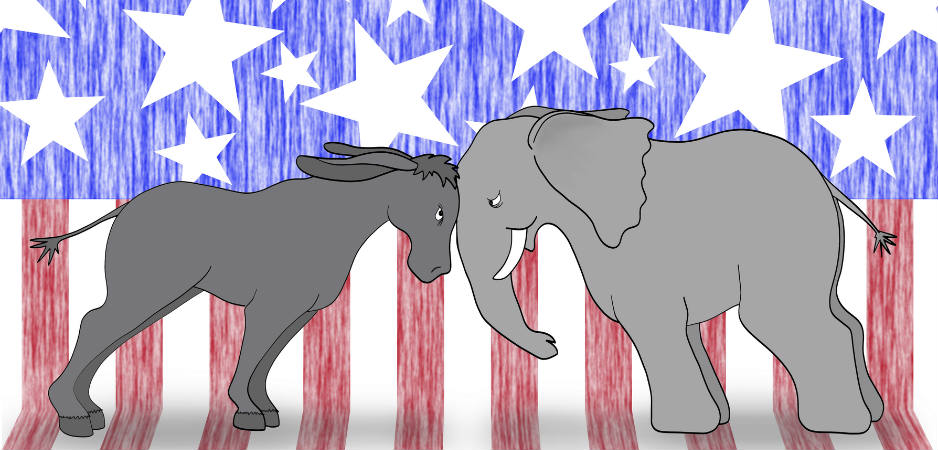



In the first presidential debate, candidates failed to provide clues about possible political responses to any of the real questions about America’s future in the world.
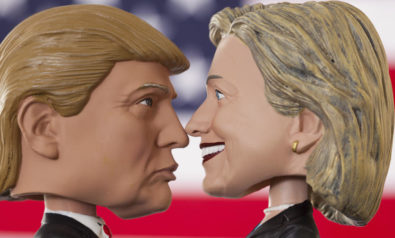
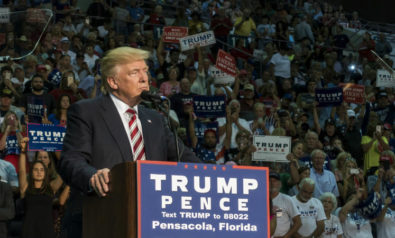
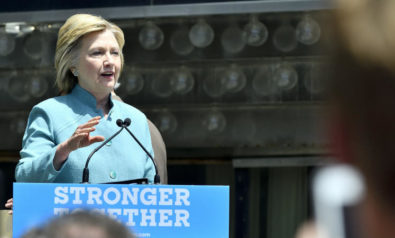
Judging from the results of the first “Super Bowl of presidential debates” it would appear that the following three statements, if not true, are at least credible: Donald Trump is manifestly not qualified to be president; Hillary Clinton may not be qualified to be president; it isn’t clear what it really means for a person to be qualified to be president.
The first debate somewhat predictably contained very little substance. Instead it danced around the relative weaknesses of each candidate, reflecting the mood of the nation, which appears to be on the verge of deciding which candidate to vote against.
There is no set of established criteria concerning the qualification to be president other than being a natural-born citizen of at least 35 years of age. A lot of people, especially on the Democratic side, feel that the ability to understand and speak clearly about issues identified as important is a criterion. Others feel that political experience should be an important factor, but most would make an exception for high-ranking military officers, or at least generals.
A much vaguer but still very powerful criterion in many people’s minds is the notion of future vision. Barack Obama built momentum on the basis of “change you can believe in.” John Kennedy, America’s youngest president, incarnated the future. But even the very senior Ronald Reagan promised “morning in America.” Neither candidate has shown an aptitude for expressing a resonating vision of the future.
Most people feel that Hillary Clinton won the debate, which means that more undecided voters will drift toward voting for her, strongly increasing her odds to win. But we also know from recent polls that approximately 60% of the population disapproves of both candidates. This unprecedented fact will probably mean that the candidate who wins in November will be unlikely to benefit from the traditional political honeymoon that encourages new presidents to set the tone for the coming term of office.
Since the two conventions in July, pollsters have consistently set the odds in favor of Clinton, even on those particular days where Trump technically draws even or nudges into the lead. Common sense combined with the media’s judgment that Clinton clearly won the debate tells us that, barring a very possible October surprise related in particular to emails, we should be looking toward a Clinton victory in November.
Hillary Takes Office
It may therefore be time to begin speculating on what might happen once she takes office. We know what her principle vulnerabilities are, that she represents the elite—not just of her party but of the establishment power structure. She is too close to both Wall Street and the interests of the military-industrial complex, which can be seen as extending deeply into foreign policy through military commitments and alliances with aggressive heavily-armed regimes such as Saudi Arabia and Israel.
Aware of that, Trump was correct to challenge her on her original support of the Trans-Pacific Partnership (TPP), though he couldn’t prevent himself from revealing his patented narcissism by claiming to be the cause of her public about face on that issue. He missed an opportunity to score a point with the Bernie Sanders loyalists by pointing out that it was Bernie who forced her to change her tune. Although it can only be speculation, Trump is probably correct in assuming that Hillary will end up endorsing TPP once in office, after discovering some previously-hidden virtues.
A non-partisan observer of this election speculating on how Hillary might act once in office must keep in mind two contrasting but not mutually exclusive hypotheses. One, that she will see her election as a mandate to further the interests of what should be called her club of governance, which includes the Clinton Foundation and friends, Goldman Sachs and the banking elite, as well as a long list of neocons and military imperialists such as Robert Kagan and Henry Kissinger. And two, that she will be so unpopular with both Republicans and Democrats in Congress and the electorate as to be totally powerless, in which case the oligarchy that silently supports her will simply let her rot on her perch while they manage affairs in their usual manner.
It’s truly difficult to imagine Hillary Clinton assuming the mantle of leader, and not because she’s a woman, but simply because, like Trump, in the eyes of the public she doesn’t represent anything other than her own interests. In a not-distant past, presidential candidates were required to represent the identified demographics of their party. That is no longer the case in 2016.
The tidal wave of angry populism that began for the Republicans with the rise of the Tea Party subsequently morphed into Trumpism, with no discernible ideological and demographic convergence. Not even racism, though the appeal to white supremacy is clearly part of it. At the same time the neoliberal drift of the Clintons’ New Democrats launched in the 1990s led the party to abandon the themes dear to its traditional working-class base in favor of a focus on polarizing cultural issues: abortion, climate change, minorities’ rights, with particular attention to minorities where the majority was white—women and LGBT.
 Fair Observer provides you deep and diverse insights for free. Remember that we still have to pay for servers, website maintenance and much more. So, donate now to keep us free, fair and independent.
These cultural themes resonate strongly with the more educated urban segment of liberals and traditional Democrats, many of whom happen to be attracted to high paying professions such as law and finance and therefore identify consciously or unconsciously with the elite.
Looking to the Past
The result of these shifts is the exceptionally interesting phenomenon in 2016 that neither candidate has received the kind of enthusiastic, unified ideology-driven endorsement of their party, a fact the media appear to be intent on ignoring. Instead of two distinct rival philosophies of government attempting to seduce the electorate, the choice is between two “operators,” one political and the other a businessman.
The Republican political elite boycotted their own convention. At the Democratic convention the strongest discernible ideology was militaristic nationalism, a theme formerly monopolized by the Republicans. The one vague ideological frontier between the two parties in this election could be framed in the following way: Democrats are for inclusion (diversity), Republicans for exclusion (protecting the imaginary American way of life). The problem for both is that Clinton is seen as a member of an exclusive elite and Trump, as a billionaire, doesn’t appear to be one of the “people.”
Even more curious this year is the appeal of both of these unappealing candidates, not to the future—like Kennedy, Reagan and Obama—but to the past. In one sense, this election has come down to a simple choice of nostalgia for Americans: Do you prefer to live in the 1950s (Trump) or the 1990s (Clinton)?
The 21st century appears to be too complicated to think about. This became clear in the debate when, in spite of casually evoking some the key issues facing the world—the wars in the Middle East, climate change, income inequality—absolutely nothing was detailed or debated in terms of future policy about any of them, not even racism, which was “talked about” in terms of stop-and-frisk but not examined with any idea of serious vision or problem-solving policy.
With Clinton’s probable victory there is a further risk—a permanent temptation for unpopular leader—that of a new wag-the-dog foreign policy. As Margaret Thatcher showed at the nadir of her popularity, war is the great unifier. But the next war won’t be in the style of the Falklands. Both candidates have a plan—one open, the other secret—to destroy ISIS and bring peace to the Middle East.
The one very positive thing that can be said about Obama is that, even at those moments when his popularity precipitously dipped, he studiously avoided that temptation though, as is his wont, through compromise rather than resolute leadership. His “drone them and no one will notice” approach to war does lower the tone on jingoism. But it is otherwise both as brutal and cruel at a human level as it is totally logical at a financial-economic level. It extends and intensifies the military-industrial orientation of the economy and foreign policy, while appearing to be both technologically cutting edge and efficient. Efficiency, we mustn’t forget, is a core value in US culture.
Giving Capitalism a Human Face
The most solid argument in favor of Hillary Clinton today is that she will have the means of taming the elite, whose powers and influence have clearly become excessive. Some cite the precedent of the progressive movement of the early20th century that aimed at giving capitalism a human face thanks to laws challenging trusts and protecting unions and workers. Bernie Sanders chose this as the basis of his appeal to the Democrats: a return to Rooseveltian politics. This historical process of reforming capitalism went through a number of interesting cycles but over time the underlying dynamics tended toward what we have today: consolidated oligarchy. The elites only accepted to be “tamed” in the knowledge that it was necessary to improve their image, not to change their strategy.
Nothing illustrates this better than the Smedley Butler saga in the first half of the 20th century. At the very moment when Teddy Roosevelt was taming capitalism and attacking trusts, the US government was “taming” every foreign economy and population within its reach, starting with the Spanish colonies, from Cuba to the Philippines, which the US took control of following its victory in the Spanish American war of 1898—a war famously provoked by the contrived propaganda of Hearst’s yellow press.
But there was also Hawaii, Central America (Honduras, Nicaragua) and Mexico, which Woodrow Wilson’s government had planned to invade and “tame” in the midst of its own prolonged revolutionary conflict. Smedley Butler played a key role as intelligence operative in that attempt, which was abandoned after the confusion of what was called the Tampico affair.
What he fails to understand is that what the US spends on the military and useless wars is precisely what allows it to dominate the world economy and to maintain the dollar as the universal currency of global trade. He might have added depth to his argument by pointing out that TTP ultimately aims at the same thing.
The same successive governments that were intent on mitigating the effects of capitalist concentration at home were deploying the marines in all these foreign regions, not to “make the world safe for democracy” but rather to secure advantages and private control of resources and commodities, i.e., direct capitalist control rather than European-style political colonialism. This is what has come to be known as neocolonialism.
Major General Smedley Butler built his reputation as a heroic participant and leader in many of those foreign operations, including China. Quite naturally the cabal of industrial leaders who put together the notorious “Business Plot” selected Butler as the natural figurehead to head the fascist government they would put in place after deposing FDR. Fascism at the time appeared to many industrialists and financiers to be an efficient way of getting things done and scaling up industrial power. Many leading US companies including GM, Ford, Brown and Harriman (of which Prescott Bush was an associate), IBM, Standard Oil, Dow and Alcoa developed deep complicity with Hitler’s regime. They very directly provided the material and financial means required by a nation bankrupted by war debts after the Treaty of Versailles to begin expanding its Lebensraum by invading and attempting to conquer all its neighbors.
As the Business Plot took form, it was Smedley Butler, its designated leader, who had second thoughts and informed Roosevelt of the plot. A House investigation conducted some years later in secret concluded: “In the last few weeks of the committee’s official life it received evidence showing that certain persons had made an attempt to establish a fascist organization in this country … There is no question that these attempts were discussed, were planned, and might have been placed in execution when and if the financial backers deemed it expedient.”
The media, playing its already consecrated role of excluding the real news whenever discretion or financial interest requires it, called the whole story a hoax. The law of government and industrial omertà meant that the only firm publicly mentioned as associated with the plot was the bank, JP Morgan. And of course no one was prosecuted. Some have suggested that Roosevelt understood that his own life was at stake if the truth were to come out.
Butler ended his career denouncing, in books and lectures, US military policy as a tool of capitalist rather than national interests. In the eyes of many the two had already become synonymous.
In US political mythology, the cycle of progress in reforming the most extreme vices of capitalism spanned two Roosevelt presidencies and even continued through a good portion of the Cold War, which in the name of saving Europe’s ex-colonies from communist influence provided a new excuse for plundering other economies in Asia, Latin America and Africa while reinforcing America’s own welfare state under Eisenhower, Kennedy, Johnson and even Nixon. It was only the Reagan revolution in the 1980s that began handing all discretionary power back to the capitalists, in the name of deregulation that, of course, signified “efficiency.”
The end of the Cold War posed a new problem. With the communist bloc in disarray, how would it be possible to justify the system of predatory control of economies that were no longer tempted by the alternative of an alignment with the Soviet Union? It took a decade and a single dramatic event to come up with the solution: the War on Terror against a permanent and omnipresent enemy.
It was the innovation of George W. Bush’s administration, for which 9/11 provided the perfect pretext, but the Clinton administration had also been preparing for it as early as 1995 with Presidential Decision Directive 39: “We shall work closely with friendly governments in carrying out our counterterrorism policy and will support Allied and friendly governments in combating terrorist threats against them. … Furthermore, the United States shall seek to identify groups or states that sponsor or support such terrorists, isolate them and extract a heavy price for their actions.”
Six trillion reasons
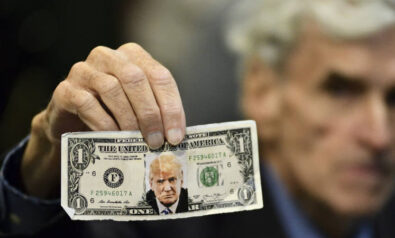
In Monday’s first debate, Trump brought out one of his campaign talking points that makes theoretical sense, but whose implications he clearly doesn’t himself understand: that with the $6 trillion spent on hopeless, destructive wars in the Middle East, the US could have rebuilt its infrastructure and financed education and health at home twice over.
What he fails to understand is that what the US spends on the military and useless wars is precisely what allows it to dominate the world economy and to maintain the dollar as the universal currency of global trade. He might have added depth to his argument by pointing out that TTP ultimately aims at the same thing. Which is why Hillary really did see this contested agreement—quite literally—as the “gold standard,” a good choice of words since the actual meaning of gold standard is “a monetary system in which the standard economic unit of account is based on a fixed quantity of gold.” Trump is almost certainly right that, once elected, Hillary will support it.
It’s worth noting that among all the chitchat about Trump’s sniffles and both candidate’s temperament, references to Miss Piggy and other random insults, no one in the media has highlighted the most significant issue brought up in the debate: the political and financial question of the $6 trillion and rebuilding infrastructure.
It’s worth noting that among all the chitchat about Trump’s sniffles and both candidate’s temperament, references to Miss Piggy and other random insults, no one in the media has highlighted the most significant issue brought up in the debate: the political and financial question of the $6 trillion and rebuilding infrastructure. Hillary successfully ignored it. Trump, the populist isolationist and pseudo-political opportunist, proved incapable of understanding and developing the very things he’s talking somewhat intelligently about.
It’s revealing that no one else in the press or the media wants to talk about those things that it would be easy to claim are six trillion times more interesting than Trump’s tax returns, the unsubstantiated merits of stop and frisk—proven ineffective but excellent for driving a wedge between the police and the community, a point Clinton might have tried to make in a serious debate—and the supposed “presidential qualities” of the candidates.
We now have to wait for the two other Super-Bowl debates to see if either candidate seeks to provide not necessarily answers but at least a clue or two about possible political responses to any of the real questions about America’s future in the world.
The views expressed in this article are the author’s own and do not necessarily reflect Fair Observer’s editorial policy.
Photo Credit: WildLivingArts
Support Fair Observer
We rely on your support for our independence, diversity and quality.
For more than 10 years, Fair Observer has been free, fair and independent. No billionaire owns us, no advertisers control us. We are a reader-supported nonprofit. Unlike many other publications, we keep our content free for readers regardless of where they live or whether they can afford to pay. We have no paywalls and no ads.
In the post-truth era of fake news, echo chambers and filter bubbles, we publish a plurality of perspectives from around the world. Anyone can publish with us, but everyone goes through a rigorous editorial process. So, you get fact-checked, well-reasoned content instead of noise.
We publish 3,000+ voices from 90+ countries. We also conduct education and training programs
on subjects ranging from digital media and journalism to writing and critical thinking. This
doesn’t come cheap. Servers, editors, trainers and web developers cost
money.
Please consider supporting us on a regular basis as a recurring donor or a
sustaining member.
Will you support FO’s journalism?
We rely on your support for our independence, diversity and quality.



















Commenting Guidelines
Please read our commenting guidelines before commenting.
1. Be Respectful: Please be polite to the author. Avoid hostility. The whole point of Fair Observer is openness to different perspectives from perspectives from around the world.
2. Comment Thoughtfully: Please be relevant and constructive. We do not allow personal attacks, disinformation or trolling. We will remove hate speech or incitement.
3. Contribute Usefully: Add something of value — a point of view, an argument, a personal experience or a relevant link if you are citing statistics and key facts.
Please agree to the guidelines before proceeding.