


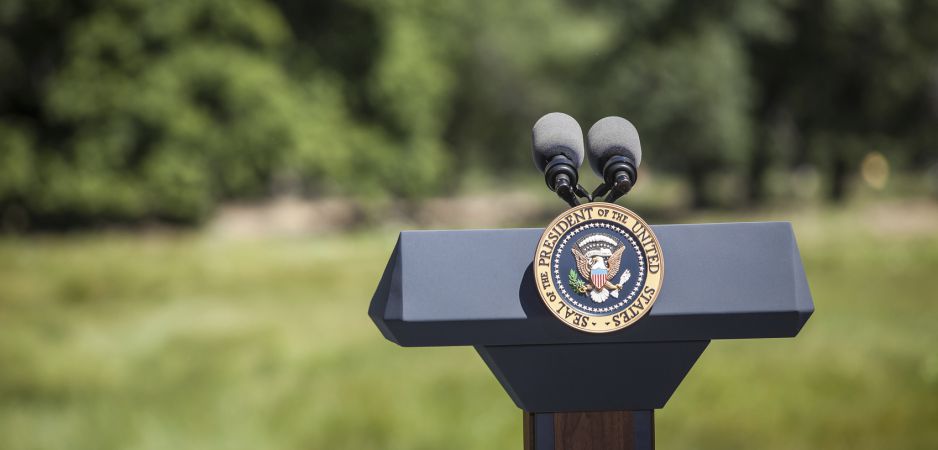



Donald Trump has no experience in either foreign policy or national security, no background in government and no overarching approach to America’s indispensable role in the world. As previous presidents, he will be mightily challenged in the troubled Middle East. Former US Ambassador Gary Grappo explains.
President Donald J. Trump. Those are words that few people expected would ever be uttered. However, come January 20, 2017, that is exactly how people will begin referring to America’s 45th president.
For many in the Middle East, as well as elsewhere around the world concerned about affairs in that region, the coming months will be filled with angst and uncertainty. President-Elect Trump has little knowledge of the Middle East, and his campaign was marked by a singular dearth of detail about whether or how exactly he will address the region’s many problems.
Here’s what little we do know.
America’s Role in the World
Broadly speaking, the president-elect enunciated no overarching philosophy of America’s role in the world. His campaign reflected an unclear and sometimes conflicting foreign policy platform—e.g., warming relations with Russia, walking away from the Iran nuclear accord, discontinuing trade agreements, and breaking with America’s traditional security alliances, most importantly the North Atlantic Treaty Organization (NATO). Judging from his “America first” rhetoric, Trump seemed to want to walk America back from its globalization policy, one it has championed since World War II and from which both the United States and the world have benefited immensely.
With no experience in government and little-to-no background in foreign policy, other than what he may have learned during the presidential campaign, Donald Trump starts with an effective blank slate. Most of his pronouncements addressed what he opposed. He offered nothing resembling a coherent overarching framework for US foreign policy in the early 21st century. This is unprecedented for the presidential candidate of a major American political party, much less the president-elect.
Good News for Israel … For Now
Trump wants a close relationship with Israel. Lacking specifics, one must conclude that will start with a much better personal relationship with Israeli Prime Minister Benjamin Netanyahu than his predecessor has had these past eight years. The best that Palestinians might expect for the moment is indecision. Trump has uttered few, if any, words about the Israeli-Palestinian conflict, and he likely has an ill-conceived notion of the conflict and a decided sympathy for Israel and little for Palestine.
Trump is likely to take his cue from Netanyahu, who is in no rush to see another American initiative to bring the Israelis and Palestinians back to the negotiating table. That may be sensible at the outset. Netanyahu’s Palestinian counterpart, Mahmoud Abbas, confronts serious problems within his own ranks regarding his continued leadership and potential successor. But in the long run, no action on this front could spell serious trouble for the Palestinians and, ultimately, the Israelis.
Trump also wants the Islamic State (IS) destroyed. He is likely to have a receptive ear throughout the Middle East on this subject, though Arab leaders as well as Washington’s European allies will want to know much more. President Barack Obama has largely sought the same objective. So, what will be different?
With the imminent expulsion of IS from Mosul, Iraq, it will be up to the Trump administration to outline the next steps, including the terrorist organization’s destruction in Syria. More importantly, how does he plan to work with America’s Arab allies and Turkey in eradicating the venomous ideology of IS and other such extremist groups—an objective that has eluded them all since 9/11? It would be useful to know whether Trump and his advisors have even contemplated the subject.
What of the US-Saudi Partnership?
The president-elect has also said he wants Saudi Arabia to “pay up,” presumably for American protection of the kingdom’s oil. That suggests considerable ignorance of America’s long-running strategic alliance with the Kingdom of Saudi Arabia and the many advantages derived therefrom.
Saudi Arabia buys massive quantities of weapons and military hardware from the US, some $60 billion in the last year alone. Surely that’s worth something. The Saudis were close allies in the fight against communism during the Cold War, and now serve in a similar capacity in the struggle to eliminate terrorism. Moreover, as the geographic and religious center of one of the world’s monotheistic faiths—some 1.6 billion faithful and growing—that alliance will remain vital to the US and all those enjoined in the fight against terrorism in the Middle East and elsewhere.
Finally, the Saudis share America’s interest in maintaining the region’s stability—which is very much at risk at present—and the viability and strength of the global economic system. And in the latter, that will mean keeping prices for the world’s most strategic commodity, oil, as stable as possible. Saudi Arabia has largely been a responsible steward of its vast oil resources, and Trump would be wise to keep it that way.
Sending the Saudis a bill for America’s “protection services,” which serve American interests, too, will only undermine what has been and needs to remain a key strategic partnership for both nations. Trump needs to find a way to diplomatically walk back from such irresponsible talk.
Trade as an Effective Tool for US Economic and Security Policy
The president-elect, in his campaign, repeatedly talked of either canceling or renegotiating America’s trade agreements. The US has free trade agreements with several Middle Eastern and North African nations: Israel (presumably off the table—see above), Morocco, Jordan, Bahrain and Oman. It is doubtful that any of these, with the possible exception of Israel’s, account in any significant way for America’s trade imbalance. And if any of these “steal American jobs,” it is more likely to be Israel’s but even that would be a stretch.
In fact, all of these trade agreements represent America’s commitment to some of its strongest allies in the region, and offer the best free market-based approach to economic reforms and self-sufficiency in today’s global economy. Trump would be wise to simply avoid the subject and, perhaps even wiser, to offer the tantalizing opportunity to other progressive governments in the region, assuming they are willing to meet America’s high standards for such agreements.
Iran: More Firmness But Also Diplomacy
Finally, Trump does not like Iran or the nuclear accord negotiated by the US and its P5+1 partners with the Iranians in 2015. For most of the Arab world, this is likely to be very well received—again, however, with more details please. Proclaiming one’s dislike for the Islamic Republic makes good campaign copy but hardly amounts to a strategy for dealing with one of the region’s largest and most powerful nations. Is there a diplomatic strategy for dealing with Iran?
And if America wants to militarily confront that nation, then how, and which allies will be with us? Trump falsely proclaimed he did not support America’s war in Iraq. But any confrontation with Iran would be at least an order of magnitude greater than that exercise.
In fact, there may be no alternative to diplomacy with Iran. And the nuclear accord provides the vehicle for moving in that direction, but not with abrogation of the agreement, which would garner little to no support among any of our most important allies, never mind the P5+1. Even with those constraints, Trump will have much to work with, whether confronting Iran’s support for terrorism, hegemonic advances in Iraq, Syria, Yemen and elsewhere, or bellicose rhetoric toward the US, Israel and the West. He’d best get to work soon on fashioning such a policy since the support of America’s many allies will be critical.
Other Challenges in the Middle East
And then there are the region’s many other challenges that President Trump will have to take up on January 20. A greatly unsettled Iraq, a Syria in crisis under a despised dictator sustained and supported by Russia and Iran, Yemen’s civil war, continued instability in Egypt under an all-controlling military leadership, and the failed state of Libya—each one alone a major policy challenge for the US—have yet to cross Trump’s mind to date. Becoming properly briefed alone will be a major task.
Perhaps the first sign of Trump’s direction will come in his initial rounds of appointments to key foreign policy posts—e.g., secretary of state, and advisory positions inside the White House and National Security Council, e.g., national security advisor. Strong appointments, such as those with sustained experience with and knowledge of these many complicated issues, will be a sure sign that he intends to address them and America’s overarching role and status in the Middle East with purpose and direction.
The country and the world await, Mr. Trump.
The views expressed in this article are the author’s own and do not necessarily reflect Fair Observer’s editorial policy.
Photo Credit: Bruce Willey
Support Fair Observer
We rely on your support for our independence, diversity and quality.
For more than 10 years, Fair Observer has been free, fair and independent. No billionaire owns us, no advertisers control us. We are a reader-supported nonprofit. Unlike many other publications, we keep our content free for readers regardless of where they live or whether they can afford to pay. We have no paywalls and no ads.
In the post-truth era of fake news, echo chambers and filter bubbles, we publish a plurality of perspectives from around the world. Anyone can publish with us, but everyone goes through a rigorous editorial process. So, you get fact-checked, well-reasoned content instead of noise.
We publish 3,000+ voices from 90+ countries. We also conduct education and training programs
on subjects ranging from digital media and journalism to writing and critical thinking. This
doesn’t come cheap. Servers, editors, trainers and web developers cost
money.
Please consider supporting us on a regular basis as a recurring donor or a
sustaining member.
Will you support FO’s journalism?
We rely on your support for our independence, diversity and quality.





Commenting Guidelines
Please read our commenting guidelines before commenting.
1. Be Respectful: Please be polite to the author. Avoid hostility. The whole point of Fair Observer is openness to different perspectives from perspectives from around the world.
2. Comment Thoughtfully: Please be relevant and constructive. We do not allow personal attacks, disinformation or trolling. We will remove hate speech or incitement.
3. Contribute Usefully: Add something of value — a point of view, an argument, a personal experience or a relevant link if you are citing statistics and key facts.
Please agree to the guidelines before proceeding.