


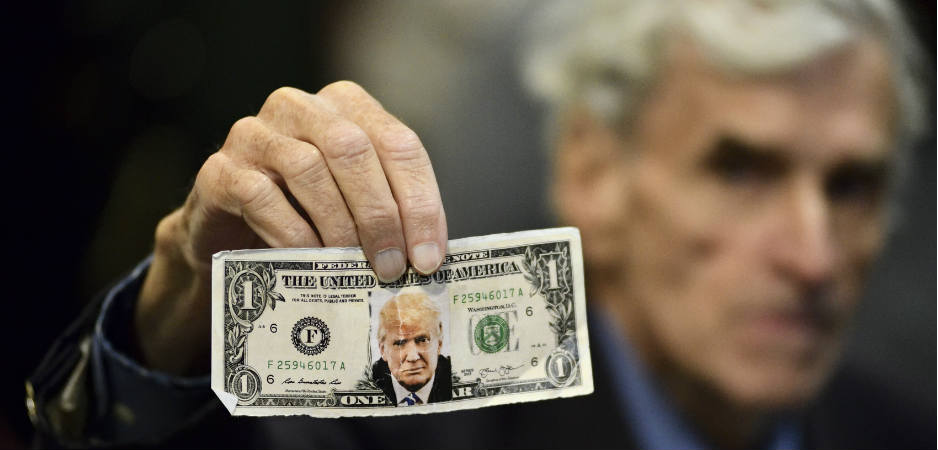


Donald Trump wins a truly historic US election.
A populist wave that began with Brexit in June reached the United States in stunning fashion on November 8. In one of the biggest upsets in American political history, Donald Trump won a truly historic victory in the US presidential election.
Trump’s remarkably decisive win stunned most political pundits, myself included. Throughout the campaign, Trump seemed to have a polling ceiling of about 44% and he consistently had the highest unfavorability rating of any major party nominee in history. Accordingly, months ago I predicted that Hillary Clinton would easily beat Trump.
Then, at the beginning of October, the uproar over Trump’s lewd and offensive remarks on the Access Hollywood videotape, combined with the escalating number of women who accused Trump of sexual assault, seemed to finish off his campaign. Right up until Tuesday afternoon, therefore, a comfortable victory for Clinton seemed like a foregone conclusion.
But I was dead wrong. Trump won a sweeping victory in the presidential race. His night began with critical victories in Florida, North Carolina and Ohio, three states essential to his path to 270 electoral votes. As the night wore on, Clinton’s “blue wall” collapsed amid a red tide that swept across the country from the Atlantic coast to the Rocky Mountains. The blue states of Pennsylvania, Michigan, Wisconsin and Iowa fell to Trump like dominoes. The election returns made clear that Trump would carry over 300 electoral votes, more than enough to win the presidency.
It’s extremely early to draw conclusions about the 2016 election results, but here are five factors that at least partially explain what happened.
The Silent Trump vote
There really was a silent Trump vote that the polls failed to pick up on. The nationwide polling average gave Clinton about a 3-point lead overall, and the state-by-state polls indicated that she would win at least 300 electoral votes.
But the polls were as wrong as the pundits. Problems with the polls’ methodologies will undoubtedly be identified in the days and weeks ahead.
It seems equally reasonable to conclude that many Trump voters kept their intentions to themselves and refused to cooperate with the pollsters.
The extraordinary role of James Comey, director of the Federal Bureau of Investigation (FBI), in the presidential campaign cannot be underestimated either. Two weeks ago, Clinton seemed on the verge of winning a double-digit victory. But Comey’s October 28 letter to Congress, which announced that the FBI was reopening its investigation into Clinton’s State Department emails, changed the momentum of the race. Clinton retook the polling lead at the end of last week, but the final polls masked the lasting damage that the Comey letter had done to her campaign.
Whatever the ultimate explanation for the polls’ failure to predict the election’s outcome, the future of the polling industry is in question after Tuesday. Trump’s astounding victory demonstrated that the polls simply cannot be trusted.
Celebrity beat organization
A longstanding assumption of political campaigns is that a first-rate “Get Out the Vote” organization is indispensable. The conventional wisdom in 2016 thus held that Trump’s lack of a grassroots organization was a huge liability for his campaign.
But as it turned out, he didn’t need an organization. Trump has been in the public eye for over 30 years, which meant that he entered the race with nearly 100% name recognition. Trump’s longstanding status as a celebrity enabled him to garner relentless media attention from the moment he entered the race. One study found that by May 2016, Trump had received the equivalent of $3 billion in free advertising from the media coverage his campaign commanded. Trump seemed to intuitively understand that the controversial things he said on the campaign trail captured the voters’ attention in a way that serious policy speeches never could.
Most important of all, he had highly motivated voters. Trump’s populist rhetoric and open contempt for civility and basic standards of decency enabled him to connect with the Republican base like no candidate since Ronald Reagan. Trump didn’t play by the normal rules of politics, and his voters loved him for it.
 Fair Observer provides you deep and diverse insights for free. Remember that we still have to pay for servers, website maintenance and much more. So, donate now to keep us free, fair and independent.
Trump’s victory would seem to herald a new era of celebrity politicians. He showed that a charismatic media-savvy outsider has significant advantages over traditional politicians and conventional political organizations in the internet age. In the future, we may see many more unconventional politicians in the Trump mold.
A Populist revolt
It will take days to sort through the data to figure out what issues resonated most deeply with Trump’s base. But immigration and trade seem virtually certain to be at the top of the list. Trump bet his whole campaign on the idea that popular hostility to liberal immigration and free trade policies would propel him to the White House.
From the beginning to the end of his campaign, he returned time and again to those two cornerstone issues. In his announcement speech, he promised to build a wall on the Mexican border and deport 11 million unauthorized immigrants. He also pledged to tear up free-trade agreements and bring back manufacturing jobs. From day one, he made xenophobic and nationalistic policies the centerpiece of his campaign.
Critics rightfully condemned his vicious attacks on Mexicans and Muslims, but Trump clearly understood that hostility toward immigration and globalization ran deep among a critical mass of American voters.
His decision to focus on immigration and trade paid off in spades on election day. It’s no coincidence that Trump did exceptionally well in the traditionally blue states of Wisconsin, Michigan and Pennsylvania, all of which have large populations of white working-class voters. Previous Republican nominees such as John McCain, who embraced generous immigration policies, and Mitt Romney, who advocated free trade, never managed to connect with blue-collar voters in the Great Lakes region.
But Trump’s anti-immigration and protectionist trade policies gave him a unique opening with white working-class voters, and he made the most of it.
Outsiders against insiders
Trump will be the first president without elective office experience since Dwight Eisenhower in the 1950s. Eisenhower, however, served as supreme allied commander in Europe during World War II and had unrivaled expertise in foreign affairs.
So how did Trump make his lack of government experience an asset in the campaign? The answer lay in the intense and widespread public hostility to the political, media and business establishments that lead the country. Trust in institutions is at an all-time low and a majority of Americans believe the country is headed in the wrong direction. The angry and volatile public mood made 2016 the ultimate change election.
Amid such a potent anti-establishment spirit, Trump’s vulgar, intemperate and unorthodox style struck voters as far more genuine than the highly cautious and controlled Hillary Clinton. As the brash and unpredictable Trump positioned himself as an agent of change, Clinton seemed like the establishment’s candidate, an impression that proved fatal to her campaign. Indeed, Trump used Clinton’s deep experience in the White House, Senate and State Department against her by citing it as evidence that she represented the status quo.
Ironically, Bill Clinton won the White House 24 years ago using a similar anti-establishment strategy. In the 1992 election, he successfully depicted incumbent President George H.W. Bush as an out-of-touch elitist. Eight years later Bush’s son, George W. Bush, employed the same tactic to defeat Vice President Al Gore. And in 2008, Barack Obama successfully ran as an outsider against John McCain.
Trump is thus the fourth consecutive president to win the White House by running as an “outsider” candidate. That is a lesson that future presidential candidates forget at their peril.
America, the divided
Above all, the 2016 election made clear that America is a nation deeply divided along racial, cultural, gender and class lines. Under normal circumstances, one would expect the new president to attempt to rally the nation behind a message of unity.
But Trump will not be a normal president. He won the White House by waging one of the most divisive and polarizing campaigns in American political history. It is entirely possible that he may choose to govern using the same strategy of divide and conquer.
In any case, Trump will soon be the most powerful person in the world. He will enter office on January 20 with Republican majorities in the House and Senate, which means Republicans will dictate the nation’s policy agenda and control Supreme Court appointments for the next four years. It seems highly likely, therefore, that November 8, 2016, will go down in the history books as a major turning point in American history.
The 2016 election defied the conventional wisdom from start to finish. It is probably a safe bet that the Trump presidency will be just as unpredictable.
*[This article was originally published by The Conversation.] 
The views expressed in this article are the author’s own and do not necessarily reflect Fair Observer’s editorial policy.
Photo Credit: Bastiaan Slabbers
Support Fair Observer
We rely on your support for our independence, diversity and quality.
For more than 10 years, Fair Observer has been free, fair and independent. No billionaire owns us, no advertisers control us. We are a reader-supported nonprofit. Unlike many other publications, we keep our content free for readers regardless of where they live or whether they can afford to pay. We have no paywalls and no ads.
In the post-truth era of fake news, echo chambers and filter bubbles, we publish a plurality of perspectives from around the world. Anyone can publish with us, but everyone goes through a rigorous editorial process. So, you get fact-checked, well-reasoned content instead of noise.
We publish 3,000+ voices from 90+ countries. We also conduct education and training programs
on subjects ranging from digital media and journalism to writing and critical thinking. This
doesn’t come cheap. Servers, editors, trainers and web developers cost
money.
Please consider supporting us on a regular basis as a recurring donor or a
sustaining member.
Will you support FO’s journalism?
We rely on your support for our independence, diversity and quality.





Commenting Guidelines
Please read our commenting guidelines before commenting.
1. Be Respectful: Please be polite to the author. Avoid hostility. The whole point of Fair Observer is openness to different perspectives from perspectives from around the world.
2. Comment Thoughtfully: Please be relevant and constructive. We do not allow personal attacks, disinformation or trolling. We will remove hate speech or incitement.
3. Contribute Usefully: Add something of value — a point of view, an argument, a personal experience or a relevant link if you are citing statistics and key facts.
Please agree to the guidelines before proceeding.