





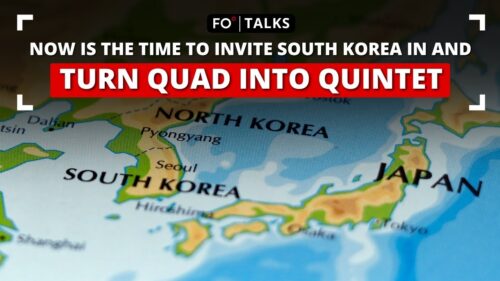
In this episode of FO° Live, FO° Editor-in-Chief Atul Singh speaks with Jaewoo Choo, a professor of Chinese foreign policy in the Department of Chinese Studies at Kyung Hee University, South Korea, and Haruko Satoh, a professor at the Osaka School of International Public Policy, Japan. The matter at hand is South Korea’s potential membership in the Quadrilateral Security Dialogue, or Quad.
The Quad is a grouping of four major Indo-Pacific democracies: the United States, India, Japan and Australia. It was relaunched in 2017 to counterbalance China’s growing influence by promoting a free and open Indo-Pacific through cooperation in security, infrastructure and trade.
Despite this ambition, the Quad faces significant limitations. Critics argue it remains a "talking shop," where dialogue seldom leads to concrete action. Additionally, some members have limited bilateral experience working together, which hampers effective collaboration.
South Korea was notably absent when Japan’s Prime Minister Shinzo Abe first conceived the Quad in 2007. Abe’s vision was geographically focused; he pictured a rhombus with its corners in Japan (north), Australia (south), the US (east) and India (west). The idea was to cover ground and secure critical shipping lanes. This left South Korea, located in the middle, outside the equation.
Yet, South Korea has considerable strengths. South Korea and Japan, are the only two economic powers in the region that can plausibly compete with China in building infrastructure rapidly and at scale. South Korea is also a strong defense partner of the US, with a technologically advanced military boasting half a million active personnel — ten times the size of Australia’s. Moreover, South Korea is a leader in global industries like shipbuilding, memory chips and electric vehicle batteries, making it not just a regional player but a global one. Most importantly and obviously, it is a vibrant democracy. For all these reasons, it merits membership in the Quad.
The broader context is the growing security threat posed by China, which seeks to control sea lanes in the East and South China Seas and use its economic power to influence its neighbors. While it makes sense for South Korea to join the Quad, it is unlikely to make provocative moves against China, its largest trading partner and greatest military threat, without a security guarantee from the US. Ultimately, the Quad (or Quint) seems destined to evolve into a military alliance.
[Anton Schauble wrote the first draft of this piece.]
[Note: This FO Talks/FO Live is part of the Osaka School of International Public Policy’s “Peace and Human Security in Asia: Toward a Meaningful Japan-Korea Partnership” project supported by the Korea Foundation.]
The views expressed in this article/video are the author’s own and do not necessarily reflect Fair Observer’s editorial policy.








































Comment