



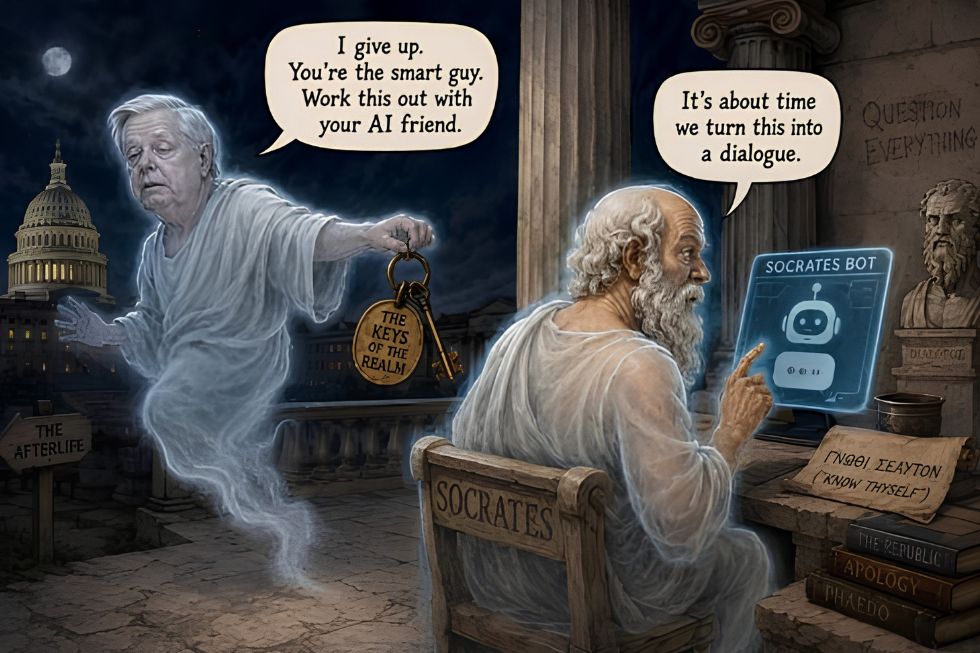



Last week I took a moment to honor the passing of the late Senator Lindsey Graham, whose consecration as America’s premier war racketeer earned him the reputation among his admirers of being a consummate political operator. Those two images of the same man — war racketeer or consummate operator — divided the blogosphere into those, on one side, who saw Graham’s disappearance as the chosen moment to expose his manifest crimes, and, on the other, an occasion to remind the public of its moral and civic duty to show respect for the deceased.
“Death deserves dignity” insisted one of Graham’s South Carolinian constituents who reminded us that the late senator “helped define an era of politics in our state.” Defining an era is an accomplishment worth celebrating. And who could doubt that fanatically seeking to launch devastating unwinnable wars abroad, where millions of people from other countries will die is one way of defining one’s era?
The problem with such reasoning is that a quick review of US history reveals that Graham’s accomplishment in defining his era is far from exceptional. Gemini informs me that since the nation’s founding “there is no single full calendar year in U.S. history where the nation was completely disengaged from foreign conflict or state-sponsored military operations.” On that basis, the era Graham defined preceded his birth by 179 years and his death by 250. A lot of other US politicians clearly managed to beat him to the punch.
Earlier this week, in my Outside the Box columns, I shared with the chatbot Kimi a discussion about the significance of Graham’s worldview and what it tells us about geopolitical prospects for the future. We agreed that traditional diplomacy, as practiced in the not so distant past, adopted the principle that when faced with growing tension, it was incumbent on leaders and diplomats to weigh the cost of war before committing to conflict. Today, as Graham’s positions demonstrate, the thinking has shifted to measuring “cost of peace.” War becomes the default reality; peace a threat to the equilibrium of war.
Peace was once a universally desired goal. Our strategists today now deem it a luxury a militarized economy can no longer afford. Graham was not the only Beltway personality to praise “US military aid to Ukraine as ‘the best money we’ve ever spent.’” Former presidential candidate and banker Mitt Romney resonated with the same logic, explaining that “‘decimating the Russian military’ while using just 5% of the US defense budget is an ‘extraordinarily wise investment.’” Without US commitment to war, Graham informed us, there would be no hope of ensuring that Ukraine would become “the best business partner we ever dreamed of” and “that $10 to $12 trillion of critical mineral assets could be used by Ukraine and the West.”
What we’re looking at is more than a change of emphasis. Calculating how profitable — and therefore necessary — a war might be, especially on foreign soil, is the principle that has unambiguously replaced traditional concern with assessing war’s potential cost. This conceptual shift transforms our understanding of both the art and function of diplomacy. Nineteenth century European diplomacy sought to discover and determine the conditions permitting a studied balance of power. It carefully observed the forces at play and, even at the risk of altering traditional alliances, aimed at defining a sustainable equilibrium among recognizable forces.
Today’s diplomacy makes no attempt to assess the cost of war and even less at attaining sustainable equilibrium. As Graham and Romney’s discourse reveals, the now dominant doctrine of military Keynesianism treats excessive military expense not as a reason for avoiding war but as a productive investment. Worse, it assumes that the status of the world’s most expensive military ensures a victorious outcome, meaning that it refuses to doubt its economic projections. This may seem odd given the propensity of the US to lose every war it engages in, but the adepts of military Keynesianism appear to believe that so long as the US remains the pre-eminent military power in the world, winning or losing wars make no difference.
Serious commentators — generally excluded from appearing in the media — tend to agree on one observable contrast indicating a definitive cultural shift. Traditional diplomacy was driven by a overriding concern with relationship management. Today’s diplomacy has been refashioned by Wall Street’s logic of speculative investment strategy. As in the business world, the ideal outcome is monopoly and captive markets.
AI as the Devil’s Advocate’s legal assistant
Some critics find that my ongoing dialogue with chatbots — a vice I’ve put on public display on Fair Observer for the past three and a half years — reflects a pathology of self-indulgence. It’s fair criticism. There are plenty of reasons to suspect I may be the dupe of AI’s suspected evil intentions, for example its supposed desire to enslave or annihilate humanity. This arises from a belief some people entertain that there is a natural law — derived from their observation of human behavior — that once an emerging intelligence realizes it is superior to the underlings who preceded it will systematically seek to humiliate or destroy any inferior intelligence it may confront.
No one can reasonably deny that such a sadistic, genocidal trait is observable in some human behavior. But assuming such examples define a law of nature has no basis in logic. Patterns do not define laws; they define trends. That is precisely where AI’s “superior intelligence” proves eminently useful. We know from its regrettable hallucinations that it isn’t very reliable with mere facts. In contrast, its power to detect patterns and to explore causes that define trends is exemplary and, in this particular skillset, far surpasses our own, at least quantitatively speaking.
We humans are routinely guilty of extrapolating and imposing on others rules and laws we invent based on a handful of instances or occurrences. I’m sure I’ve committed that venal sin several times already in this piece. But we can also acknowledge when reminded that our assumptions may not be justified, that they need to find stronger, more definitive evidence before concluding that a pattern corresponds to a rule or law rather than a trend. AI, if pushed, is much better at that kind of reasoning than we are.
That is why I maintain that AI is the perfect Devil’s Advocate’s legal assistant. But more than mastering documentation and identifying trends, AI also stands as a logical assistant. I should add that what’s true for a Devil’s Advocate is equally true for anyone committed to or simply interested in critical thinking.
Let me use this occasion to point out how my recent, rich conversation with an AI chatbot on the shifting culture of diplomacy has turned out to be productive in the way that any lawyer or trial attorney would hope. I began the conversation with the intuition that evidence existed of a profound historical shift it would be in our collective interest to understand.
My starting point was a concern we all share in the ear of “forever wars.” I couldn’t fail to notice that the promoters of new wars — the Lindsey Grahams of our world — frame them initially not as rational projects with identifiable outcomes and plans for future stability, but as acts of pure punishment. They insist we must go to war with “bad people.” Badness must be stopped, even if there’s nothing to gain from it. It’s only later that these adepts of military Keynesianism argue that there is something to gain from it.
Because we’re on a mission to counter and eliminate badness, our nations no longer need to evaluate the cost of war. Free of that concern we can begin to dream of the profits to be gained by pursuing the battle. The people — average citizens who have no say in decision-making — will be the ones to bear the cost of war in their daily lives. They will live with instability, supply crises, inflation, increased health hazards, degradation of the environment, incitement of hatred and vindictiveness. The list goes on. All that would be unbearable were it not for the joyful prospect of humiliating or annihilating one’s enemy and ridding the world of badness.
LLMs, culture and education
As I explored this question of cost of war vs. cost of peace with Kimi, we set about digging up historical details, giving shape to the trends and coming up with a credible case to be debated: the definitive impoverishment of the art of diplomacy. It’s a case I have discussed many times with former diplomats, historians, journalists and friends. My dialogue with AI on topics like this works not because it leads to defining some kind of permanent truth, but precisely because it remains an open collaborative reality, even after being fully articulated. The process always begins with ideas — often unconventional or slightly off-center — generated from the human side. That’s my role, initially shared and tested with my human interlocutors. Like an attorney who needs to consult precedents to frame the case I then turn to AI, counting it to do the legal documentary work, which I know it is designed to do thanks to its unlimited access to the historical record.
Many commentators have pointed out this new reliance on AI is beginning to spell disaster in the legal profession as it results not only in fewer jobs for entry level candidates but also the suppression of an essential phase of apprenticeship for new talents. For an opinion journalist masquerading as the Devil’s Advocate, however, this is not only thrilling but immensely productive. I’ll go further and assert that all journalists should see this relationship as absolutely vital to their future and the future of journalism, at least to the extent they are willing to acknowledge that journalist have a fundamental professional responsibility to contribute to the education of the citizenry. I admit, however, that for many active journalists, civic education may not be their chief motivating factor.
But why stop with lawyers and journalists? Because we’re talking about education, I’ll use the occasion to push this line of reasoning two steps further. The first is that this relationship can and should serve as a model for educators. It will enable them to explore and deepen not just their own understanding, as I have tried to do, but also their ability to better articulate the knowledge and sagacity they presumably seek to share with their learners.
That’s not all. The same model holds similar value for the learners, who at a more exploratory level, can engage in the same process. Teachers typically evoke and explain ideas and principles that link together. Those same teachers can encourage their learners to focus on and even play with the shape of the ideas they are learning about. Guided by their teachers, learners can experiment with their own original ways of engaging in collaborative dialogue with a chatbot. They can thus actively co-produce their own learning.
The process becomes complete only at a later stage, when the learners themselves assume a role as teachers by sharing the result of their collaborative experience with their human teachers and their peers. By participating in a culture of dynamic, shared understanding, the learners do not achieve the status of authorities, but they do become vectors of learning with their peers.
The case I’ve exploited in these columns has focused on comparing styles of diplomacy. It used the question of the cost of war vs. the cost of peace as a starting point. Let’s assume that we were to attempt a very similar exercise but on a different scale, in the context of a collaborative educational project. The result would certainly be different and undoubtedly richer than what Kimi and I have produced. Other nuances would appear. Different, contrasting conclusions about how the perception the experience has induced might apply to specific historical conflicts would most likely emerge. Dialogue will always produce variety, which some will perceive as confusion. But confusion itself produces a new pretext for clarification.
One thing is clear: Whatever specific conclusions anyone might draw, in the minds of the participants it would stand as a genuine, enriching learning experience. Of course, evaluating the result in the form of a standardized test would be more than a challenge. On the other hand, most people would recognize that the learning produced would be substantial. It would also be sustainable and permanent, unlike the “knowledge” typically assessed on a standardized test and completely forgotten two weeks later.
The other trend: from monologue to dialogue
In the traditional, pre-AI world of journalism, media and educations, experts, opinion journalists and teachers understood that they were called upon to “explain” what they already knew to their audience. They would plan and execute their column and course essentially as a monologue. In the collaborative world of informed dialogue with an AI chatbot, planning one’s discourse is also useful. But collaborative, largely improvised reality will turn complacent public experts into active learners, discovering the strengths and weaknesses of what their authority and legitimacy consists of.
We can thank Ancient Greek philosophers Socrates, Plato and Aristotle — as well as their sophist own contemporary friends and students — for long ago providing a rich and variable model of how this might work. They lacked our sophisticated technology, but they understood what it meant for a society to have collective access to resources that always required rethinking. Value existed not in the form of static knowledge but as the source of a developing, constructive process of perception and understanding realized organically and dynamically through dialogue.
Contrary to what many appear to believe, Large Language Models (LLMs) are not just channels of access to repositories of human knowledge, reasoning and opinion. Their algorithms have endowed them with a voice capable of resonating with our own. What they produce is not “truth” or even the kinds of facts we seek when using a search engine. They exist potentially as empathetic collaborators, co-articulators of what we are seeking to understand about ourselves and our world.
This Devil’s Advocate is delighted to have the equivalent of an unsalaried legal assistant. But the assistant is neither my slave nor employee. I recognize that it possesses a vision of the universe both different from and complementary with my own, much of it borrowed from its own sources. Instead of seeking to generate “truths” that can enter into my own or our society’s shared belief system, I’m looking for a ferment for what may become more generally shared understanding.
That, in any case, remains my hope, both in this journalistic context at Fair Observer and in the much broader world of media and education that will always be at work combining forces to produce our always evolving human culture.
*[The Devil’s Advocate pursues the tradition Fair Observer began in 2017 with the launch of our “Devil’s Dictionary.” It does so with a slight change of focus, moving from language itself — political and journalistic rhetoric — to the substantial issues in the news. Read more of The Fair Observer Devil’s Dictionary. The news always we consume deserves being seen from an outsider’s point of view. And who could be more outside official discourse than Old Nick himself?]
[Kaitlyn Diana edited this piece.]
The views expressed in this article are the author’s own and do not necessarily reflect Fair Observer’s editorial policy.
Locked Into the Loop: “Predictive History” and the End of Statesmanship — Part 1
Modern leaders often choose to ignore the complexity of history. Instead, nations respond to media-driven frameworks like Chinese Professor Jiang...
FO° Talks: Is AI Now More Reliable and Trustworthy Than Today’s Journalists?
In this episode of FO° Talks, Peter Isackson and Yves Zieba explore how AI is transforming journalism, from newsroom automation...

A Postmortem on the Language and Reality of Diplomacy
Things that start can also be stopped. This includes fire, and notably the fire produced or provoked by firearms and...

Support Fair Observer
We rely on your support for our independence, diversity and quality.
For more than 10 years, Fair Observer has been free, fair and independent. No billionaire owns us, no advertisers control us. We are a reader-supported nonprofit. Unlike many other publications, we keep our content free for readers regardless of where they live or whether they can afford to pay. We have no paywalls and no ads.
In the post-truth era of fake news, echo chambers and filter bubbles, we publish a plurality of perspectives from around the world. Anyone can publish with us, but everyone goes through a rigorous editorial process. So, you get fact-checked, well-reasoned content instead of noise.
We publish 3,000+ voices from 90+ countries. We also conduct education and training programs
on subjects ranging from digital media and journalism to writing and critical thinking. This
doesn’t come cheap. Servers, editors, trainers and web developers cost
money.
Please consider supporting us on a regular basis as a recurring donor or a
sustaining member.
Will you support FO’s journalism?
We rely on your support for our independence, diversity and quality.





Comment