Get Our Free ePublication Now
We publish monthlies, yearbooks and more to inform and educate our global community. Escape algorithms driving you to echo chambers and see through the eyes of our 3,000+ authors from 90+ countries. Make sense of the world one perspective at a time.
Complete the form below to download your free copy of Fair Observer Monthly: July 2026 now.
What We Cover in This ePublication
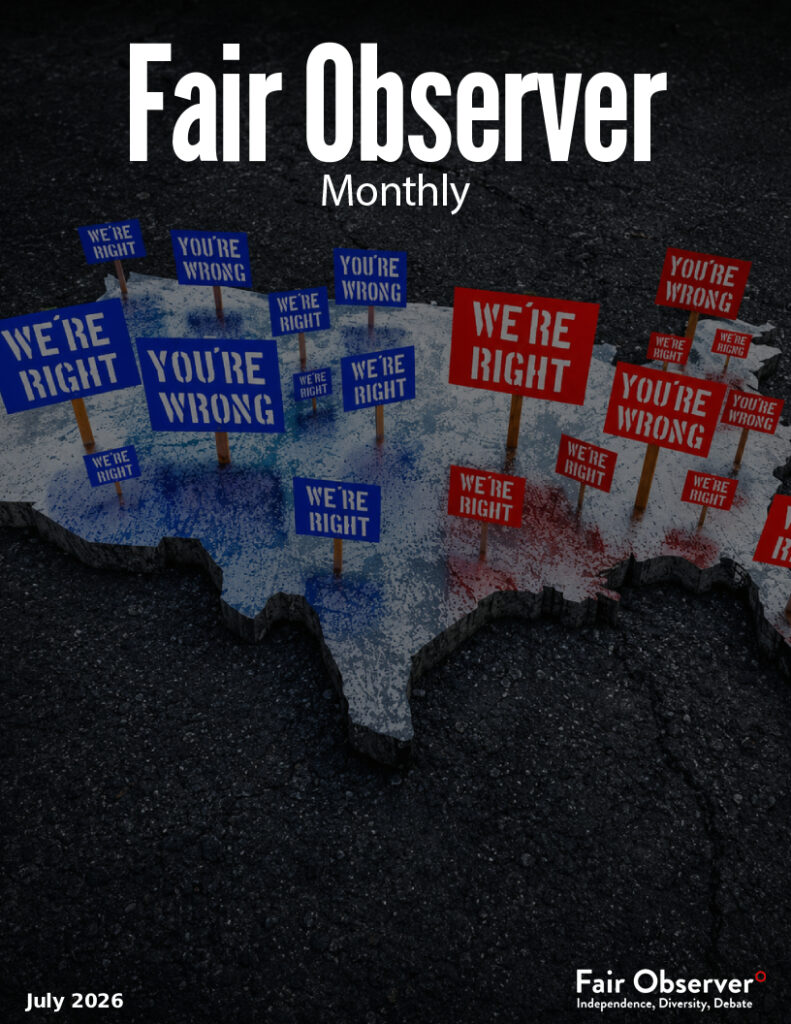
Our e-magazine, Fair Observer Monthly, enables you to take stock of our ever-changing world one month at a time. We compile 15 of our best original articles from the past month for you. In keeping with our ethos, we bring you insights from diverse voices around the world on a multitude of subjects. Our goal is to give our FO° Community a snapshot of the past month. The perspectives in our monthly will inform and educate you. They will take you away from echo chambers, and you will disagree with some. For the discerning reader, Fair Observer Monthly is a good way to make sense of the world at a time of polarization, sensationalism and fake news. So, download our monthly now.
The July Fair Observer Monthly examines how technological change is reshaping society, often in unsettling ways. Chief Strategy Officer Peter Isackson explores the growing conflict between AI and education, asking whether AI-assisted cheating reflects a deeper failure of modern schooling. Resident sociologist Ellis Cashmore warns that AI-powered smart glasses threaten to erase the remaining boundaries of personal privacy, while global business leader Usama Malik examines how technological change and opaque corporate decision-making enable corruption and leave the public bearing the costs. Biophysicist William Softky offers a more philosophical perspective, using Pope Leo’s encyclical Magnifica Humanitas to reflect on the importance of authentic, embodied relationships in an increasingly digital world.
The US was also a major focus this month. Focusing on the country’s 250th birthday, entrepreneur and foreign policy analyst Emma Isabella Sage exposes the divide in American identity and the tension between loyalty to one’s country and moral responsibility. American educational technologist Steve Foerster also reflects on America 250, bringing attention to the country’s flawed system of “liberty for some” rather than “liberty for all.” Both Isackson and Elliot Neaman, a professor of European intellectual history, reflect on US Senator Lindsey Graham’s life and legacy in the wake of his death. Isackson examines Graham as a symbol of the enduring relationship between war and political power, while Neaman assesses Graham’s long political career and the costs of pursuing influence. Former CIA officer Glenn Carle and Fair Observer Editor-in-Chief Atul Singh analyze the strategic consequences of the so-called US–Iran memorandum of understanding, arguing that it favors Iran and fails to achieve American objectives.
Politics, climate and generational change
The monthly covers other regions as well. Europe attracted attention: Kent Jenkins Jr. explores how Andy Burnham, the new British prime minister, has forged a distinctly local brand of populism, while Francesca Collu examines how extreme temperatures in Europe have become the new normal as climate change accelerates. Farther east, Vasavi Seethepalli analyzes India’s Generation Z-driven Cockroach Janta Party movement and questions whether India’s leadership will finally address the generational reckoning at the heart of the uprising.
In the Western Hemisphere, Brazilian journalist Luiz Cesar Pimentel looks beyond refugee statistics to reveal the human stories and geopolitical forces driving displacement of millions. Venezuelan academic Leonardo Vivas assesses his country’s difficult recovery following the devastating June earthquakes during a fragile political transition. Farther north, retired librarian Margaret Smale critiques Alberta’s new book-banning policy, arguing that restrictions on classroom reading threaten intellectual freedom and undermine students’ ability to engage with diverse ideas and perspectives.
But before you read on, we must ask: Do you value independent journalism, free of billionaire owners filtering the news through their agendas? Do you appreciate Fair Observer’s mission to keep dialogue and debate free and uncensored? Do you want benefits that make our site a better user experience?
If yes, please consider donating below. For a one-time or, ideally, recurring payment, you can keep free, fair and independent Fair Observer chugging along. By becoming a sustaining member, you will be able to bookmark pieces, leave comments, engage in discussions and more. So, sign up today.
Note: We are a section 501(c)(3) nonprofit registered in California, and our EIN is 46-4070943. If you pay taxes in the US, your donation is tax-deductible.
Content of Publication
Book Banning, Alberta Style: Censorship in the Classroom – Margaret Smale
Venezuela: The Tortuous Road After the June Earthquakes – Leonardo Vivas
Andy Burnham and “Manchesterism”: The New Face of Populism? – Kent Jenkins Jr.
How Pope Leo Turned Out to Be the Greatest Physicist – William Softky
Celebrating 250: America’s Two Visions of Liberty – Steve Foerster
The End of the Negotiation: The Public Bears the Cost of Corruption – Usama Malik
FO Exclusive: Iran Trumps Trump in New Art of the Deal – Glenn Carle, Atul Singh
Lindsey Graham: Requiem for a War Racketeer – Peter Isackson
The Picture Behind the Numbers: Refugees, Power and the Human Cost of Geopolitics – Luiz Cesar Pimentel
Will the Gen Z-Fueled CJP Achieve What It Set Out To Do? – Vasavi Seethepalli
Lindsey Graham’s Legacy and the Price of Relevance – Elliot Neaman
America: My Country, Right or Wrong? – Emma Isabella Sage
Summer in Europe: Hotter Than Yesterday, Colder Than Tomorrow – Francesca Collu
AI, Cheating and Teacher Trickery: Is This Modern Education? – Peter Isackson
From X-Ray Specs to AI-Powered Glasses: The End of Privacy? – Ellis Cashmore