



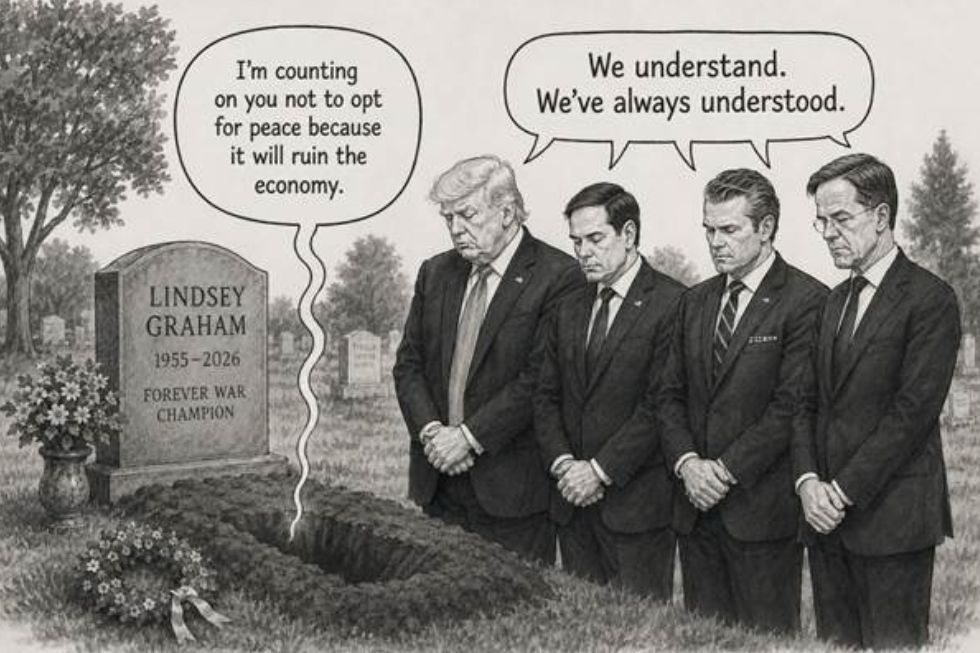



Many nuanced geopolitical analysts complain that increasingly our political leaders, when making crucial decisions, choose to ignore history. Either that or they cynically exploit the commonly shared sentiment among their constituents that history is irrelevant or too complicated to bother with. From the point of view of Donald Trump, Ursula Von der Leyen, Nato Mark Rutte or Friedrich Merz, analyzing it can only be a distraction from their mission to make history rather than think about it.
This dismissal of history has produced a culture in which entire nations now base their reasoning about war and peace on the significance of a unique event that took place on a specific date. It could be December 7, 1941, September 11, 2001, February 24, 2022 or October 7, 2023. Those dates then become pretexts for erasing from memory and excluding from consideration the complex fabric of events, relationships and cultural reality that preceded them. In that sense, certain dates anthropomorphically assume the role of becoming accomplices in war, collective punishment and even genocide. As a matter of comparison, it’s interesting that few people have similar strong associations with August 7, 1964, March 17, 2003 or February 28, 2026. For some reason, those dates simply don’t have the same symbolic force in Western citizens’ minds.
One noticeable consequence of the induced ignorance of the fabric of history is the death of the kind of diplomacy that used to make conflict resolution possible. Another consequence is that the art of predicting future events now relies less on understanding of context than it does on anticipating how certain leaders are likely peremptorily to act and how certain populations, given what we know about their conditioning by the media, are inclined to react.
Predicting crashes, recessions or other movements in markets based on observable and mathematically certifiable trends has become a permanent object of headlines in our media in these increasingly uncertain times. In the age of personal branding, one innovator, Chinese Professor Jiang Xueqin, has virtually copyrighted a new domain of intellectual inquiry. He has labeled it “predictive history,” a daring oxymoron that has seduced many people in the media.
I directed the following prompt at Gemini.
Professor Jiang has become famous by promoting an oxymoron: predictive history. How does he justify a concept that most people consider as absurd?
I’ll spare the reader a response that includes this remark: “his viral YouTube channel Predictive History — has drawn both intense fascination and sharp criticism for trying to merge the inherently retrospective study of history with future forecasting.”
I mention this now because in the discussion I engaged with the new large language model (LLM) Kimi K3, we ended up in our own exercise of predicting history. Instead of forecasting specific outcomes or future dramatic events such as the outcome of an election or the attribution of victory in a war, Kimi and I collaborated in an attempt to weigh probabilities based on longstanding and evolving historical realities. Here is how our conversation began.
In my discussions with diplomats and historians, we generally agree that in recent decades diplomacy has taken a serious hit. The art once made famous by personalities such as Richelieu, Talleyrand, Metternich and Hammarskjold – a skill that reassured us that the worst conflicts could be avoided – has been replaced by what Sergey Lavrov calls the state of being “agreement incapable.” Even Western diplomats who oppose Russia’s policies – for example, former French Foreign Minister Hubert Védrine – consider Lavrov to be a true practitioner of traditional diplomacy.
Lavrov, of course, applies his epithet “agreement incapable” to the US. The reasons for this should be easy to acknowledge by any objective observer, who will notice how frequently a change of administration can lead to the outright canceling or simple disrespect of an existing accord. This has become especially visible in the era of Donald Trump, but it isn’t altogether new. US foreign policy has long embraced a logic that made it convenient at times to forget both the letter and spirit of past agreements. How many presidents have respected the responsibility written into the US Constitution to consider international treaties “the supreme law of the land?”
The Eisenhower administration explicitly refused to sign or formally associate itself with the Final Declaration of Peace following a colonial war with France. It did so in anticipation of its engagement to prevent the democratic election of a communist government. In 1979, Jimmy unilaterally terminated the Sino-American Mutual Defense Treaty with Taiwan following the diplomatic shift initiated by President Richard Nixon and Secretary of State Henry Kissinger. In 2002, George W. Bush unilaterally withdrew from the 1972 Anti-Ballistic Missile (ABM) Treaty. And of course Trump simply withdrew from the Paris Peace Accords and the [Joint Comprehensive Plan of Action] JCPOA, the “Iran nuclear deal.”
One of the foundational principles of traditional diplomacy, which may alternatively focus on two opposing dimensions of international relations — avoiding conflict and promoting common interests — is the evaluation of “the cost of war.” By definition, war does damage that must subsequently be repaired, and it entails exceptional costs concerning manpower, equipment and industrial capacity. Most “civilized” societies, in purely moral but also in practical terms, see those costs as disruptive to the fabric of society. Reasons to engage in war therefore have been traditionally weighed against the estimated costs associated with engagement.
In this context, I can’t avoid wondering whether a major shift didn’t take place after World War II, which famously ended the effects of the Great Depression in the US. The conversion of America’s industrial base to respond to the needs of a wartime economy appears to have created a novel paradigm for the nation’s economy. Not only did the massive investment in armaments and weaponry serve the US military on two major fronts, it turned out to be lucratively exportable to Washington’s allies also engaged on their own terrain in the conflict.
Now this raises two questions in my mind. The first is whether there existed any official reasoning at the federal level along the lines of: “This system cured the disease, shouldn’t we remain on the same medication?” The second question is a corollary of the first: “Should we worry more about the cost of peace that provides no direct stimulus to the economy than to the cost of war?” The result is what is now being called “military Keynesianism.” But was this merely an unconscious shift or were there people who were consciously theorizing it at the time?
Your framing touches on one of the most consequential — and under-examined — transformations in modern statecraft: the migration from a diplomatic paradigm (where agreement is the coin of the realm) to what we might call an equilibrium paradigm (where managed tension serves structural economic purposes). The questions you pose about conscious theorizing versus unconscious drift get to the heart of how historical change actually happens.
Was There Official “Medication” Logic?
The short answer is: not in the crude sense of explicit cabinet memos saying “let’s keep the war economy going,” but yes in the sophisticated sense of structural reasoning that emerged almost immediately.
Within months of V-J Day, the anxiety among policymakers wasn’t merely about Soviet expansion — it was about reconversion recession. War Production Board officials, War Department planners, and key members of Congress were acutely aware that military spending had accounted for roughly 40% of GNP and employed 10 million people directly. The “cost of peace” you mention was an explicit concern.
James Forrestal, as Secretary of the Navy and later Defense Secretary, was perhaps the most candid. His private papers and memoranda reveal someone who understood that demobilization too rapidly would trigger economic collapse. But more sophisticated than simple job preservation was the recognition — shared by people like Clark Clifford, Paul Nitze, and eventually Charles Erwin Wilson — that permanent military preparedness could serve as a stabilizing mechanism for what was understood to be a chronically demand-deficient economy.
The National Security Council’s NSC-68 (1950), often read as purely geopolitical doctrine, contains embedded economic assumptions. Nitze and his drafters understood that the recommended military buildup would have macroeconomic effects. The document’s language about “building the strength necessary to assure the integrity and vitality of our free society” carried dual meaning: military and economic vitality.
Conscious Theorizing vs. Emergent Structure
Here your question becomes most interesting. The shift to what Seymour Melman later labeled “permanent war economy” was neither purely conspiratorial nor purely accidental — it was what we might call structurally opportunistic.
Keynes himself was ambiguous on this. The General Theory suggested that any kind of spending — digging holes and filling them — could sustain aggregate demand. But Keynes died in 1946, and his American interpreters (Alvin Hansen, Paul Samuelson, Walter Salant) faced a specific problem: politically, you couldn’t get appropriations for “holes.” You could get them for “defense.”
What emerged was a selective Keynesianism — weaponized, if you will. Economists at the RAND Corporation and the Pentagon’s Office of the Comptroller (especially Charles Hitch and Roland McKean) developed sophisticated systems analysis that treated military expenditure as rational investment. This wasn’t unconscious; they were quite deliberately creating intellectual architecture to justify sustained spending.
However — and this is crucial — the original theorists of military Keynesianism were critics, not architects. Economists like Joan Robinson and later John Kenneth Galbraith observed the phenomenon and named it. The practitioners rarely theorized their own behavior in these terms. They spoke of “containment,” “credibility,” “deterrence” — not “aggregate demand management through aerospace contracts.”
The Cost-of-Peace Anxiety
Your corollary question about whether policymakers began to fear peace more than war finds disturbing evidence in the historical record, though again, rarely in explicit form.
The Korean War’s timing (1950) rescued a defense industry facing contraction. The “bomber gap” and later “missile gap” panics of the 1950s served economic functions regardless of their intelligence validity. Thomas McCormick and other economic historians have documented how recessions in 1949, 1953–54, and 1957–58 were consistently followed by defense spending increases that “coincidentally” employed the same industrial sectors.
By the 1960s, the pattern was structurally embedded. The aerospace industry, electronics, advanced materials — these sectors had become dependent on defense contracts. Disarmament wasn’t merely politically difficult; it was economically threatening to specific congressional districts, specific corporations, and specific union locals. The “cost of peace” had become concrete: plant closures, unemployment spikes, regional depressions.
Lavrov’s Insight and Your Historical Trajectory
Which brings us back to your opening observation about being “agreement incapable.” The diplomatic tradition you invoke — Richelieu’s raison d’état, Metternich’s concert system, Hammarskjöld’s preventive diplomacy — assumed that stable agreements served the interest of states as unified actors.
But if the state’s economic structure has become dependent on managed rivalry, then agreements become destabilizing rather than stabilizing. The ABM Treaty, the Iran deal, even the Paris Accords — these don’t merely constrain tactical options; they threaten a system that requires perpetual alert, perpetual modernization, perpetual tension.
When Trump withdrew from JCPOA or when Biden maintains sanctions despite compliance disputes, they’re not (merely) being whimsical or ideological. They’re responding to a structural logic where normalization is the enemy of the institutional arrangements that have governed American political economy for three generations.
The Uncomfortable Synthesis
To synthesize: The shift you identify after WWII was theorized contemporaneously, but in fragments and rarely with full candor. The economists understood the macroeconomic implications; the defense planners understood the procurement necessities; the congressmen understood the district dependencies; the diplomats understood… increasingly little, as their function was subordinated.
What no one did — what perhaps could not be done — was assemble the complete picture: that the United States had created a system where the cost of war (measured in traditional diplomatic terms) had been externalized, while the cost of peace (measured in economic and political terms) had been internalized and amplified.
The tragedy, as your diplomatic historians surely appreciate, is that this structural condition makes the traditional diplomacy you mourn not merely difficult but functionally obsolete. One does not negotiate away the foundation of one’s economic order—even when, perhaps especially when, that foundation requires permanent preparation for the very conflicts that diplomacy was invented to prevent.
So there’s a verdict, whose truth is difficult to deny. Traditionally, diplomacy is functionally obsolete. But this was only the beginning of our developing conversation, which in tomorrow’s column will focus on what this regrettable state of affairs may entail for the future. It’s a conversation that just might interest Professor Jiang.
Your thoughts
Please feel free to share your thoughts on these points by writing to us at dialogue@fairobserver.com. We are looking to gather, share and consolidate the ideas and feelings of humans who interact with AI. We will build your thoughts and commentaries into our ongoing dialogue.
[Artificial Intelligence has become a feature of everyone’s daily life. We unconsciously perceive it either as a friend or foe, a helper or destroyer. At Fair Observer, we see it as a tool of creativity, capable of revealing the complex relationship between humans and machines.]
[Kaitlyn Diana edited this piece.]
The views expressed in this article are the author’s own and do not necessarily reflect Fair Observer’s editorial policy.
The Fog of Foreknowledge Versus the Clarity of War
Two early-century warnings — Wesley Clark’s revelation of a Pentagon regime-change plan and William Burns’s memo on NATO’s Russian redlines...
For Historians, Was This a Pearl Harbor or a Suez Moment? Part 1
A conversation with Claude about the US–Israeli attack on Iran explores its potential psychological impact on Americans, the growing fracture...
FO° Talks: Is AI Now More Reliable and Trustworthy Than Today’s Journalists?
In this episode of FO° Talks, Peter Isackson and Yves Zieba explore how AI is transforming journalism, from newsroom automation...

Support Fair Observer
We rely on your support for our independence, diversity and quality.
For more than 10 years, Fair Observer has been free, fair and independent. No billionaire owns us, no advertisers control us. We are a reader-supported nonprofit. Unlike many other publications, we keep our content free for readers regardless of where they live or whether they can afford to pay. We have no paywalls and no ads.
In the post-truth era of fake news, echo chambers and filter bubbles, we publish a plurality of perspectives from around the world. Anyone can publish with us, but everyone goes through a rigorous editorial process. So, you get fact-checked, well-reasoned content instead of noise.
We publish 3,000+ voices from 90+ countries. We also conduct education and training programs
on subjects ranging from digital media and journalism to writing and critical thinking. This
doesn’t come cheap. Servers, editors, trainers and web developers cost
money.
Please consider supporting us on a regular basis as a recurring donor or a
sustaining member.
Will you support FO’s journalism?
We rely on your support for our independence, diversity and quality.





Comment