



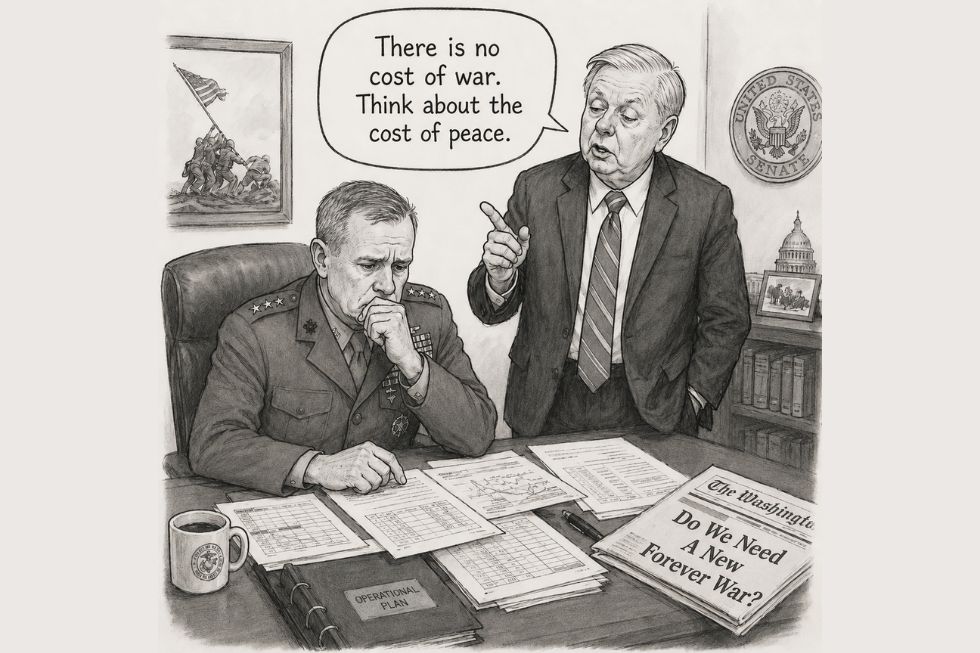



Last week South Carolina’s Senator Lindsey Graham returned from a brief trip to his beloved Ukraine, a country whose rare earth resources he once famously valued at more than $1 trillion, believing them to be his and his nation’s birthright. Though he apparently shared with intimates the fact that he was feeling ill upon arrival in Washington, he bravely dismissed their recommendations of seeking urgent medical care. He was keenly aware of the importance of remaining available for a planned interview on Sunday’s Face the Nation, in which he intended to bring home encouraging news from the front.
Having spent some time examining a drone manufacturing facility while hobnobbing with “President” Volodymyr Zelenskyy, Graham was undoubtedly keen on revealing the evidence proving that thanks to a new generation of weapons Ukraine was now, for the first time, poised to wipe everyone’s common enemy, Russia from the Eurasian map, an ambition he had often salivated for in the past. (It was out of journalistic rigor that I added quotes to Mr. Z’s title in acknowledgement of the fact that for the past two years he has remained in office not as Ukraine’s elected leader but by virtue of martial law. Polls indicate he would be likely to lose a new election, were he tempted to call one and run).
Alas, the senator from South Carolina’s availability for television was interrupted by an unfortunate, unplanned encounter with the Grim Reaper. The fact that he was a mere 71 – nine years younger than his most recent political idol whom he once claimed was unfit for public office – has shocked the world and the media, who shamelessly remind us of our obligation to show respect to a man who proved himself a masterful political operator.
Even before Trump himself – the ultimate operator who proved that presidents could earn billions while in office rather than waiting for the glory and riches that would be heaped on them once they’ve retired – Graham demonstrated what it means to be an effective political personality in US politics. First, establish your presence in the media. Then intervene endlessly to denigrate anything that doesn’t flatter your own image.
For many, Graham’s clairvoyant description of Trump in 2016 revealed his capacity to see and express the truth: “What I see is a demagogue, somebody that has solutions that will never work, that is playing on people’s prejudices and the dark side of politics.” His subsequent loving embrace of a man specialized in bankrupting casinos who had masterfully attained the summit of political power revealed not only Graham’s political astuteness, but also the deepest secrets of the unique operating system that drives the 21st century US republic in the name of democratic capitalism. Principle number 1: follow the money that defines power. Then immediately align with the power and profit from money it generates. Finally, worship both as quasi-religious idols.
The fact that Graham appeared to be in good health while cavorting in Kyiv two days before giving up the ghost has led some to speculate about Russian (Iranian or Israeli) malfeasance, or some other sinister scenario. When a good man goes down, someone must be blamed. Fate, providence or medical reality cannot compete with the need to find an interested culprit. And in cases like this – unlike the JFK, MLK or Charlie Kirk murders – it can’t be a lone gunman. When a “true patriot” dies unexpectedly it has to be the work of a political operator, just as clearly as it we should never suspect a political operator in those other killings.
In the wake of Graham’s demise, the question of whether public etiquette requires highlighting the talents and masquerading the moral failures of a public personality who has just died seems to preoccupy a lot of people in the media. Those who quietly supported the bellicose positions Graham so brazenly and embarrassingly promoted have invoked the principle of respect for the recently deceased. Those who refuse to highlight Graham’s political skills do so for a specific reason: the man was an incorrigible warmonger.
Graham consistently expressed a point of view that urged the US to engage in wars with any nation that dared resist the US-Israeli mission to manage the world order. Whatever the conflict, the media could count on Graham to support just to prolong but to intensify any war already underway. Total annihilation of “disobedient” peoples stood as a guiding principle in Graham’s moral system. He wasn’t alone in that mindset. When Hillary Clinton laughingly commented on Libyan President Muammar Gaddafi’s fate, “We came, we saw, he died,” she revealed a very similar moral compass, despite party differences.
An echo of the 1930s
Very few Americans have even heard of a man who, a century ago, was once considered the nation’s greatest war hero, who had acted with bravado and distinguished himself in a series of foreign wars. His name was Smedley Butler. He fought for the US in the Philippines (1998-9), China during the Boxer Rebellion (1900), Veracruz, Mexico (1914), Haiti (1915) and France in World War I (1918). He rose to the rank of Major General and was the most decorated Marine of his era. Had Lindsey Graham lived at the time, there can be no doubt the now deceased Senator would have militated for all of those wars, which inaugurated the era of US imperial expansion. Graham’s creativity would certainly have led him to identify other potential battlefields that he would like to see US soldiers– certainly not himself or his children (since he has none) – die in for the sake of however many trillions of dollars the control of their economies might eventually bring to the US.
Lindsey Graham was no innovator. He simply excelled at prolonging the great national tradition of using the American eagle deadly talons to threaten and then perpetrate the violence so capably carried out by loyal soldiers like Butler, all in the name of establishing a stable, functioning order. American businessmen and politicians like Graham already existed in Butler’s day. Just like Lindsey, they cultivated the art of putting pressure on leaders, the military and the media to push for the next war. When Butler woke up to notice how he and his troops had been thrown in harm’s way to fulfill their agendas, he published his embarrassing truth-telling book with a simple thesis summed up in it’s title: War is a Racket.
It’s because of that book and Butler’s daring honesty that his name has since disappeared from US history classes. The details of his career he exposes in his book are of no interest to “official” historians, and especially the media. Nor are they curious about the dramatic episode that began in 1933 when a group of American businessmen and financiers, enamored of fascism attempted to recruit Butler to replace President Franklin Roosevelt in a coup that’s known as “The Business Plot.” Had Graham been alive at the time, he would have at the very least encouraged, if not joined the plot.
The conspirators apparently were so deeply upset about Roosevelt’s reform effectively moving away from the gold standard and his “socialistic” policies benefitting the poor that they deemed it worthwhile to contravene the US constitution by replacing a sitting president. As citizens whose fundamental right is to speculate on markets, they couldn’t abide the idea of taking the civilian economy off the gold standard. As businessmen they clearly understood how annoying it might be for the government to meddle with the flexibility of the labor pool by offering support to those who struggle. Lindsey Graham has consistently shown the same high-level concern for private business interests and studied indifference to the cost of conflict or economic crisis on the lives and well-being of ordinary people.
Should believers in the value of diplomacy mourn warmongers?
One of the foundational principles of traditional diplomacy, which may alternatively focus on two opposing dimensions of international relations – avoiding conflict and promoting common interests – is the evaluation of “the cost of war.” By definition, war does damage that must subsequently be repaired and it entails exceptional costs concerning manpower, equipment and industrial capacity. Most “civilized” societies, in purely moral but also in practical terms, see those costs as disruptive to the fabric of society. Reasons to engage in war therefore have been traditionally weighed against the estimated costs associated with engagement.
Lindsey Graham’s reasoning when speaking about any existing or prospective conflicts in which American forces might be deployed has been consistently oriented in the direction of “more is better.” In the final analysis, Graham’s intuition and his deepest conviction correspond perfectly to a trend no one seems to want to acknowledge, at least publicly. Though contrary to the tradition that focused on analyzing the cost of war, his reasoning begins with a reflection on “the cost of peace.” Allowing other nations in the world to determine what is in their best interest rather than what aligns with Washington’s and Wall Street’s goals, will in the end prove costly.
For foreign policy strategists like Graham, the Ukraine war isn’t about NATO expansion or a Russian perception of an existential threat. It isn’t about preserving democracy in a nation run by oligarchs presiding over a system of organized corruption. It’s about access to Ukraine’s resources and strategic position on the Black Sea. It’s also about Zbigniew Brzezinski’s conviction that controlling Ukraine was the key to preventing Russia from becoming the dominant power in Eurasia.
The Israeli-US undeclared war on Iran – just like George W Bush’s 2003 war on Iraq – has never been about the usually cited causes: liberating women trapped in Sharia law, preventing terrorist nations from acquiring nuclear weapons or deposing an abusive tyrant. Both military campaigns that clearly violated international law were aimed at one thing: taking over the West Asian fossil fuel economy and confiding the local management of affairs to a consortium composed of Israel and Saudi Arabia, America’s always reliable allies. Exactly 20 years ago George Bush’s Secretary of State Condoleezza Rice revealed the vision when she spoke of the “birth pangs” of a new Middle East.
The cost of peace with Iran was too high. Since at least the 1950s Lindsey Graham’s nation has exercised the noble responsibility of maintaining the military-industrial complex (MIC) so usefully delineated by President Dwight Eisenhower three days before leaving office. If there are no wars, the system that props up the entire economy – notably by gifting the fruits of military research to private investors to meet the needs of the consumer society– loses its bearings. Imagine what might happen if peace were to become America’s default position. Chaos would ensue.
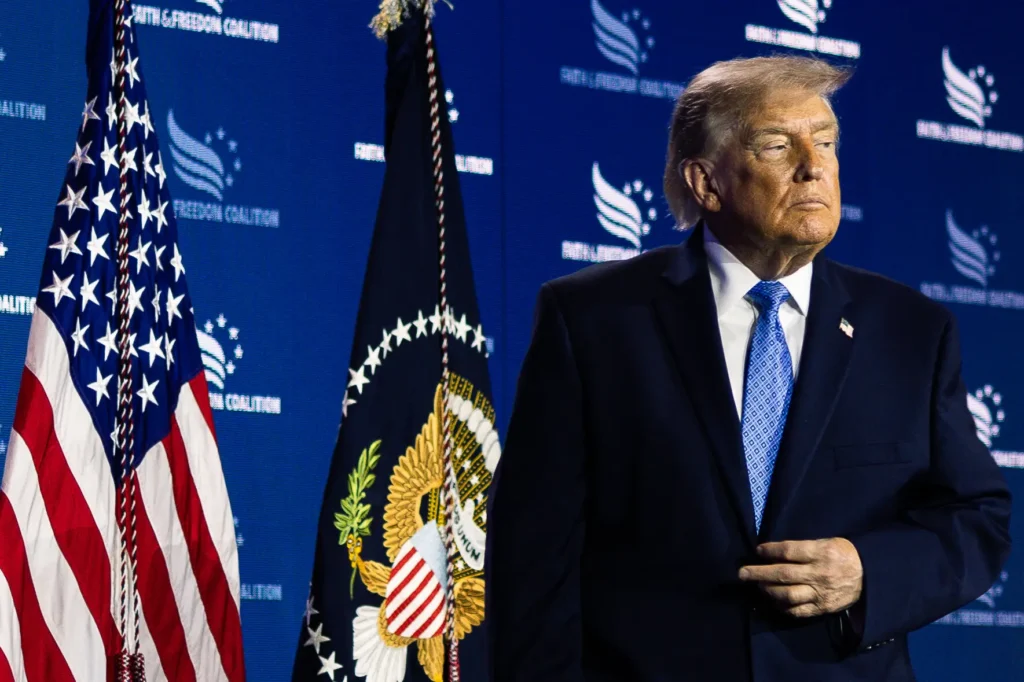
Sadly, a great warrior habituated to visiting battlefields from a safe distance, a man committed with every fiber of his being to impeding the descent into the chaos of peace and common prosperity, has left us. But his legacy lives. No sooner did he exit the scene than his great (but formerly vilified) friend, Donald Trump, chose to honor his grave by escalating a war that might otherwise have faded for lack of momentum, leaving the nation with the terrifying task of managing the incalculable cost of peace.
*[The Devil’s Advocate pursues the tradition Fair Observer began in 2017 with the launch of our “Devil’s Dictionary.” It does so with a slight change of focus, moving from language itself – political and journalistic rhetoric – to the substantial issues in the news. Read more of The Fair Observer Devil’s Dictionary. The news always we consume deserves being seen from an outsider’s point of view. And who could be more outside official discourse than Old Nick himself?]
The views expressed in this article are the author’s own and do not necessarily reflect Fair Observer’s editorial policy.
Support Fair Observer
We rely on your support for our independence, diversity and quality.
For more than 10 years, Fair Observer has been free, fair and independent. No billionaire owns us, no advertisers control us. We are a reader-supported nonprofit. Unlike many other publications, we keep our content free for readers regardless of where they live or whether they can afford to pay. We have no paywalls and no ads.
In the post-truth era of fake news, echo chambers and filter bubbles, we publish a plurality of perspectives from around the world. Anyone can publish with us, but everyone goes through a rigorous editorial process. So, you get fact-checked, well-reasoned content instead of noise.
We publish 3,000+ voices from 90+ countries. We also conduct education and training programs
on subjects ranging from digital media and journalism to writing and critical thinking. This
doesn’t come cheap. Servers, editors, trainers and web developers cost
money.
Please consider supporting us on a regular basis as a recurring donor or a
sustaining member.
Will you support FO’s journalism?
We rely on your support for our independence, diversity and quality.





Comment