







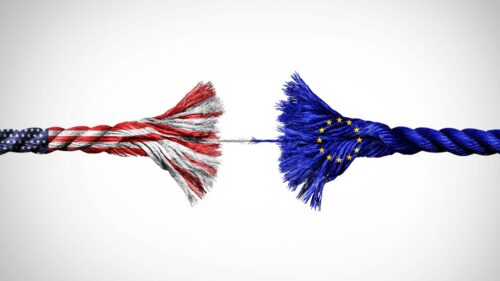
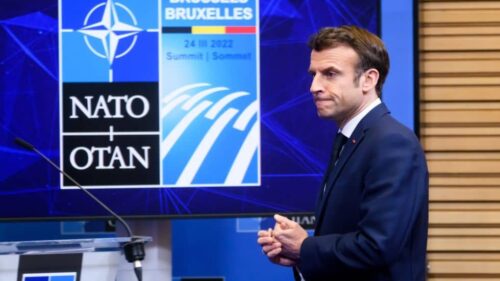
Editor-in-Chief Atul Singh hosts a discussion with former US Ambassador Gary Grappo, ex-CIA officer Glenn Carle and retired Royal Air Force officer Peter Hoskins to examine NATO’s uncertain future amid shifting American priorities, renewed European rearmament and Russia’s continued challenge to European security. While the alliance faces unprecedented political and strategic pressures, it remains essential to transatlantic security, though its members must prepare for Europe to assume greater responsibility for its own defense. The discussion explores how NATO must adapt to changing geopolitical realities without losing the institutional strengths that have sustained it for more than seven decades.
Trump accelerates NATO’s transformation
The discussion opens with the panel considering whether NATO has entered a fundamentally new era. Hoskins argues that calls for European allies to shoulder a greater share of the defense burden predate US President Donald Trump, but Trump’s confrontational style has dramatically altered the political atmosphere surrounding the alliance. Hoskins believes the United States is likely to continue reducing its military commitment to Europe over time, regardless of who occupies the White House.
Grappo agrees that American administrations have long pushed for greater burden-sharing but contends that Trump’s unusually aggressive rhetoric has strained relationships between Washington and its allies. Even so, he maintains that NATO remains central to US national security and that congressional support and public backing make an American withdrawal highly unlikely. As he puts it, “The defense and the security of Europe is a core security interest of the United States.”
Carle argues that Trump’s approach reflects a longstanding isolationist tradition within American politics rather than an entirely new phenomenon. He suggests that the combination of domestic political shifts, China’s rise and Russia’s renewed assertiveness has forced NATO to confront structural changes that were already underway before Trump’s return to office.
Europe prepares for a larger security role
The panel next examines whether Europe can build a more independent defense capability while preserving NATO’s cohesion. Hoskins points to growing military cooperation through joint procurement projects, including surveillance aircraft, submarines and frigates, as evidence that European governments are strengthening their defense industries and operational coordination.
Simultaneously, he rejects proposals for a separate European defense organization outside NATO. He argues that duplicating NATO’s command structure would waste resources and create unnecessary complications given the alliance’s existing institutional framework and the participation of countries such as Canada and the United Kingdom. Every American commander within NATO is paired with a European deputy, which gives the alliance an established structure capable of adapting even if the US military presence gradually declines.
Turkey also features prominently in the discussion. Grappo describes Ankara as a “problematic member” whose strategic importance is matched by recurring political disagreements with other allies. While he views Turkey’s decision to abandon its Russian radar system as a significant diplomatic achievement, Grappo considers the renewed F-35 agreement less consequential than the political symbolism surrounding it.
Russia has restored NATO’s purpose
The conversation then turns to the strategic environment confronting the alliance. Carle argues that the Soviet Union’s collapse left NATO searching for a clear mission, but Russia’s invasion of Ukraine has effectively restored the alliance’s original purpose by reminding members of the importance of collective defense. Rather than rendering NATO obsolete, renewed Russian aggression has strengthened its relevance.
The panel also discusses the conflict involving Iran and the absence of meaningful NATO coordination. Grappo argues that European governments were justified in declining requests to support American operations near the Strait of Hormuz because they had not been consulted beforehand and modern coalition warfare requires months of military planning and diplomatic coordination. Hoskins recalls the extensive preparation required before coalition forces entered the Gulf War, emphasizing that multinational military operations cannot be assembled overnight.
The discussion also revisits France’s longstanding interest in greater European strategic autonomy. Hoskins argues that recent events have weakened support for an independent European defense structure because NATO already possesses the experience, command systems and institutional memory needed to coordinate collective security effectively.
Populism reshapes politics on both sides of the Atlantic
Beyond military questions, the panel explores how demographic and political change is influencing NATO’s future. Carle believes that right-wing populism in the US represents a reaction against decades of social, cultural and economic transformation rather than simply a foreign policy dispute. He believes these domestic tensions have contributed to the rise of a more nationalist outlook that questions traditional alliances while stopping short of predicting a permanent American retreat from Europe.
Hoskins identifies similar political currents across Europe, particularly in France, where far-right politician Marine Le Pen has broadened her appeal beyond immigration by attracting working-class voters affected by deindustrialization. He warns that a future French government could maintain NATO’s political membership while reducing its participation in the alliance’s integrated military command, echoing former French President Charles de Gaulle’s earlier policy.
The speakers argue that countries closest to Russia, including Poland, Finland and the Baltic states, remain deeply committed to NATO because they perceive a far more immediate security threat than many Western European countries.
Rearmament brings new opportunities and new challenges
The discussion concludes with Europe’s accelerating military buildup. The speakers highlight Germany's rapidly expanding defense budget, increased weapons production and plans to enlarge its armed forces as evidence that Berlin is assuming a greater leadership role within NATO after decades of restraint. Grappo argues that France, Italy and Spain must also increase their contributions if the alliance is to maintain credible deterrence.
Hoskins welcomes Germany’s renewed investment but notes that rebuilding military capability will require years of modernization after prolonged underinvestment. He also warns that expanding defense budgets will force difficult political choices as European governments balance military spending against popular social programs. “The higher the wall, the better the neighbor,” he recalls from a Russian military counterpart. Russia’s geopolitical ambitions continue to make NATO indispensable.
In closing, Carle suggests that emerging technologies such as drones may provide new opportunities for multinational cooperation by allowing European countries to develop joint capabilities without becoming trapped in longstanding industrial rivalries. Together, the panel concludes that NATO does not face imminent collapse but must adapt as both Europe and the US redefine their respective roles within the alliance.
[Lee Thompson-Kolar edited this piece.]
The views expressed in this article/video are the author’s own and do not necessarily reflect Fair Observer’s editorial policy.






























Comment