




Editor-in-Chief Atul Singh and Ben Freeman, co-author of The Trillion Dollar War Machine: How Runaway Military Spending Drives America into Foreign Wars and Bankrupts Us at Home, discuss US President Donald Trump’s proposed $1.5 trillion defense budget. Their conversation moves beyond headline numbers to examine threat inflation, the power of defense contractors and the mounting risks posed by America’s nearly $39 trillion national debt. At stake is military posture toward China and the long-term sustainability of the American state.
The 1.5 trillion-dollar question
Singh opens by noting that Trump has called for a $1.5 trillion military budget for fiscal year 2027, a figure endorsed by The Washington Post’s editorial board. Supporters argue that as a percentage of GDP, defense spending is historically low, and that China’s rapid military buildup demands urgent investment.
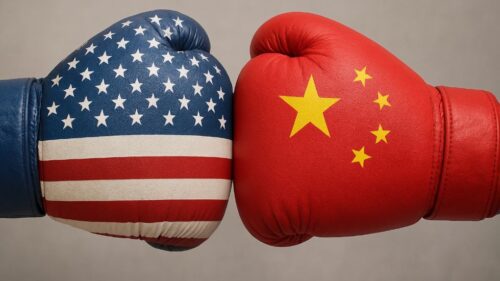
“I don’t think much of it,” Freeman says bluntly. He points out that the current US military budget is already roughly three times larger than China’s. The United States maintains more than 700 overseas bases, effectively surrounding China, while Beijing operates only a handful abroad. Ignoring that accumulated infrastructure distorts the debate.
When Singh raises concerns about China’s 22 shipyards, drone production and expanding industrial capacity, Freeman stresses the difference between quantity and quality. “The Chinese Navy pales in comparison to the US Navy,” he states, insisting that technological sophistication and global reach matter more than raw output. For him, tripling China’s spending has already secured a qualitative advantage. Raising it to five times China’s level requires a clearer strategic rationale than simply invoking Beijing’s rise.
Threat inflation and the iron triangle
The conversation then turns to “threat inflation,” a concept central to Freeman’s work. The military-industrial complex requires a persistent adversary to justify its scale. Without an external foe, Americans might begin asking why resources are not directed toward healthcare, education or infrastructure.
Freeman describes the “iron triangle” linking Congress, the Pentagon and defense contractors. Roughly 54% of the Department of Defense budget flows to private contractors, including Lockheed Martin, Raytheon, Boeing, Northrop Grumman and General Dynamics. These firms then invest heavily in lobbying, campaign contributions and hiring former officials, reinforcing a cycle that sustains high spending.
The result, he says, is a self-perpetuating system that has expanded beyond what President Dwight Eisenhower warned about in 1961. Today, the ecosystem includes think tanks, universities, media organizations and even local institutions, all reinforcing the normalization of American militarism.
The defense tech disruption
Yet the system is not static. Singh asks whether the “Big Five” will simply continue vacuuming up taxpayer money indefinitely. Freeman points to the rise of defense tech firms such as SpaceX, Anduril and Palantir as a disruptive force.
These companies, often backed by Silicon Valley capital and closely connected to the Trump administration, are competing with legacy contractors for Pentagon contracts. Freeman characterizes the moment as a pivotal transition, with tech-driven firms potentially supplanting parts of the old guard.
But he tempers expectations. “A rising tide is lifting all defense contractors right now,” he notes. Even if the composition of contractors changes, the overall budget trajectory shows little sign of decline.
Debt, deficits and the limits of expansion
The most sobering portion of the discussion concerns the national debt. With US debt nearing $39 trillion and annual deficits exceeding $1 trillion, Freeman warns that any increase in defense spending will be entirely debt financed. According to projections, a $1.5 trillion annual budget could add nearly $6 trillion to the debt over a decade.
For the first time, US debt servicing costs now exceed the Pentagon budget. Interest payments alone are approaching $1 trillion annually. Freeman cautions that borrowing to pay interest risks triggering a vicious debt spiral. The US has not run a budget surplus since 1999, making this a bipartisan problem decades in the making.
If defense spending remains politically sacrosanct and debt servicing unavoidable, the remaining pressure points are the long-untouchable Social Security, Medicare and Medicaid. Cutting them, Freeman observes, would be “political suicide.” That leaves Washington with few painless options.
A new cold war?
As the US–Russia New START treaty expires and nuclear arms control weakens, Singh raises the prospect of an accelerating arms race. Freeman questions the strategic logic of expanding nuclear arsenals beyond already overwhelming levels, arguing that such expansions chiefly benefit contractors.
Still, he concedes that a technological cold war with China is real. Competition in artificial intelligence, robotics, drones and hypersonics is intensifying. Here, Freeman does not oppose investment per se. Instead, he criticizes what he sees as misallocation. The problem, he suggests, is not insufficient funding but inefficient spending on legacy platforms at the expense of emerging technologies.
Ultimately, the debate is about how the US will prepare to face Chinese competition. Singh and Freeman leave viewers with a dilemma: expand the war machine and risk fiscal crisis, or reform it before the debt itself becomes the greatest national security threat of all.
[Lee Thompson-Kolar edited this piece.]
The views expressed in this article/video are the author’s own and do not necessarily reflect Fair Observer’s editorial policy.










































Join the conversation
Share your perspective
Log in to share your thoughts and take part in the discussion.