






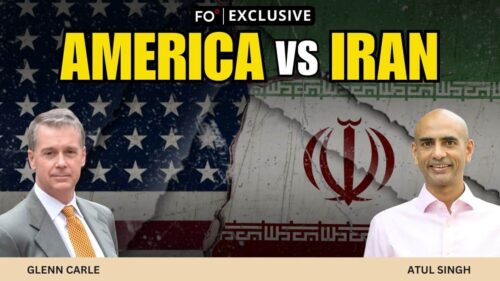
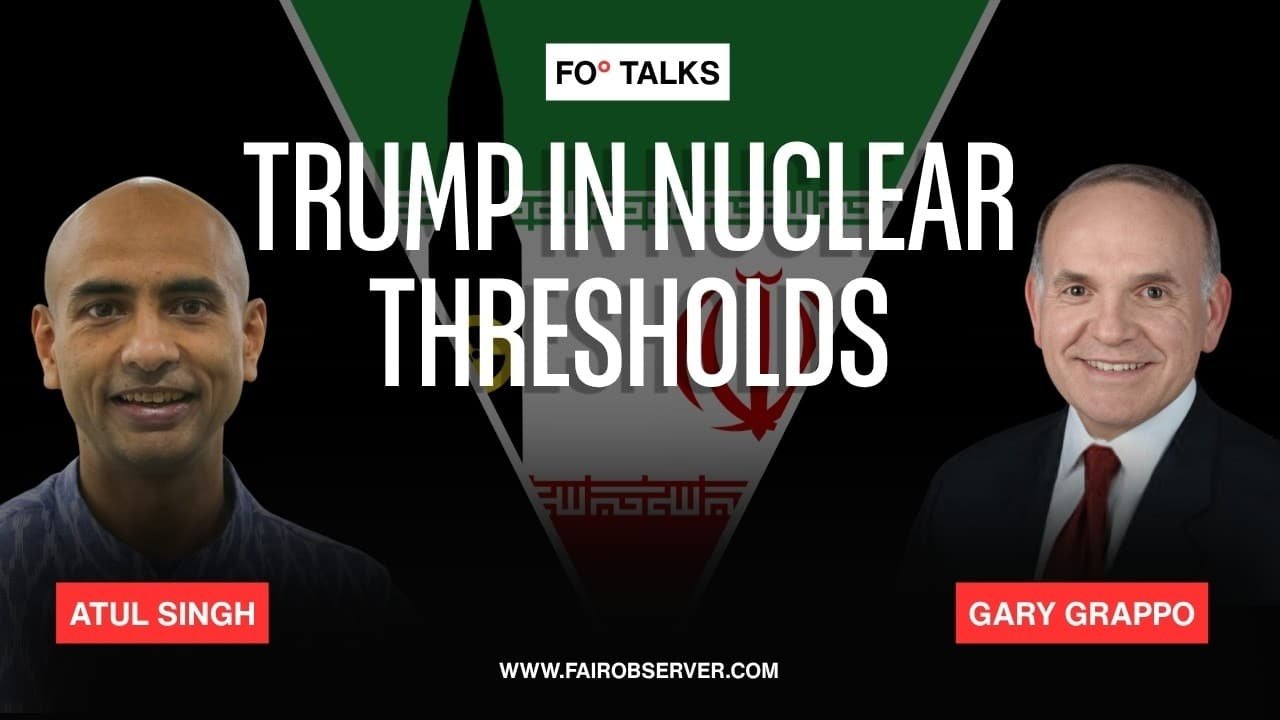
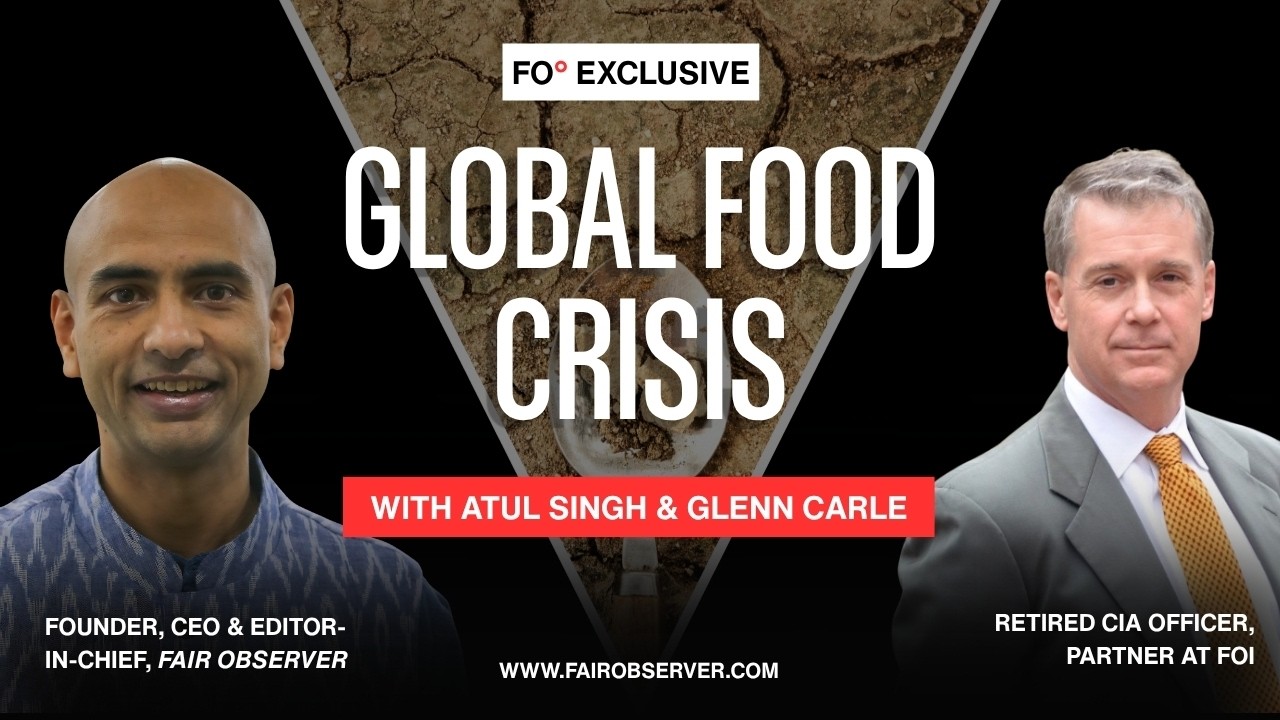
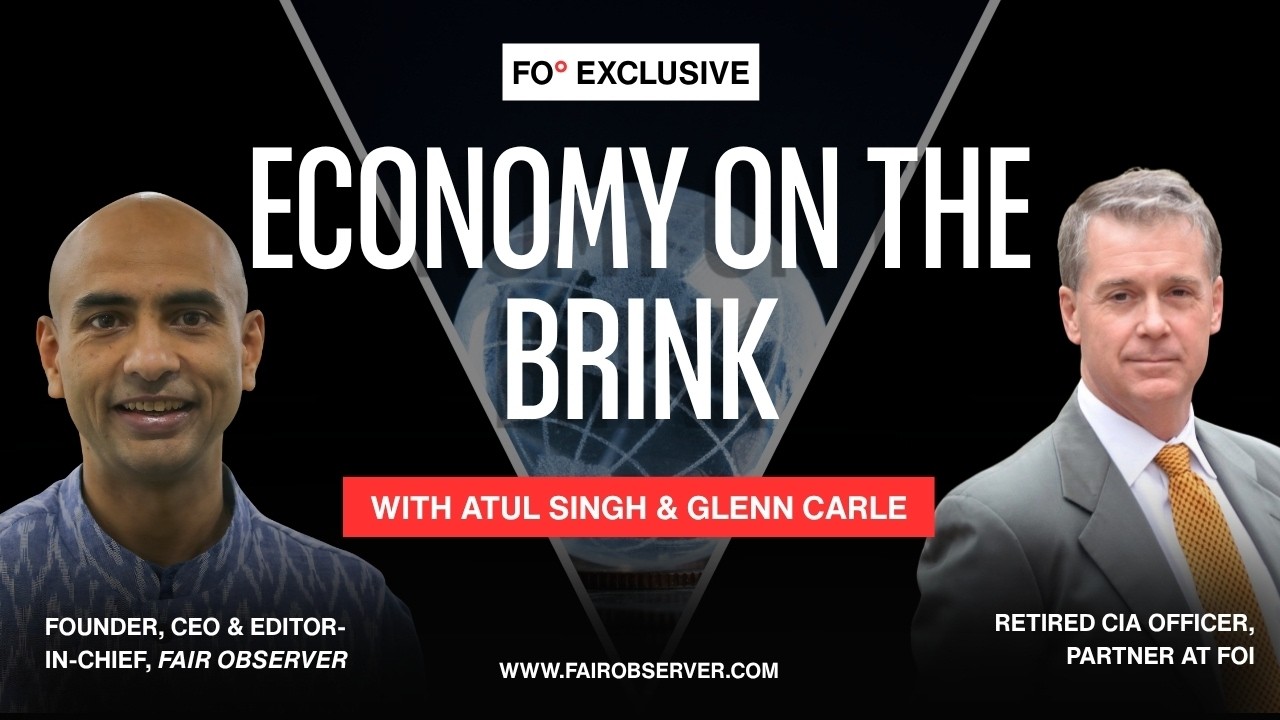
Editor-in-Chief Atul Singh speaks with former US Ambassador Gary Grappo, who served as Envoy and Head of Mission of the Office of the Quartet Representative Tony Blair in Jerusalem; and FOI Senior Partner Glenn Carle, a retired CIA officer who now advises companies, governments and organizations on geopolitical risk. They discuss the expanding war between the United States, Israel and Iran. They analyze a simple but urgent question: Can Washington or Jerusalem shape the conflict on their own terms, or has the region already entered a more dangerous and open-ended phase? As the three discuss military limits, Iranian regime dynamics and global economic exposure, they suggest that the war is unlikely to end neatly and may instead deepen many of the structural problems it is supposed to solve.
War without a clear end
Atul begins by pressing Gary and Glenn on the most immediate issue: how long the conflict might last. Gary rejects the idea that US President Donald Trump can simply decide when the war ends. Iran retains agency and can continue the confrontation even after Washington declares success. Tehran has multiple ways to keep pressure on the US, Israel and the Gulf states, so the conflict could stretch on for weeks or even months.
Glenn agrees and places the problem in a broader American mindset. He argues that US leaders too often imagine war as if it were governed by the logic of sports, with fixed rules, a final whistle and an obvious winner. That illusion is especially dangerous in this case. “There is always a tomorrow and today is never decisive,” he says, warning that military campaigns rarely produce clean political endings.
Even so, Glenn notes that the war does have material limits. However powerful the US may be, it cannot sustain high-intensity operations indefinitely because munitions are being consumed faster than they can be replaced. That creates a likely window of several weeks, after which political patience in Washington may begin to erode.
Iran’s regime is wounded, not transformed
The discussion then turns to Iran’s internal structure after the death of Iranian Supreme Leader Ayatollah Ali Khamenei and the rise of his son, Mojtaba. Atul describes the succession as a hardening rather than a break, arguing that the new order combines personal vengeance with institutional continuity. Gary agrees that the regime sees the war as existential, but he stresses that the decisive force is not the supreme leader alone. In his account, the Islamic Revolutionary Guard Corps remains the true center of power, shaping strategy, controlling major parts of the economy and exercising influence across intelligence, security and the judiciary.
Although many Iranians may despise the system they live under, both Gary and Glenn are skeptical that popular anger can easily become organized political transformation. Glenn argues that autocratic systems are highly effective at eliminating credible challengers before they can emerge. Gary adds that in wartime, ordinary people worry first about survival: food, water, work and family security, not abstract democratic transition.
Military pressure may weaken Iran, destroy infrastructure and deepen public misery without producing a viable alternative political order. It seems hopes for a sudden uprising or a unifying opposition figure remain improbable.
Global economic shock
Atul next broadens the frame from strategy to economics. He points to soaring insurance costs, stalled shipping and the vulnerability of the Strait of Hormuz, through which roughly a fifth of global gas and oil passes, along with a significant share (a third) of the global fertilizer trade. Even before any total closure, fear alone is enough to disrupt commerce. Shipowners hesitate, insurers raise premiums and energy markets become unstable.
Glenn argues that these effects will not collapse the world economy outright, but instead generate inflationary and recessionary pressures that reach nearly every country. Gary further emphasizes how deeply interdependent the global economy remains. Gulf monarchies rely on hydrocarbon revenues, imported food and fragile social bargains. South Asia and Africa are particularly exposed to spikes in oil, gas and fertilizer prices. Iran, already under strain, is even more vulnerable.
Atul also raises a larger possibility: that prolonged disruption could force states to accelerate their transition away from Middle Eastern hydrocarbons. Gary agrees, suggesting that the war may strengthen long-term investment in electric vehicles, solar energy and other alternatives. In that sense, a conflict centered on oil could also hasten the search for a post-oil future.
Grand strategy or chaos
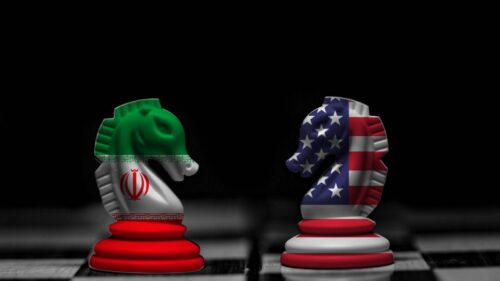
Atul asks whether the Trump administration is pursuing a wider geopolitical strategy aimed at controlling oil chokepoints, weakening Iran and squeezing China. Glenn dismisses this idea outright. “That is crazy talk,” he says. He argues that foreign policy is usually far less coherent than outside observers imagine. Statesmen are rarely master strategists calmly moving pieces across a global chessboard. They are more often overwhelmed officials responding to crises as they arise.
Gary broadly agrees. Long-range planning exists in theory, he says, but war reduces governments to reacting under pressure. He doubts that any such strategy would work anyway, especially because Russia would almost certainly continue supplying China if Beijing faced an energy shock. Both Gary and Glenn therefore see less evidence of a grand design than of improvisation, contradiction and strategic drift.
That diagnosis leads to a deeper criticism of US power. Glenn argues that American conservatives have repeatedly assumed military force can reshape political and cultural realities abroad, despite decades of evidence to the contrary. Iraq remains the obvious warning. In Iran, as in earlier wars, destruction may be achievable, but durable political transformation will not be.
A long conflict with no satisfying outcome
Atul, Gary and Glenn converge on the view that Iran may emerge weaker and less able to project power beyond its borders, but the underlying political structure may survive. Israel and the US may win battles in the air while failing to produce a stable regional order. The global economy may absorb the shock, but only by spreading pain far beyond the battlefield.
Gary and Glenn also dismiss fears of an imminent Israeli nuclear strike on Iran, arguing that such an action serves no meaningful military purpose under present conditions. That restraint matters, but it does not change the larger picture. This war is less a controlled campaign than a dangerous process whose consequences will be felt in the capitals of Tehran, Tel Aviv, Washington and far beyond.
[Lee Thompson-Kolar edited this piece.]
The views expressed in this article/video are the author’s own and do not necessarily reflect Fair Observer’s editorial policy.




























Comment