





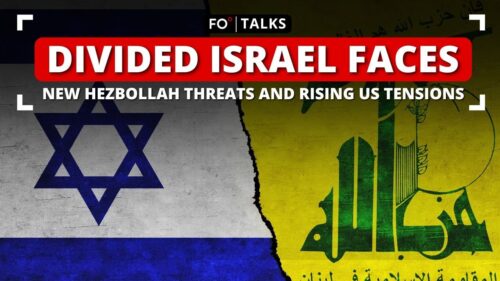
Fair Observer Founder, CEO & Editor-in-Chief Atul Singh and former Israeli Government Official Josef Olmert explore the deep divisions within Israel over Prime Minister Benjamin Netanyahu’s Gaza policy. A petition signed by prominent former security, intelligence and political officials urges US President Donald Trump to intervene and end Netanyahu’s war. This group represents one pole of the debate, while the other body of senior figures largely supports Netanyahu.
The split reflects ideology and policy more than strict party lines. The petitioners lean center-left, while Netanyahu’s supporters stand on the center-right with a stronger right-wing character. Olmert observes that many signatories are not strictly tied to party politics, but most on the right likely back Netanyahu.
War goals and progress
Olmert raises a central question: “What’s the goal? What does the government of Israel want to achieve these days?” After the infamous Hamas attack of October 7, 2023, Netanyahu declared the goals to be the total destruction of Hamas and the complete release of hostages. According to intelligence, of the original 250 hostages, about 20 are believed alive and 30 bodies are noted, leaving around 50 still unreturned. Olmert expresses the hope that all are alive. He adds that while more than 80% of Hamas may have been destroyed militarily, these figures show the government has not achieved its declared goals.
Political pressures and Knesset dynamics
Netanyahu faces relentless pressure from his far-right partners, particularly the factions of Israeli politicians Itamar Ben-Gvir and Bezalel Smotrich, who hold 14 seats. Together, they insist on nothing less than full achievement of the war’s goals. Israel’s Knesset — the Israeli legislature — has 120 seats, and a governing majority requires 61. Netanyahu’s coalition controls about 68–70 seats, meaning that if Ben-Gvir and Smotrich withdraw, his government collapses and new elections follow.
Netanyahu wants to avoid early elections, preferring the scheduled date of November 2026. Although his popularity plummeted after October 7, it has partially rebounded after what Olmert calls a “successful campaign against Iran,” an outcome Netanyahu claimed credit for. The far right, however, continues to push him to destroy Hamas completely, even if this endangers the remaining hostages. Petitioners, by contrast, urge ending the war to save lives and relieve international pressure.
External and international pressures
Olmert argues that Trump is also pressing Netanyahu to bring the conflict to an end, either through a decisive military blow or through a deal. He characterizes Netanyahu as reluctant to make such weighty decisions, fearing the loss of his parliamentary majority.
In addition to Trump, Germany and Great Britain are also applying pressure. According to Olmert, Netanyahu floats the idea of “final occupation” as a delaying tactic to appease the far right while maneuvering for time. He interprets Netanyahu’s stance as brinkmanship — a strategy of pushing Hamas to change its position on hostages under pressure from outside actors such as the United States, Egypt, Saudi Arabia or Qatar.
The Israeli establishment and historical precedent
Olmert highlights the petition’s extraordinary nature: For the first time in Israeli history, former officials openly appeal to a US president to restrain their own prime minister. He mentions reports that many senior officers of the Israel Defense Forces and Mossad national intelligence agency want to end the Gaza war and refocus on Iran, which they view as the greater existential threat. Netanyahu, however, remains mistrusted by much of the defense establishment — a mistrust he uses to his political advantage, casting himself as anti-establishment, much like Trump. Olmert stresses that Netanyahu relies heavily on Trump’s approval, treating it as the ultimate “green light or red light.”
Societal schisms and international perceptions
Olmert underscores that the war is widening Israel’s societal chasms, even though these divides always existed. He points to the extreme right’s rhetoric about “ethnic cleansing,” which unsettles many military and intelligence professionals who see it as diplomatically suicidal. He acknowledges Israel’s deteriorating international status but warns against blaming Netanyahu alone. Deeper forces of bias and antisemitism, he argues, also shape Israel’s isolation. Still, he emphasizes that while Israel was united against the Hezbollah paramilitary group and Iran, the Gaza conflict uniquely splits the country at its core.
Allegations and humanitarian claims
Human rights groups accuse Israel of committing genocide in Gaza, but Olmert rejects these claims outright. He insists, “There is no genocide and no starvation in Gaza.” He argues that Gaza is “swamped with food,” and that problems stem from distribution, not supply. He blames the United Nations — and especially the United Nations Relief and Works Agency for Palestine Refugees in the Near East — for playing a “negative role” by enabling Hamas and controlling food aid. He strongly criticizes Cindy McCain, the executive director of the UN World Food Programme, for calling Gaza a humanitarian catastrophe and accusing Israeli troops of firing on civilians; he dismisses her claims as propaganda. For Olmert, starvation “as a phenomenon does not exist in Gaza.”
The catch-22 and Israel’s future
Olmert frames the conflict as a catch-22. If Israel utterly destroys Hamas, the result would be mass casualties and global condemnation. If it refrains, Hamas remains intact, undermining the war’s purpose. He insists that Hamas, not Israel, created this dilemma. On the West Bank, he calls for restraining settlers who “misbehave” but also stresses the need to prevent a Hamas-style threat from emerging there.
Olmert concludes that Netanyahu is not managing the Gaza situation well, prioritizing political survival over national interest. His proposed solution is new elections as soon as possible, though he acknowledges Netanyahu and his far-right allies will resist because polls show they would likely be swept from power.
[Lee Thompson-Kolar edited this piece.]
The views expressed in this article/video are the author’s own and do not necessarily reflect Fair Observer’s editorial policy.


































Comment