



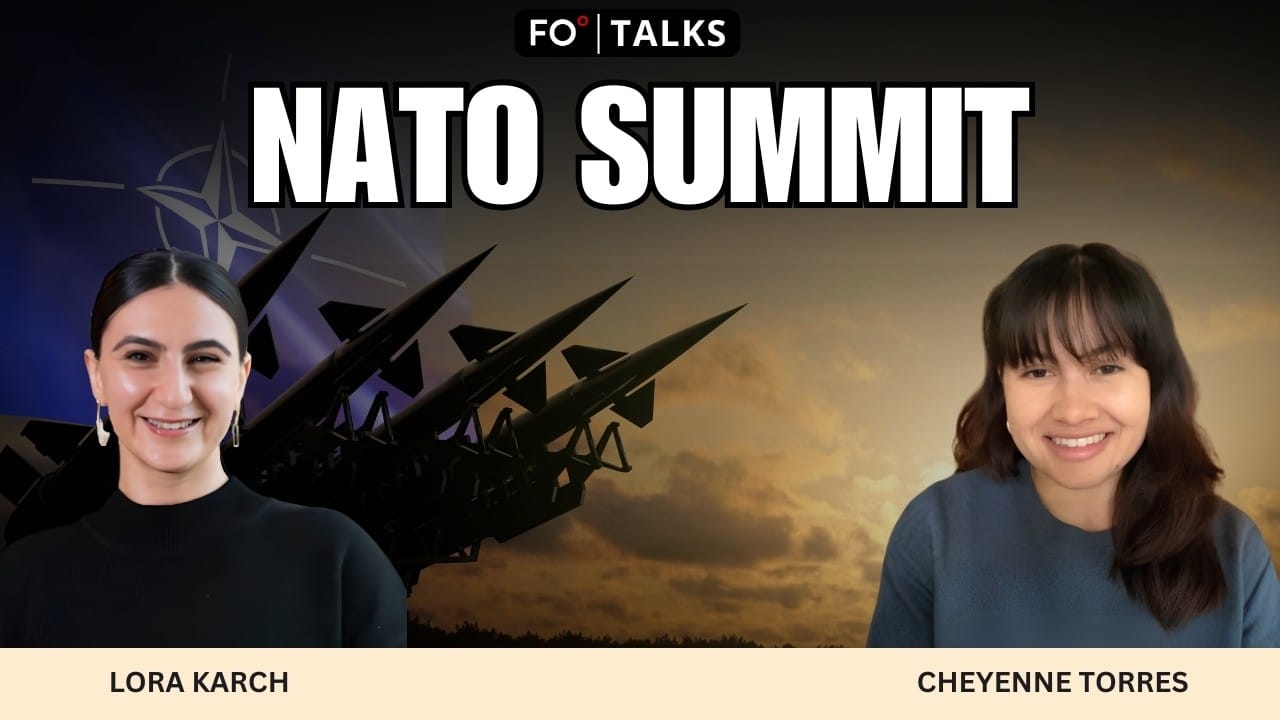
Fair Observer’s operations chief of staff Cheyenne Torres and independent policy writer Lora Karch examine what the recent NATO summit reveals about US President Donald Trump’s changing foreign policy. They discuss Washington’s pressure on Europe to assume greater responsibility for its defense, Trump’s controversial engagement with Syria’s new leadership and Turkey’s emerging regional role. Karch believes that these developments could help the United States replace military intervention with diplomacy in the Middle East.
Europe must assume greater responsibility
Torres begins by asking what a reduction in US forces would mean for NATO and European security. Karch views Trump’s position as an attempt to make European governments take greater responsibility for their own defense. The US remains NATO’s largest military spender, while the alliance has long expected members to spend at least 2% of GDP on defense.
Karch feels Europe must develop greater strategic agency while maintaining a united front with Washington. European countries face a continuing security challenge from Russia and sit closer to instability in the Middle East. Although Karch cannot envision an immediate and complete US withdrawal, she considers a gradual reduction consistent with Washington’s declared goal of ending prolonged Middle Eastern wars.
Can Washington work with Syria’s new leader?
Trump’s meeting with Syrian interim President Ahmed al-Sharaa is the summit’s most consequential development. Al-Sharaa, formerly known as Abu Muhammad al-Jolani, led jihadist organization and al-Qaeda affiliate Jabhat al-Nusra, and once appeared on a US terrorism list. Karch remains uncomfortable with Washington engaging a former militant whose movement fought American forces, but she regards the meeting as a practical response to Syria’s new political reality.
Under former President Bashar al-Assad, Syria provided Iran with a strategic corridor for supplying Hezbollah in Lebanon. Assad’s fall has weakened that connection and created an opportunity for Washington to draw Damascus away from Tehran. Nevertheless, Karch stresses that Syria’s new government must meet concrete requirements involving counterterrorism, regional stability and minority protections. Fighters associated with the government still face accusations of kidnappings and attacks against Alawites.
Karch hopes diplomatic recognition will encourage Syria to behave like a responsible state. She suggests that opening a Syrian embassy or consulate in Washington could give Damascus both international standing and greater responsibility. As a Syrian, she also hopes the country will eventually hold “real, true democratic elections.”
Karch also identifies Syria’s possible accession to the Abraham Accords as an important diplomatic opportunity. Reports that Syria and Lebanon could eventually normalize relations with Israel remain speculative, but she believes such a development could begin a broader regional transformation. It would further distance Damascus from Tehran, weaken Iran’s ability to support Hezbollah and give Syria an incentive to maintain stable relations with its neighbors. Karch sees this as a possible first step toward reducing the hundreds of US military installations across the region to a much smaller presence. Diplomacy would not eliminate American involvement, but it could substantially reduce Washington’s reliance on force.
Turkey returns to the NATO fold
Turkey’s prominence at the summit signals another diplomatic realignment. Karch argues that Ankara is moving closer to its NATO partners after years of tension under President Recep Tayyip Erdoğan. Washington is also seeking a Turkish role in efforts to disarm Hezbollah in Lebanon, potentially involving Turkish troops and Syrian fighters.
Turkey’s history of conflict with Kurdish groups in Syria and Iraq remains a serious obstacle. Western governments must therefore press Ankara to avoid renewed hostility while encouraging it to accept greater regional responsibility. Karch believes treating Turkey as a consequential NATO partner may persuade it to behave accordingly. The strategy allows Washington to delegate security tasks instead of relying primarily on American military power.
Can the Middle East manage its own security?
Karch sees Trump’s diplomacy with Syria and Turkey as part of a possible transition from war to political engagement. US priorities remain preventing Iran from acquiring nuclear weapons, keeping the Strait of Hormuz open and limiting Tehran’s support for Hezbollah. Syria’s separation from Iran could advance all three objectives.
Regional diplomacy also suggests that Middle Eastern states can assume more responsibility. Oman is mediating with Iran, while Saudi Arabia has signed a joint defense pact with Pakistan. Karch concludes that Washington should “demonstrate a little more restraint” and allow regional countries greater control over their own affairs. If these diplomatic initiatives succeed, the US could reduce its extensive military footprint without abandoning its central security interests.
[Lee Thompson-Kolar edited this piece.]
The views expressed in this article/video are the author’s own and do not necessarily reflect Fair Observer’s editorial policy.




























Join the conversation
Share your perspective
Log in to share your thoughts and take part in the discussion.