





Fair Observer’s Video Producer Rohan Khattar Singh speaks with former Royal Air Force officer Peter Hoskins about a campaign that appears tactically flawless yet strategically ambiguous. The US–Israel air war against Iran showcases extraordinary coordination and firepower, but its political objectives remain unclear and, in some cases, unmet. As the conflict evolves, will America’s overwhelming military capability produce durable political outcomes?
Tactical success, strategic uncertainty
Khattar Singh opens by highlighting the scale and sophistication of the air campaign. Thousands of sorties, advanced aircraft and tightly coordinated support systems point to what Hoskins describes as a “picture perfect” execution from a purely military standpoint. The operation reflects decades of doctrinal development in joint and coalition warfare, where precision, coordination, intelligence, communication and logistics converge.
Yet this technical success sits uneasily alongside uncertain results. Despite repeated claims of destroyed capabilities, Iran continues to be able to launch missiles and drones, indicating that its core military infrastructure remains intact. For Hoskins, this gap between battlefield performance and political outcome is the central problem. The campaign demonstrates what modern air power can do, but also exposes its limits when strategic goals are either unclear or unrealistic.
The limits of air power
The conversation turns to a long-standing debate in military theory: whether air power alone can achieve decisive political change. Hoskins draws on both historical precedent and personal experience to challenge that assumption. “Even as an aviator, I’ve never believed that air power alone can achieve the kind of political goals associated with regime change,” he says.
Air campaigns can degrade infrastructure, destroy weapons and disrupt operations. They can delay or complicate an adversary’s plans. But translating that disruption into regime collapse or lasting deterrence is far more difficult. In the case of Iran, the continued missile salvos suggest that the state retains both capacity and will.
Hoskins is blunt about what would be required to fully eliminate Iran’s capabilities. “There’s only one way you’re going to do that 100%, and that’s with a land invasion,” he notes. However, he emphasizes that such a scenario is highly unlikely. The result is a strategic middle ground: enough force to inflict damage, but not enough to achieve decisive political change.
Asymmetry and adaptation
Khattar Singh shifts the focus to Iran’s response, which highlights a different model of warfare. Lacking a modern air force, Iran has invested heavily in missiles and drones, using them to strike infrastructure across the Gulf. This approach allows it to exert pressure without matching the conventional capabilities of its adversaries.
Hoskins views this as a calculated adaptation rather than a weakness. “They were smart enough to conclude that the best way to do that was through unmanned vehicles… and their ballistic missiles,” he explains. By focusing on systems that are cheaper, harder to intercept and easier to scale, Iran has found a way to remain operationally relevant despite technological disadvantages.
This form of asymmetry complicates the notion of air superiority. Even when one side dominates the skies, the other can still impose costs and disrupt stability. As such, the conflict persists despite clear imbalances in conventional power.
NATO under pressure
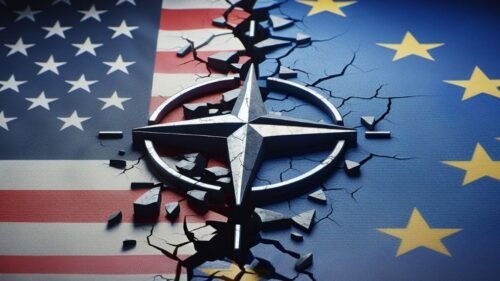
Beyond the battlefield, the discussion widens to the political environment shaping the conflict. Khattar Singh raises US President Donald Trump’s repeated criticisms of NATO, including threats to withdraw the United States from the alliance. Hoskins feels such rhetoric undermines a strategically valuable system.
He points out that NATO is not simply a financial burden on the US but a network that enables global reach, shared capabilities and collective defense. European allies contribute not only funding but also operational support, as seen in joint efforts to counter drones and missiles in the Middle East.
Hoskins also stresses the legal and political barriers to a US withdrawal, stating that such a move would face significant resistance. Even so, the rhetoric itself introduces uncertainty, raising questions about the durability of alliances that have long underpinned Western security.
Europe’s position in a shifting landscape
The final part of the discussion examines Europe’s response to overlapping crises. While some observers see deep divisions, Hoskins offers a more measured view. Differences among European states, he says, reflect variations in emphasis rather than fundamental fractures.
European governments remain committed to international law and cautious about entering conflicts with unclear objectives. Yet they are not indifferent to the outcomes of the Iran war or the broader strategic environment. The expansion of NATO to include Finland and Sweden signals a continued willingness to adapt in the face of perceived threats.
Hoskins states that Europe retains both the capacity and the institutional framework to manage its security, particularly through NATO. Even in a scenario where US involvement declines, he believes the alliance could evolve rather than collapse.
A familiar dilemma in modern war
Khattar Singh and Hoskins ultimately return to the central tension of the conflict. Advanced militaries can achieve rapid and impressive tactical results, but those results do not automatically translate into political success. In Iran, as in other recent conflicts, the gap between military action and strategic outcome remains wide.
Hoskins’s assessment tells that this is not a failure of execution but a mismatch between means and ends. Air power can shape the battlefield, but it cannot by itself determine the political future of a state. As long as that gap persists, even the most sophisticated campaigns risk prolonging instability rather than resolving it.
[Lee Thompson-Kolar edited this piece.]
The views expressed in this article/video are the author’s own and do not necessarily reflect Fair Observer’s editorial policy.































Comment