





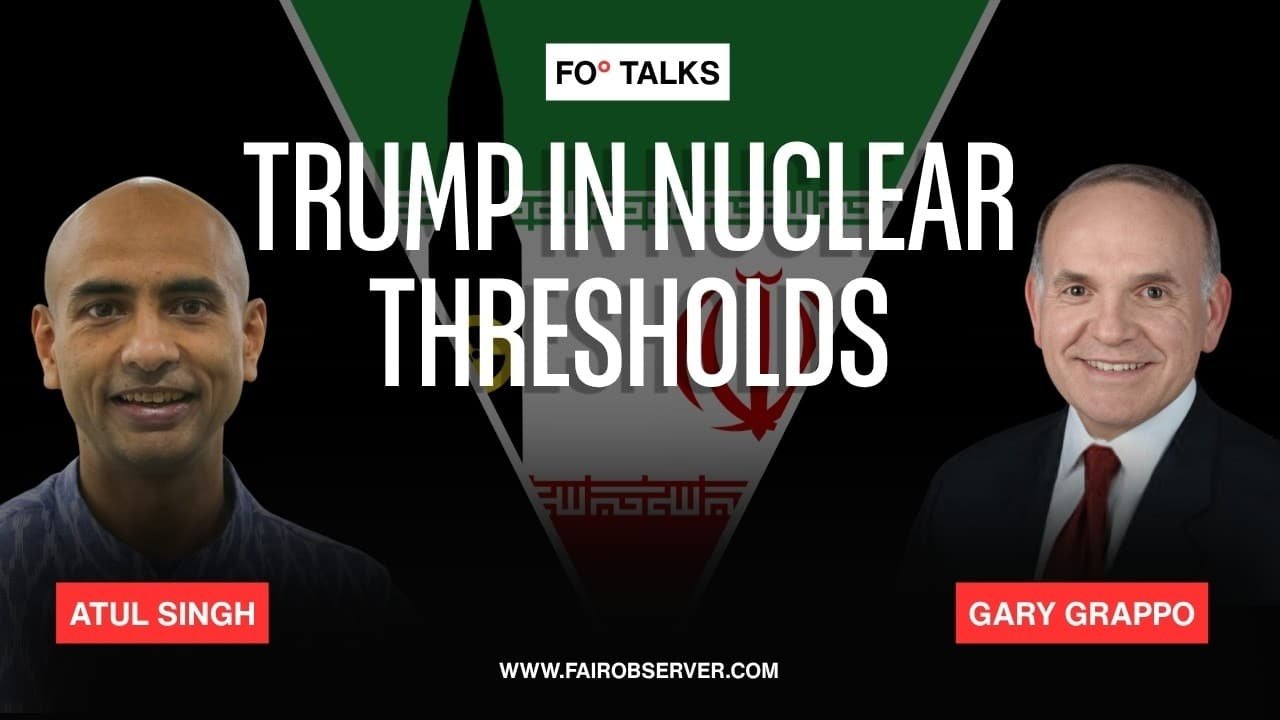
Editor-in-Chief Atul Singh and former US Ambassador Gary Grappo, who served as Envoy and Head of Mission of the Office of the Quartet Representative Tony Blair in Jerusalem, discuss US President Donald Trump’s 20-point peace deal. The agreement has halted more than two years of war in Gaza and opened a narrow path toward political talks. Gary argues that this is “probably the best chance Israelis and Palestinians have had in at least a decade,” but only if Trump sustains pressure, regional actors cooperate and both sides accept deep, uncomfortable compromises.
Trump’s 20-point peace deal
Atul begins by asking Gary what the deal actually does. Gary explains that the 20-point plan was designed with two specific goals: to stop the fighting in Gaza and secure the release of Israeli hostages. In those terms, it has largely worked.
Yet the plan is intentionally narrow. It is not a grand Middle East peace framework; it focuses almost entirely on Gaza. The West Bank — the deeper, more complex question — appears only in two closing points about Palestinian reform and a future horizon for statehood. The deal’s architecture reflects who shaped it. Outside actors drove the negotiations: the United States, Egypt, Turkey and several Gulf states. Palestinians, apart from their pressured Sunni nationalist militant group, Hamas, had virtually no role in writing the text. That absence of local ownership is one of its core weaknesses.
What next for Gaza?
The agreement lays out three pillars for Gaza’s immediate future: a hostage–prisoner exchange, a transitional authority that excludes Hamas and the disarmament of Hamas’s military infrastructure. That last condition is the most challenging. On the question of Hamas disarmament, Gary admits he is doubtful.
Security is meant to be handled by an International Stabilization Force — a multinational presence inside Gaza. But no country wants to place its troops between Israel’s military, the Israeli Defense Forces and Hamas. Additionally, Israel has already ruled out some likely contributors. Without a credible force on the ground, enforcing disarmament will be extremely difficult.
Meanwhile, Gaza finds itself with staggering humanitarian needs. Gary says that roughly 80% of housing has been damaged or destroyed, basic services have been “largely decimated” and about two million people lack adequate shelter. Aid is now flowing more steadily and famine indicators have improved. However, reconstruction will require an estimated $50–60 billion and credible assurances that Gaza will not return to war in a few years.
How the deal happened
Atul then inquires why the deal happened now. Gary points to Israel’s strike on Hamas leaders in Doha, Qatar. Hitting a state that hosts the largest US base in the Middle East infuriated Trump and united the Gulf in protest. For the first time since the war began in October 2023, Trump chose wider regional interests over unconditional support for Israel.
Trump then applied direct pressure on Israeli Prime Minister Benjamin Netanyahu, warning that Israel’s international standing had collapsed and that sanctions were being discussed in some capitals. Netanyahu, already weakened at home, had little space to resist.
At the same time, Qatar, Egypt and Turkey leaned heavily on Hamas, leaving the movement with no realistic way to decline. Ironically, Gary notes, the Trump deal looks rather similar to a framework former US President Joe Biden had advanced a year earlier; what changed was leverage and timing, not the basic outline.
What’s next for Israel?
Israel’s calculus is fraught. Netanyahu governs with far-right partners who reject any move toward Palestinian self-determination. Accepting the plan meant swallowing language that hints at a path to Palestinian statehood, which the Israeli right considers anathema.
Israel has withdrawn from roughly half of Gaza but does not want to leave entirely. Many Israelis view the current pause as just round one of a larger confrontation. If Hamas fails to deliver on any key obligation, Israel will have a ready argument for returning militarily, and parts of its leadership expect exactly that.
Politically, Netanyahu also pays a domestic price for appearing to bow to US pressure, deepening questions about how long he can last in office.
International community’s role
Gary argues that the plan would benefit from formal endorsement by the UN Security Council, which would provide legal grounding and global legitimacy. So far, neither Washington nor Israel’s Jerusalem seems interested; they appear to prefer flexibility over binding commitments.
Without broad international buy-in, the reconstruction of Gaza will be slow and vulnerable to renewed violence. Yet regional donors will not invest tens of billions of dollars unless they see a durable political horizon — meaning progress on the Palestinian question that goes beyond Gaza alone.
Will the peace deal hold?
Gary is cautious in his prognosis of the deal. He believes “The odds are not even 50/50 in their favor right now, despite what President Trump might say,” he states. After all, the peace plan faces tremendous obstacles: Hamas’s resistance to disarmament, Israel’s reluctance to withdraw fully and the huge task of building a functioning governing authority and security force in a shattered territory.
Crucially, he stresses that the deal relies on Trump’s personal, sustained engagement. If the White House’s attention drifts even briefly, the plan could unravel quickly.
Gary concludes with a structural truth: Gaza and the West Bank cannot be solved separately. Every serious peace effort has recognized that the core issues — territory, identity, security, statehood and trust — run across both. The current plan is a necessary start, but until both territories are engaged within a single political framework, and until leadership on all sides rebuilds a minimum of trust, no agreement can truly endure.
[Lee Thompson-Kolar edited this piece.]
The views expressed in this article/video are the author’s own and do not necessarily reflect Fair Observer’s editorial policy.































Comment