





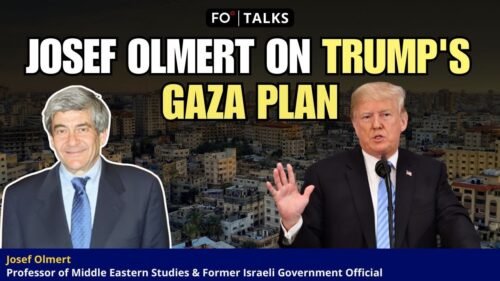
Editor-in-Chief Atul Singh and Josef Olmert, a former Israeli government official and Middle East scholar, analyze the ceasefire between Israel and Gaza that has reshaped regional politics. Together, they examine how US President Donald Trump’s pressure on both sides produced the agreement, whether it can evolve into real peace and what the future now holds for Israel, Gazans and the Sunni Palestinian political organization Hamas.
Peace in the Middle East?
Singh and Olmert open by puncturing the headline hope: This is not a region-wide settlement. Olmert stresses that what just happened is a ceasefire agreement, not a comprehensive peace. The breakthrough, he argues, comes from sequencing and leverage: The Trump team spots a narrow window when both Israel and Hamas are susceptible to simultaneous pressure, and it pushes both sides into a first step that neither can easily walk back.
On Israel’s side, Olmert says Israeli Prime Minister Benjamin Netanyahu boxed himself into reliance on Trump, who paired pressure with a powerful incentive: the return of hostages. On the United States’s side, Washington secured Qatari commitments to squeeze Hamas and offered the Turkish capital of Ankara sales of F-35 Lightning II Joint Strike Fighters to enlist Turkish pressure. Fatigue within Hamas helped; Olmert says, “In diplomacy, timing is at least 50% of everything.” A process has begun, and that momentum is itself an achievement — yet it creates new dilemmas for all actors.
What’s next in Gaza?
The “day after” is where rhetoric meets risk. Olmert lists immediate friction points: who controls areas the Israel Defense Forces vacates, whether local clans and ad-hoc militias can hold ground against a reassertive Hamas and how quickly enforcement mechanisms appear. He warns that reports already suggest Hamas is retaking territory and carrying out reprisals, while weapons flow back into its hands.
The most combustible near-term issue is disarmament. If an international force is tasked to oversee it, Olmert doubts Western governments will accept casualties for that mission. He cites Israel’s bad memories with the United Nations Interim Force in Lebanon.
Deradicalization is the other pillar — education, curricula and the role of the United Nations Relief and Works Agency for Palestine Refugees in the Near East. Olmert remains skeptical that outside actors will shutter institutions or field enough teachers to effect deep change. For him, Gaza’s social reality matters: It is not only political Islam, it is also tribal power, with the Gazan city of Rafah and other locales shaped by big clans and local loyalties. Any plan that ignores this tapestry, he suggests, will fray on contact.
The peace agreement
Singh presses for the architecture behind the headlines. Olmert frames it as a 20-point roadmap whose “first painful stage” is the hostages’ return. This is still incomplete, with 19 bodies outstanding and families without closure. The bargain rests on synchronized pressures: concessions traded for guarantees, with Trump as the central broker. He credits Washington’s leverage over Netanyahu’s political calculus and over regional actors who can pressure Hamas, but he is clear-eyed about limits. External brokers can start processes, but they cannot substitute for force, governance and legitimacy on the ground.
Crucially, Olmert draws a line between a ceasefire and statecraft. A ceasefire pauses fire; statecraft must decide borders, security control, administration and education. Those choices are where this agreement will either ripen into something durable or stall. His gut check on the core test — Hamas laying down arms — is cautious: “The likelihood is 51% it will not be done.” It is possible in theory, he says, but improbable in practice without actors ready to bleed for enforcement.
What’s next for Israel?
Olmert portrays Netanyahu as politically exposed and time-bound. From the outset of the war, he says, Netanyahu avoided “day after” debates. Now, each step that hints at Palestinian Authority control in Gaza triggers pushback from hawkish partners and parts of Likud, Israel’s right-wing political party. Elections loom in 2026 (perhaps earlier), tightening the vice. Meanwhile, US bipartisan reflexes on Israel have weakened. Paradoxically, this gives Trump more room to pressure Jerusalem while Netanyahu depends on him.
Could a unity government widen Israel’s maneuvering room? Olmert floats that only as a hypothetical, noting Netanyahu’s past concessions but doubting he will now cross lines that imply a Palestinian state. Israel’s option set on the Palestinian file is between bad and worse. The strategic temptation, he adds, is to avoid another Gaza round while focusing attention on Iran. But the tinder is dry, and any spark, such as an ambush or a misfire, could reignite combat at short notice.
Life of Gazans
Singh turns to the ground truth: shattered buildings, a gutted economy and disrupted aid. Olmert contends that several prominent accusations against Israel were unfounded and insists there was neither famine nor genocide. He concedes, though, that Israel has lost the battle of global perception, especially among younger audiences. He points to harmful ministerial rhetoric about annexation and Greater Israel, plus a broader failure of Israeli public diplomacy. Even if one accepts his factual rebuttals, he says, perception now constrains policy.
Reconstruction will be vast and slow. Olmert believes the suggested $50 billion floor may be optimistic. Who secures the streets while concrete is poured? Who pays, who teaches, who polices? Gaza’s future hinges on four hard questions the agreement cannot wish away:
- Can an enforceable security regime actually disarm Hamas?
- Can governance shift from warfighting networks to accountable administration?
- Can education and social services be depoliticized at scale?
- And can daily life improve fast enough to outpace spoilers?
Until those questions are credibly answered, coexistence will remain precarious — hopeful in moments, reversible in minutes.
[Lee Thompson-Kolar edited this piece.]
The views expressed in this article/video are the author’s own and do not necessarily reflect Fair Observer’s editorial policy.































Comment