




Fair Observer Contributing Editor Laura Pavón Aramburú speaks with American University Professor William M. LeoGrande about the rapid deterioration of US–Cuba relations under US President Donald Trump. They examine how Washington’s tightening of its long-standing embargo, combined with new pressure on countries supplying oil to Cuba, has deepened the island’s humanitarian and economic crisis. LeoGrande contrasts the current strategy of coercion with US President Barack Obama’s earlier engagement policy, arguing that decades of sanctions have failed to produce meaningful political change. Is the United States pursuing realistic diplomacy or repeating a regime-change strategy that has repeatedly failed elsewhere?
From engagement to economic strangulation
Aramburú opens by revisiting the Obama administration’s normalization efforts, which included restoring diplomatic relations, loosening travel restrictions and removing Cuba from the list of state sponsors of terrorism. LeoGrande notes that the two governments signed 22 bilateral agreements during Obama’s final years in office, reflecting an attempt to build cooperation around mutual interests.
Today, he says, the relationship has deteriorated dramatically. “The situation today in the bilateral relationship is probably as bad as it has ever been,” LeoGrande states. Alongside the traditional embargo imposed in 1962, the Trump administration has added new pressure through secondary sanctions targeting countries that export oil to Cuba, and foreign firms doing business in Cuba.
According to LeoGrande, Mexico, Algeria and Angola all halted shipments after Washington threatened economic retaliation. Russia remains willing to provide oil, but not enough to offset the losses. This has resulted in a worsening energy crisis that has disrupted transportation, electricity production and industrial activity across the island.
LeoGrande argues that the contrast between Obama and Trump reflects two fundamentally different theories of change. Obama believed greater engagement would gradually encourage economic and political opening. Trump’s approach, by contrast, seeks to “strangle the Cuban economy” until Havana accepts US terms.
Oil, leverage and the limits of regime change
The conversation then broadens into a larger debate about US regime-change strategies. Aramburú compares Cuba to recent US confrontations with Venezuela and Iran, questioning whether Washington’s objectives are clearly defined or driven by a broader ideological hostility toward socialism and anti-American governments.
LeoGrande points to Venezuela as an example of inconsistency. The US publicly pursued regime change while Venezuelan President Nicolás Maduro held office, yet Washington later appeared willing to work with the post-Maduro government so long as American oil companies regained access to the Venezuelan energy sector.
A similar logic may exist in Cuba. Current negotiations reportedly focus heavily on economic questions, including property claims, foreign investment and access to Cuba’s strategic minerals. Yet political demands remain a major obstacle, particularly calls from US Secretary of State Marco Rubio for leadership change in Havana.
For Cuban officials, sovereignty remains non-negotiable. LeoGrande argues that negotiations could succeed if they remain focused on economic normalization, but they are unlikely to survive any attempt by Washington to dictate Cuba’s political system.
A society under pressure
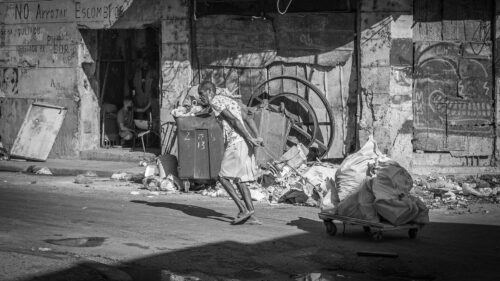
The discussion also explores the severe humanitarian effects of Cuba’s energy shortages. LeoGrande describes hospitals struggling to maintain electricity, factories closing for parts of the week and public transportation nearly collapsing because of fuel scarcity. Farmers often cannot move crops to market, further worsening food shortages.
Simultaneously, Cuba’s own economic failures have compounded the crisis. LeoGrande notes that the government delayed market reforms for years and became overly dependent on tourism. Attempts to unify Cuba’s currency system in 2021 also contributed to inflation and instability.
Even traditional pillars of the economy are weakening. Cuba’s sugar sector, once central to national identity and exports, has deteriorated so badly that the country recently had to import sugar. Cuba now needs major foreign investment to rebuild critical industries and modernize infrastructure.
Still, LeoGrande highlights some areas of resilience. China has supplied solar technology that is helping Cuba slowly expand renewable energy production, while the island’s biotechnology sector continues to demonstrate significant scientific capacity despite sanctions.
Generational divides and the Cuban diaspora
Aramburú raises the question of whether internal political change could eventually emerge from younger generations. LeoGrande describes a growing divide between older Cubans who remember the revolution’s early years more positively and younger Cubans whose experience has been dominated by austerity and economic stagnation.
Yet he remains skeptical that widespread unrest will produce regime collapse. “There’s no organized opposition,” LeoGrande explains, arguing that many critics eventually emigrate rather than build sustained movements inside Cuba. Dissatisfaction is widespread, but the state still retains strong institutional control.
The Cuban diaspora remains another major political force, especially in Florida. Cuban Americans have historically exercised outsized influence over US policy because of their concentration in a key electoral state and their strong focus on Cuba-related issues.
However, the community itself has become increasingly divided. Some supported Obama’s normalization efforts, while others continue backing a hard-line embargo strategy. Trump’s immigration policies have also created tensions by ending many of the special protections historically granted to Cuban migrants.
Negotiation or collapse?
The conversation concludes by considering possible future scenarios. LeoGrande argues that a direct US invasion of Cuba remains highly unlikely. Such an operation would alienate parts of Trump’s political base, impose enormous economic burdens on Washington and potentially trigger a prolonged guerrilla conflict.
Instead, he believes negotiations remain the only realistic path forward. “The only option for the United States to get something that it wants from the situation is to sit down at the negotiating table with the Cuban government,” he says.
Still, continued economic pressure risks producing another migration crisis similar to the Mariel boatlift or the 1994 raft exodus. For LeoGrande, the deeper tragedy is that ordinary Cubans continue paying the highest price for a geopolitical conflict that has lasted more than six decades.
[Lee Thompson-Kolar edited this piece.]
The views expressed in this article/video are the author’s own and do not necessarily reflect Fair Observer’s editorial policy.





























Comment