




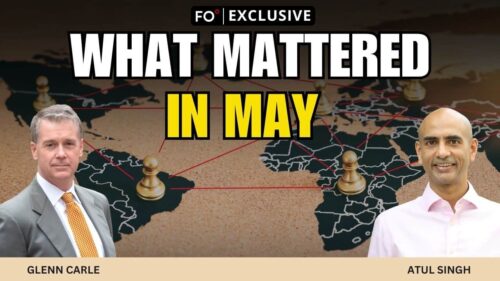
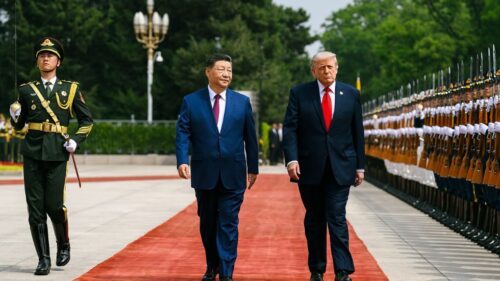
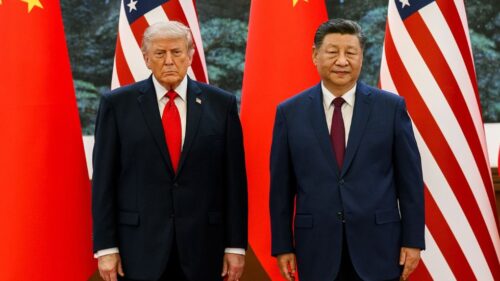
Editor-in-Chief Atul Singh and FOI Senior Partner Glenn Carle, a retired CIA officer who now advises companies, governments and organizations on geopolitical risk, examine the May 2026 summits in Beijing. Chinese President Xi Jinping first played host to US President Donald Trump and then to Russian President Vladimir Putin.
While the White House presents the Trump–Xi meeting as a historic diplomatic success, the reality does not match the rhetoric. Despite Trump taking along a gaggle of CEOs to Beijing, China did not concede much to the US. Similarly, Putin arrived in Moscow very much as a junior partner to Xi.
In a nutshell, years of strategic missteps by the US have helped propel China’s rise.
The Trump–XI summit was more show than substance
Trump’s visit to China was the first for an American president in nine years. The White House Fact Sheet tells us that “President Donald J. Trump Secures Historic Deals with China, Delivering for American Workers, Farmers, and Industry.”
Per this document, “the United States and China should build a constructive relationship of strategic stability on the basis of fairness and reciprocity. President Trump will welcome President Xi for a visit to Washington this fall.”
Furthermore, both “leaders agreed Iran cannot have a nuclear weapon, called to reopen the Strait of Hormuz, and agreed that no country or organization can be allowed to charge tolls.” Trump and Xi also “confirmed their shared goal to denuclearize North Korea.”
Trump and Xi also established two new institutions: a US–China Board of Trade and a US–China Board of Investment. According to the White House, these bodies will provide formal mechanisms for managing trade in non-sensitive goods and discussing investment issues between the world’s two largest economies.
The White House also trumpets a number of wins for American workers and businesses. China pledged to address US concerns regarding rare-earth minerals and related technologies that are critical to advanced manufacturing and supply chains. Beijing also approved an initial purchase of 200 Boeing aircraft, its first commitment to buy American-made Boeing planes since 2017. China also promised to purchase at least $17 billion annually in US agricultural products through 2028, restored market access for American beef producers and resumed poultry imports from states certified free of avian flu.
Glenn responds by saying that Atul has presented the smoke billowing from the chimney of the White House from the squib that fizzled into nothing. He then refers to Dean Acheson, arguably the greatest US secretary of state, who said, diplomats or officials in any negotiations claim they won every argument. Atul points out that the Chinese spin on the summit is very different and painted a picture of Xi being the senior statesman to Trump.
Glenn believes the summit was “sound and fury signifying not quite nothing but not a whole lot.” Trump did not achieve a grand bargain as he had hoped. Neither Taiwan nor trade was addressed in a damp squib. He believes the summit was “a tactical and even strategic win” for China. The US has made far too many strategic mistakes, aiding China’s rise.
Atul points out that China has achieved the biggest and fastest transformation in history. Never before have so many people emerged from poverty, and never before has a country gone from the catastrophes of the Great Leap Forward and the Cultural Revolution to the spectacular success of market reforms and extraordinary economic growth. Deng Xiaoping’s U-turn in 1978 from Mao Zedong’s Marxist orthodoxy was historic. By saying, “it doesn't matter if a cat is black or white, if it catches mice,” Deng propelled China to its dramatic rise after the humiliations of the 19th century and the disasters of Mao’s communism.
Glenn recalls a very different China from his childhood, when American mothers told their children to clean their plates because millions were going hungry in China. Today, that very country competes at the technological frontier and may become one of the leading powers in space exploration. Regardless of political disagreements with Beijing, Glenn says that the scale of China’s achievement is impossible to ignore.
He also goes on to say that China has transformed from a cat on the back of a porch feeding on scraps from the dinner table of the benevolent United States to a large lion or tiger that might eat the person feeding it. Unsurprisingly, American attitudes have shifted. Also, the US backed China to counter the Soviet Union. As Russia has declined and China has risen, the US has less reason to continue its old China policy.
Yet the US was unable to achieve anything concrete to contain China during this summit. The boards are symbolic and are likely to achieve much. China has now substantially diversified its agricultural imports, buying Argentinian beef and Brazilian soybeans. Prior to the summit, Boeing expected to sell 500, not 200, planes. After the summit, Boeing’s stock fell. Trump promised no more tariffs but the Chinese offered little in return. NVIDIA, the flagship American tech company, offered to sell its most advanced chips but no purchases have materialized yet. The bevy of tech CEOs went like tributaries to the Middle Kingdom and got nothing either.
The Taiwan question, North Korea and more
Trump’s willingness to discuss arms sales to Taiwan was an exercise in American self-restraint on Taiwan. Sadly, the US got nothing conciliatory from China in return. The strategic ambiguity that has been US policy for decades weakened during this summit.
In a nutshell, Trump’s negotiations with Xi followed a pattern. After Trump’s meeting with North Korean Supreme Leader Kim Jong Un, his hermit kingdom has tripled its number of nuclear weapons, improved the quality of its intercontinental ballistic missiles, increased missile numbers and sent dozens of thousands of soldiers to fight in Europe.
Similarly, Trump’s war against Iran has been a catastrophe. The Strait of Hormuz is now closed, which his ceasefire hopes to open in a wobbly and fuzzy way by paying $10–20 billion to Iran. In return, Tehran is likely to agree to much less stringent and less verifiable agreement than the Joint Comprehensive Plan of Action (JCPOA) negotiated by the Obama administration, which Trump abandoned. This tendency to undermine the little that is left of the American-led international order has undermined US strategic interests.
Atul points out that David Mahon, the Beijing-based executive chairman of Mahon China Investment Management Ltd, agrees with Glenn. In Mahon’s words,
“The recent US–China summit in Beijing, though symbolically significant as the first meeting between the two leaders on Chinese soil in nine years, yielded little concrete progress. While both sides emphasized cordiality and trade promises, underlying tensions over Taiwan, Iran and strategic distrust remained unresolved. The visit underscored a cautious, transactional coexistence between the rival powers, with deeper collaboration unlikely given entrenched geopolitical rivalries.”
Putin’s Beijing visit signals China’s growing strength
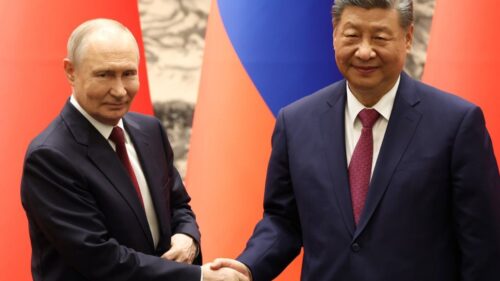
Atul goes on to discuss Putin’s visit to Beijing by noting that over 40% of the foreign exchange trading in Moscow is now in Chinese renminbi. Glenn responds by posing questions: Where are people going? They are going to Beijing. Why are they going? Because China has the wind in its sails.
Per Glenn, Beijing is now the reference point for both Russia and the US. Russia would not be able to continue its war without China. The US also needs China for trade and critical minerals. Therefore, both Trump and Putin showed up for a summit with Xi.
Atul quotes Mahon saying that “Putin met Xi as a reliable collaborator, confidante and compadre, but in economic and geopolitical terms, a junior, dependent partner.” He goes on to say that the Russia–China relationship is now more strategic. It is similar to the late 19th and early 20th century relationship between Imperial Germany and the Austro–Hungarian Empire. Like the former, China is now the industrial power while Russia is a supplier of fossil fuels. Despite border disputes and historical problems both Beijing and Moscow are locked together for now. China needs Russia’s energy while the latter needs the former’s manufactured goods and money.
[Lee Thompson-Kolar edited this piece.]
The views expressed in this article/video are the author’s own and do not necessarily reflect Fair Observer’s editorial policy.


























Join the conversation
Share your perspective
Log in to share your thoughts and take part in the discussion.