




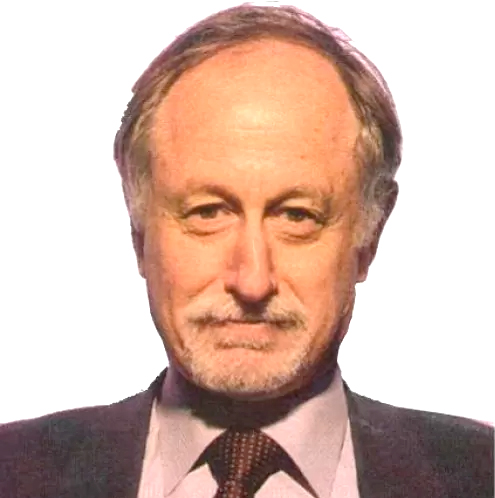
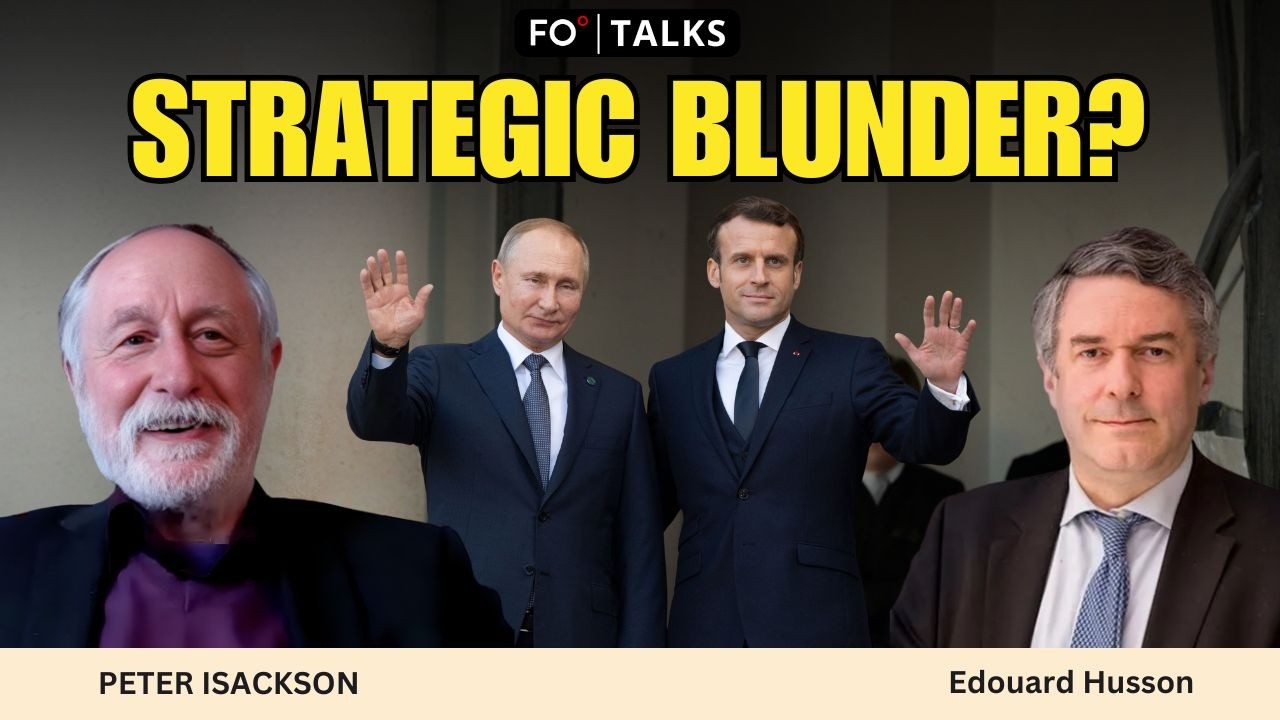
Fair Observer’s Chief Strategy Officer Peter Isackson speaks with historian Édouard Husson about the geopolitical implications of the Ukraine war and what it reveals about the erosion of diplomatic traditions in Europe. They examine how historical memory, strategic culture and competing visions of world order shape today’s crisis. Together, Isackson and Husson explore whether the conflict reflects not only tensions between Russia and NATO but also a deeper transformation in Western thinking about diplomacy, security and global governance.
The fading of historical memory in Europe
Husson begins by arguing that contemporary European leadership lacks the historical experience that once shaped diplomatic caution. Leaders of the Cold War era, he notes, had lived through the devastation of two world wars and therefore understood the stakes of confrontation. This memory informed figures such as French President Charles de Gaulle, German Chancellor Willy Brandt and UK Prime Minister Margaret Thatcher, who encouraged dialogue with the Soviet Union and contributed to ending Cold War tensions. By contrast, Husson believes today’s leaders have lost that sensibility. He describes “the lack of memory” as the defining problem shaping current policy choices.
For Husson, this generational shift has coincided with growing intellectual alignment with American strategic thinking. He suggests that younger European leaders absorbed a worldview emphasizing ideological clarity and decisive action rather than the historically grounded pragmatism that once characterized European diplomacy. This shift, he argues, has weakened Europe’s ability to act independently and to pursue negotiated settlements. Without leaders capable of challenging escalation, the continent risks drifting toward confrontation rather than compromise.
Ukraine’s complex history and competing identities
The discussion then turns to Ukraine as a case study of how historical complexity is often ignored in contemporary policymaking. Husson emphasizes that Ukraine’s regional diversity reflects centuries of shifting borders and cultural influences. Western regions were historically tied to Central Europe, while eastern areas developed closer links with Russia and the Soviet Union. These layered identities, he argues, complicate attempts to frame the conflict as a simple clash between two distinct civilizations.
Husson challenges narratives portraying Ukraine and Russia as entirely separate historical worlds. He calls it “absurd” to claim that the two share nothing in common, pointing to linguistic and cultural overlaps that developed over centuries. Isackson reinforces this point with personal reflections on family history and linguistic continuity, underscoring how identity in the region cannot be reduced to clear national categories. For Husson, ignoring this complexity has encouraged policies that deepen division rather than promote reconciliation.
He also recalls interviews conducted in eastern Ukraine, where many residents identified as Ukrainian yet opposed confrontation with Russia. These memories illustrate how local perspectives often diverge from geopolitical narratives promoted by outside actors. The failure to account for these nuances, he argues, has contributed to a conflict that pits Europeans against each other instead of encouraging diplomatic compromise.
Contradictions in threat narratives
Isackson raises another issue dominating European political discourse: the claim that failing to defeat Russia in Ukraine could lead to broader Russian expansion across Europe. Husson sees this argument as internally inconsistent. On one hand, Russia is described as militarily weak for failing to secure quick victory; on the other, it is portrayed as capable of sweeping across the continent. He highlights this contradiction to question the coherence of current rhetoric.
Husson argues that such narratives reflect what he calls an “Americanization” of European political thinking. Instead of traditional balance-of-power diplomacy, leaders increasingly adopt binary frameworks that divide the world into opposing camps. This shift, he contends, contrasts with earlier European diplomatic traditions, which emphasized coexistence among competing systems. By abandoning that approach, policymakers risk escalating conflicts rather than managing them.
The framing of global politics as a struggle between democracy and autocracy, Isackson suggests, echoes earlier crusading mindsets. Husson responds that past European diplomacy focused less on transforming other societies and more on maintaining stability between them. That pragmatic tradition helped Europe avoid major conflicts for long periods, Isackson says, and remains relevant today.
Neutrality, collective security and diplomatic traditions
Isackson and Husson then examine Russia’s long-standing calls for a neutral security zone in Europe. Husson traces this concept back through Soviet and post-Soviet thinking, arguing that Moscow has repeatedly sought arrangements based on neutrality and collective security. While interpretations differ, he sees continuity in these proposals and believes they reflect a broader European tradition of balancing interests rather than imposing ideological uniformity.
Husson contrasts this with modern approaches that prioritize ideological alignment. He argues that diplomacy historically avoided judging the internal political systems of other states and instead focused on managing coexistence. His primary concern, he explains, is not endorsing any particular regime but “securing peace in Europe.” This emphasis on stability over ideological competition reflects his broader critique of current Western policy.
Isackson adds that the concept of indivisible security — recognizing that one state’s safety depends on its neighbors — could provide a foundation for renewed diplomacy. Both speakers suggest that returning to this principle would require acknowledging competing interests and accepting compromise.
Toward a multipolar diplomatic future
The conversation concludes with a discussion of initiatives aimed at reviving diplomatic thinking. Husson outlines plans for an international school of diplomacy designed to bring together students from Europe, Asia, Africa and the Americas. Such collaboration could foster a multipolar mindset and rebuild the skills needed for negotiation in a fragmented world.
Husson also emphasizes the importance of cultural understanding and shared education. Training future leaders together could increase trust and encourage cooperation across civilizations. He ends on a hopeful note, expressing confidence that renewed emphasis on equality and mutual respect can help restore diplomacy. By acknowledging diverse perspectives and rejecting exceptionalism, the international system may move toward a more stable multipolar order.
[Lee Thompson-Kolar edited this piece.]
The views expressed in this article/video are the author’s own and do not necessarily reflect Fair Observer’s editorial policy.

























Comment