



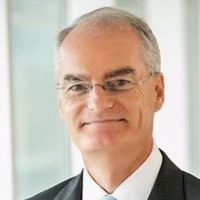


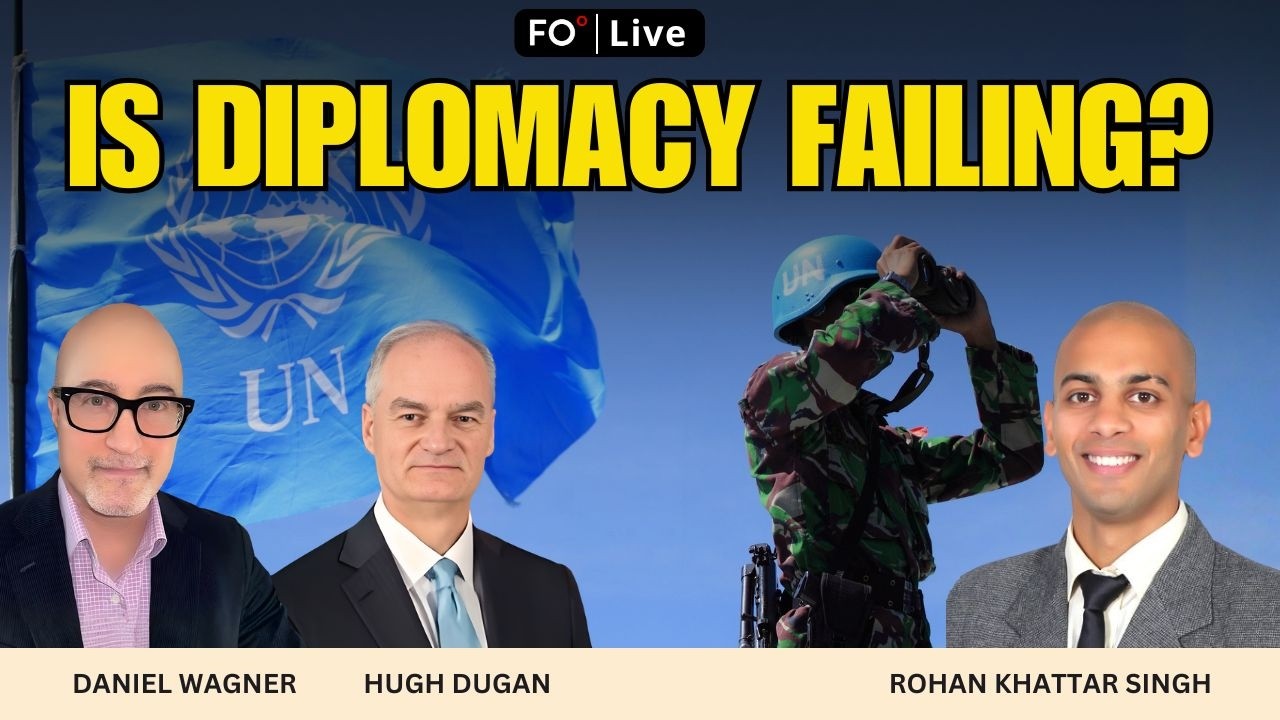
Fair Observer’s Video Producer Rohan Khattar Singh speaks with Hugh Dugan, a former UN insider and president of Multilateral Accountability Associates, and Daniel Wagner, the organization’s managing director and a political risk expert, about whether multilateralism can still function in a world shaped by war, rivalry and institutional fatigue. Global problems are increasingly interconnected, yet the institutions meant to manage them appear weaker, slower and less credible. Rather than declaring the system dead, Dugan and Wagner argue that multilateralism is changing form. The challenge now is to make it more accountable, more flexible and more relevant.
A fractured order without a clear replacement
Khattar Singh begins by asking whether today’s world is the most fractured it has ever been. Dugan resists that conclusion. He says the current moment feels unusually heavy because crises move faster, news travels instantly and everyone can now consume and comment on world events in real time. Even so, he cautions against assuming that the present is uniquely catastrophic.
Dugan points to one paradox in the current order. While internal conflicts remain widespread, wars between states are relatively rare by historical standards. He also argues that countries are now more likely than before to see distant crises as shared concerns rather than someone else’s problem.
Wagner takes a more skeptical stance. The real difficulty lies in the absence of an agreed successor to the liberal order that followed the Cold War. In his view, power has become too diffuse for any stable framework to hold. He describes this condition as “diffuse multipolarity,” which he says is “collapsing our normative architecture.” For him, the problem is not simply that the world is changing, but that no accepted structure has emerged to manage that change.
From old multilateralism to a more crowded system
The discussion then turns to what Wagner and Dugan call the “new multilateralism.” Dugan defines the old model as a system dominated by governments and intergovernmental bodies, where civil society, academics and ordinary citizens remain outside the room. That structure, he suggests, no longer reflects how influence actually works.
In its place, Dugan sees a more crowded environment. Social media, digital communication, corporations and wealthy private actors now shape global affairs alongside states. Issue-based networks can form quickly, operate across borders and exert real pressure on governments and institutions. He believes multilateralism is no longer just about formal diplomacy among states — it is also about how these newer actors enter spaces once reserved for governments alone.
This is one reason he believes institutions like the United Nations have struggled to keep pace. They still operate through older structures even as the world around them has changed. Dugan says that many of these bodies have become too bureaucratic and too inward-looking. In his telling, they have focused more on preserving themselves than on adapting to new realities.
Accountability, outcomes and the limits of reform
A central theme of the conversation is accountability. Dugan argues that international institutions have long measured the wrong things. Too often, they highlight outputs such as meetings, reports or programs rather than outcomes that show whether real progress has been made. For him, that distinction is critical. The question is not how active an institution appears, but whether it actually solves problems.
Wagner agrees and states that many countries have already responded to institutional weakness by shifting toward bilateral arrangements. They still need trade, security and cooperation, but they no longer trust the multilateral system to deliver. His preferred answer is not to abolish existing institutions, but to supplement them with more flexible coalitions built around specific issues.
He also sees a role for new tools. Wagner believes that digital governance, including blockchain and AI, could improve transparency and strengthen accountability across institutions that now rely too heavily on slow and opaque processes. Simultaneously, he doubts that major international bodies will change on their own. These organizations, he suggests, are too entrenched for wholesale reform unless governments and outside actors apply sustained pressure.
The UN Security Council and the problem of power
Wagner and Dugan disagree strongly about the UN Security Council. Wagner feels the current structure no longer reflects our modern world. He points to the five permanent members as a relic of World War II and says countries such as India remain unjustifiably excluded from the top table. He considers the arrangement outdated and increasingly hard to defend.
Dugan takes a different stance: that the Security Council still performs its core function because it forces the most dangerous powers to remain engaged with one another. “It works and it works well,” he says, not because it is democratic, but because it keeps major powers in the same room. Dugan finds the veto frustrating but useful. It gives powerful states an incentive to stay inside the system rather than act wholly outside it.
He is also doubtful that formal reform will happen soon. Instead of expanding the permanent membership, he proposes a more modest change: elected members should act as true representatives of their regions rather than merely advancing their own national interests. That would not solve the legitimacy problem, but it could make the Council more representative in practice.
Norms, middle powers and the future of the UN
Khattar Singh presses both guests on whether international rules now apply mainly to weaker states while great powers ignore them when convenient. Wagner largely agrees, though he feels that reputational costs still matter at the margins. Dugan answers with more optimism. He says the UN’s greatest achievement may not be enforcement, but the accumulation of norms that define acceptable conduct. From human rights to humanitarian principles, these standards still shape expectations even when they are violated.
The discussion ends by considering middle powers and the United States. Wagner sees countries such as India, Canada and Australia as increasingly important bridge-builders in a world where many states do not want to align fully with either Washington or Beijing. Dugan makes a similar point in more institutional terms: smaller and mid-sized states often value multilateral platforms more than great powers do because they need them more.
On the US, both reject the idea that Washington is simply abandoning multilateralism. Wagner sees recent funding cuts as a way of pressuring institutions to change. Dugan frames the Trump approach in more transactional terms, arguing that the UN is being treated like an underperforming property that powerful actors still believe could yield value if restructured.
The crisis of multilateralism is real, but it does not mean global cooperation is over. It means the old system no longer fits the world it claims to govern.
[Lee Thompson-Kolar edited this piece.]
The views expressed in this article/video are the author’s own and do not necessarily reflect Fair Observer’s editorial policy.



























Comment