




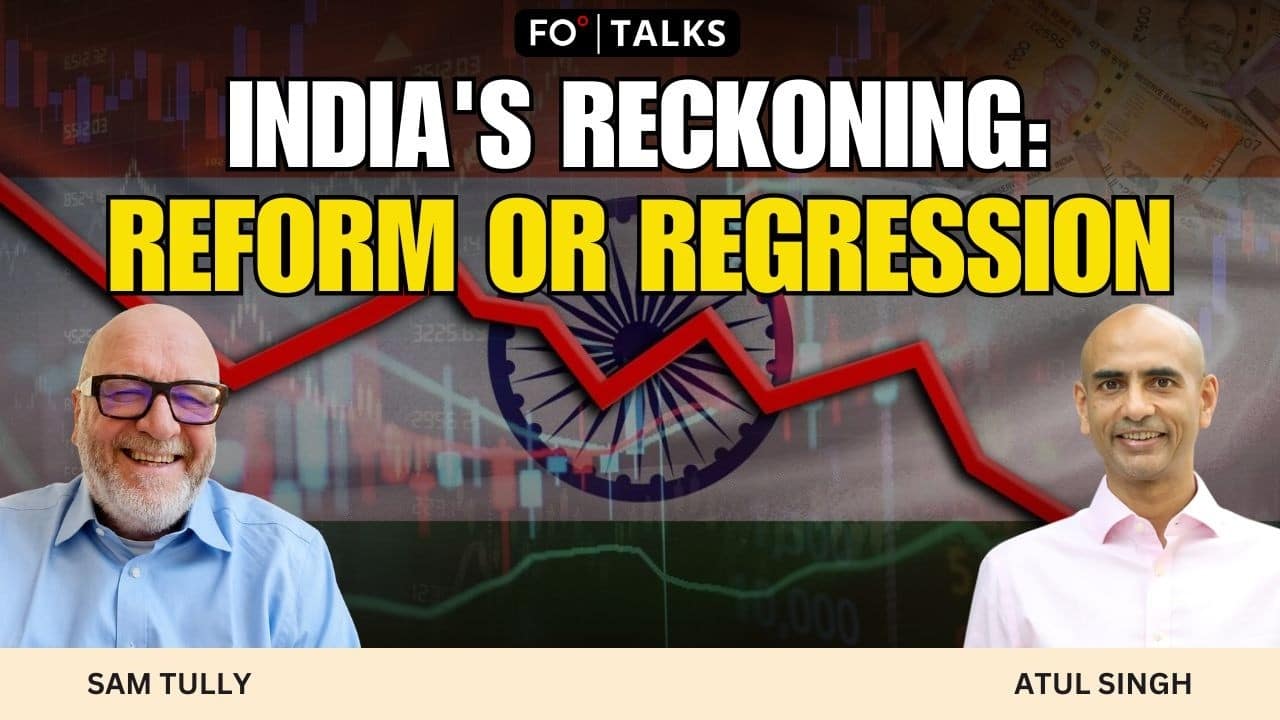
Editor-in-Chief Atul Singh and FOI Senior Partner Glenn Carle, a retired CIA officer who now advises companies, governments and organizations on geopolitical risk, examine how India’s “cockroach protests” have become a powerful symbol of youth frustration with Prime Minister Narendra Modi’s government.
The movement took its name after Chief Justice Surya Kant made remarks in May that many interpreted as comparing unemployed young Indians to “cockroaches.” Although Kant later insisted his comments had been misunderstood, the label quickly became a rallying cry for protesters. They were led by the Cockroach Janta Party (CJP), which had initially begun as a parody political party on social media.
Glenn wryly notes that parody, it seems, is dangerous, and perhaps we all must have sympathy for dictators and political figures who decry and try to suppress politically motivated humor. The deeper question is whether Indian protests were just youth letting off some steam or the beginning of a profound political shift in the country.
From exam scandal to political movement
The immediate trigger for the protests was the leak of university entrance examinations that affected two million students. Exam papers were available for sale, favoring those who could pay. Importantly, leaks have occurred with depressing regularity under Prime Minister Narendra Modi’s government. Naturally, millions of young Indians now believe the system is corrupt, unfair and unjust.
This month, dissatisfaction reached such a high that the youth took to the streets. Young protesters demanded accountability, transparency and greater opportunity. Above all, they called for a less rigged system. They also demanded the resignation of Dharmendra Pradhan, the then education minister. The Modi government responded haughtily, saying Pradhan’s resignation was out of the question.
Sonam Wangchuk, a well-respected environmental and civil rights activist, went on hunger strike in support of the youth protests. The government picked up Wangchuk and engaged in massive police brutality. This included firing an AK–47 into an unarmed crowd, using pellet guns and using sticks with nails at their ends to beat up the crowd. Police action fired up protesters who flooded the streets in many cities, and Pradhan resigned on July 25. This was a humiliating U-turn by the Modi government, which insisted that protesters were anti-national and Pradhan was a national treasure.
Why did students take to the streets?
Glenn points out that leaks, cheating and corruption have been going on for years. So he asks, why did students take to the streets?
Atul responds by saying that discontent against the Modi government has been brewing for a while. In the words of an officer of the heaven-born Indian Administrative Service (IAS), the Indian economy is dead and has been dead for a while. There are simply no jobs for India’s educated youth. Modi’s demonetization policy — arbitrarily taking high-denomination notes out of circulation — hurt small- and medium-sized industries. Far too many went bankrupt, and the people they employed ended up with no jobs. The Modi government also rolled out a nationwide goods and services tax in the middle of the financial year, destroying smaller businesses. More jobs disappeared.
Importantly, the Modi government has presided over corruption in the Ram Temple in Ayodhya. Modi’s Bharatiya Janata Party (BJP) won the election in no small part because it championed the building of a temple on the site where the Hindu god Ram was born after destroying a mosque on this site. Like many mosques, this was constructed in the medieval era after destroying a Hindu temple.
The Ram Temple was a civilizational project for the Hindu right, which believes India has been invaded relentlessly and colonized repeatedly. This temple was to be a Vatican-like project with world-class institutions such as universities and hospitals associated with the place of worship. Instead, a land scam, gross overinvoicing in construction and theft of cash donations by devotees have triggered public fury, especially in the Hindi heartland.
Atul comes from Uttar Pradesh, speaks Hindi and understands Indian politics. The Ram Temple corruption has incensed people because the Modi government has cheated faith and, in a religious country like India, there are consequences to cheating faith.
The US/Israel–Iran War has also taken a toll. Oil and gas prices have shot up. The government has forced consumers to use E20 fuel, which is standard petrol blended with 20% ethanol. Unfortunately, this E20 fuel is causing engine trouble and lowering mileage of two-wheelers and cars for millions of Indians.
The exam leaks were a spark coming on top of a dry sack of hay. Simmering public discontent erupted in fury on the streets. Such was the foul language used by protesters, especially young women, against Modi and his government, that many older people were shocked. Supporters of the Modi government blamed vested interests, foreign powers plotting Modi’s downfall and a cynical opposition, but the fact remains that far too many people revolted against what they saw as a corrupt, autocratic and arrogant government.
Why leaks occur so maddeningly regularly
Atul also explains why leaks occur so regularly. The reasons are to do with both demand and supply.
On the demand side, exams are the gateway to scarce seats in top institutions, especially medical and engineering colleges, and government jobs. They are the only institutional path for upward social mobility. So, a multibillion-dollar coaching industry has developed to coach students for these exams. If a child joins a private coaching institution, he or she will be drilled for the entrance exams. Coaching starts early and ends late. The child does not go to a real school, and the private coaching company gets dummy, i.e. fake, attendance in some school so that the child qualifies for school-leaving exams. These require a minimum attendance by law.
Atul’s father believes that the coaching industry has created a culture of deceit, dishonesty, immorality and cheating. It is yet another story of misaligned incentives. The coaching companies can charge higher fees and get more students if their clients crack the entrance exams. So, it is in their interest to bribe folks conducting tests to leak papers. The demand to succeed in entrance exams is exceedingly high and the means justify the ends.
At the same time, the supply of exams is highly compromised. The National Testing Authority (NTA) is structurally poorly designed. It is headed by Abhishek Singh, an IAS officer who was in charge of AI a few months ago. He has never conducted any examination of note before his NTA assignment. Unlike the UK, an educationist is not in charge of conducting exams. In India, the IAS controls everything from the Reserve Bank of India and the Archaeological Survey of India to exams to engineering and medical colleges. The top man or woman lacking domain expertise is a recipe for disaster. Furthermore, the NTA is undermanned and uses contractors. It has also proved to be irredeemably incompetent and corrupt, causing public fury among millions of young people.
Leaks are a symbol of a failing republic
Atul points out how the youth cockroach protests took off because of spectacular incompetence at the highest levels in the Modi government. First, the Modi government underestimated the CJP, dismissing it as a mere social media phenomenon. Second, there was a complete intelligence failure of the state machinery about the scale of public discontent. Third, the key people at the top were terrible at their jobs.
Speaking of top people, Atul points to Taranjit Singh Sandhu, the lieutenant governor of Delhi, and Anurag Kumar, Delhi’s police commissioner. Sandhu is a retired officer of the Indian Foreign Service (IFS) who was India’s ambassador to the US, while Kumar is an officer of the Indian Police Service (IPS) who headed the Intelligence Bureau (IB) at the Indian embassy in Washington, DC. Kumar served Sandhu a few years ago, and the two go back a long way. Neither has any experience of law and order or crowd control. In particular, Sandhu is known to be a narcissist obsessed with self-promotion, incapable of deep conversations and of doubtful personal integrity. The BJP gave this IFS officer a ticket to run for parliament in 2024, but he lost badly. Kumar was a spy who was plucked out of IB and made the big boss of the police just before the police unleashed violence on the young protesters.
Sandhu and Kumar are emblematic of fundamental incompetence at the top of the Modi government. It has followed a policy of what Atul has called Vegetarian Stalinism, which was the subject of a full episode of The Dialectic, the flagship podcast by Atul and Glenn. In this policy, there has been a complete centralization of power. Modi rules through bureaucrats of the IAS, IFS, IPS et al who are sycophants. His face adorns posters everywhere from trains to notice boards in schools. He takes credit for everything. At some point, Modi was bound to take the blame for something, and the leaks triggered a bullet he could not dodge.
The fury of the protests demonstrates that the youth have lost faith in the Modi government, the institutions of the state and the Indian republic itself. However, the CJP protests do not have a constructive agenda or any substantive ideas for reform. They are emotive, reactive and frenzied. The young are protesting because they feel everyone and everything is for sale, from the chief justice of the Supreme Court to entrance examinations. Think of the CJP as an Indian counterpart to Occupy Wall Street that lacks coherence as a political movement.
The protests are politically extremely significant, though. Opposition leader Rahul Gandhi protested in front of Modi’s residence and was arrested. Other opposition parties also jumped into the fray to support protesters. More importantly, BJP leaders are scared that they might have to spend time in opposition because of the loss of popularity of their party and their leader among the young. Senior BJP leader and former education minister Murli Manohar Joshi decried the use of force by the Modi government. Joshi served in the previous BJP government that lost power in 2004 and is a former professor of physics. His comments show that Modi is losing ground even within the BJP.
Atul makes a bold and final point that these protests mark the beginning of the end of Modi. Modi has run a centralized government that intimidates its critics by unleashing the Enforcement Directorate, misusing the income tax department and inflicting decades of legal trouble. Now, the dam has burst. The Hindu political project has run out of steam. The urban Hindu middle class that venerates exams and expects them to be sacrosanct has lost faith in Modi and the BJP. In the coming months, India’s economic crisis will intensify, and revolutions depend on the price of bread. So, expect more chaos. Also, expect a coalition government after the next election. The BJP will not win.
[Lee Thompson-Kolar edited this piece.]
The views expressed in this article/video are the author’s own and do not necessarily reflect Fair Observer’s editorial policy.





























Comment