




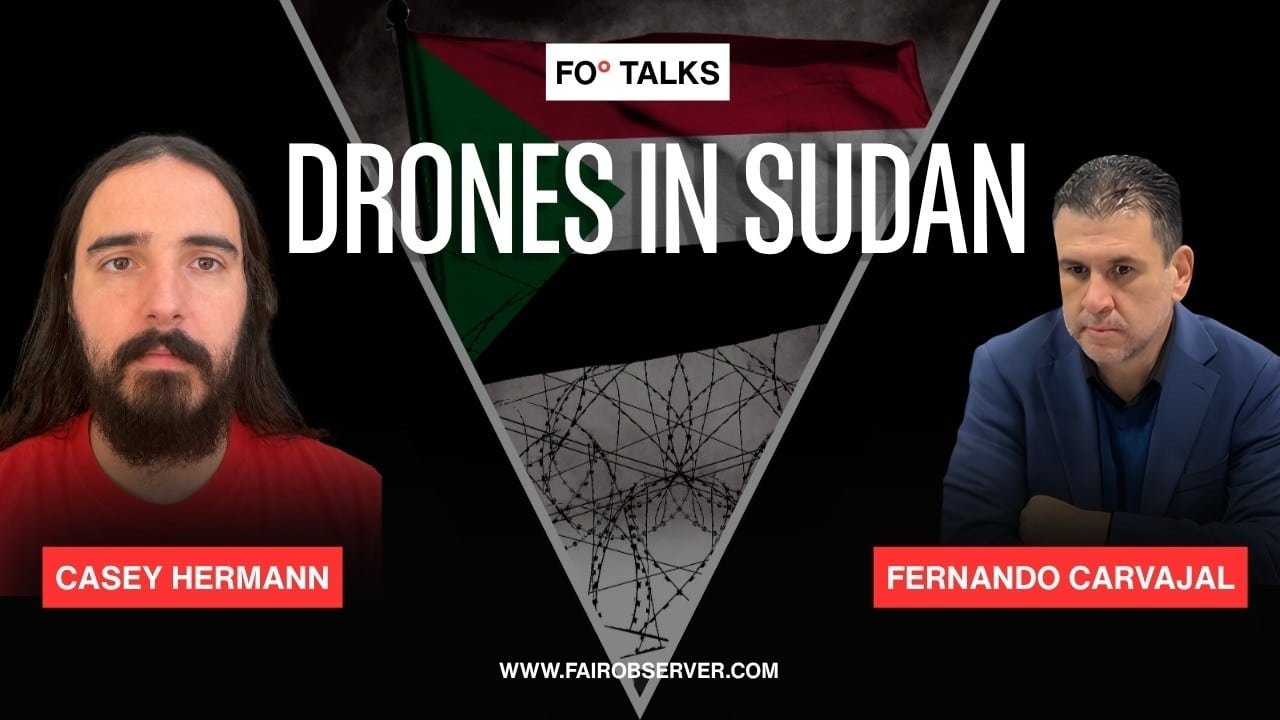
Assistant Editor Casey Hermann speaks with Fernando Carvajal, the executive director at The American Center for South Yemen Studies, about Sudan’s bloody civil war. They examine the struggle between General Abdel Fattah al-Burhan’s Sudanese Armed Forces (SAF) and Mohamed Hamdan Dagalo’s Rapid Support Forces (RSF), tracing how foreign rivalries, drone warfare and failed diplomacy deepen the humanitarian catastrophe.
Military rule and foreign interests drive the conflict
Carvajal traces the current conflict to the October 2021 military coup against Sudan’s civilian-led transitional authorities. The coup derailed efforts to move beyond former Sudanese President Omar al-Bashir’s regime. In April 2023, the partnership between Burhan and Dagalo, known as Hemedti, collapsed into war.
For Carvajal, the split involves competing visions of governance and the influence of Bashir-era Islamist networks within military institutions. He presents the RSF’s opposition to Muslim Brotherhood influence as central to its stated position. This account describes the group’s political justification rather than establishing its commitment to civilian government.
Sudan’s instability also reflects decades of military rule, corruption and regional interference. Agricultural potential has repeatedly collided with insecurity, inadequate investment and disrupted commerce, weakening the foundations of recovery.
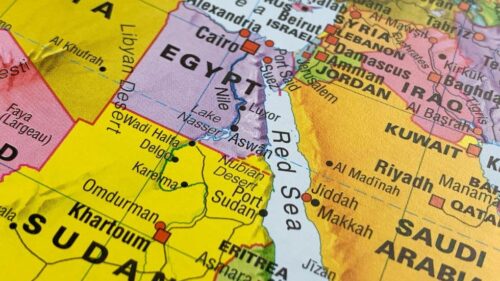
Sudan connects African hinterlands with the Red Sea corridor, placing its coastline at the intersection of commercial routes and security rivalries. Port Sudan serves both as a strategic asset and as the SAF government’s base after its displacement from Khartoum.
Carvajal identifies China and Russia as seeking logistical access, while describing Iranian involvement in weapons storage and military support. He recounts RSF allegations that warehouses near Port Sudan held drones and other weapons associated with Iran and Yemen’s Houthis. These allegations underpin his criticism of coverage that overlooks the port’s military uses.
Saudi Arabia’s nearby commercial and energy infrastructure adds another strategic dimension. Carvajal links Riyadh’s engagement with Burhan to concerns about threats originating across the Red Sea. Egyptian, Turkish and Gulf interests further entangle Sudan’s battlefronts with regional competition. These overlapping pressures make Sudan’s war increasingly difficult to resolve.
Displacement and economic collapse reinforce each other
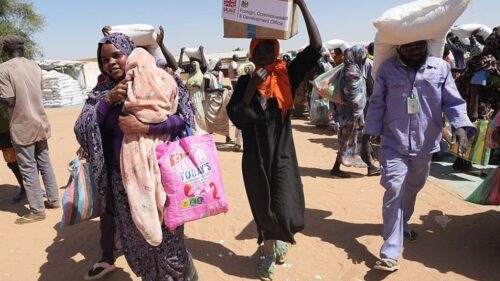
Hermann turns to the civilians fleeing the fight and the pressure on neighboring countries. Refugees enter Chad, Egypt, Ethiopia and South Sudan, spreading the humanitarian burden across states already facing economic difficulties. Carvajal also describes Egyptian returns of Sudanese refugees.
Inside Sudan, displacement, drought and damaged transport routes undermine farming and trade. Armed actors extract revenue through gold exploitation, taxation and extortion, draining communities while financing continued warfare. Reduced harvests and disrupted markets compound hunger and inflation.
Carvajal connects deteriorating humanitarian assistance to US funding restrictions and inadequate contributions from other powers. Direct donor involvement can also reinforce rivalries when assistance favors particular factions.
Drones expand civilian danger
Drone operations increasingly precede ground offensives and shape fighting around cities. Carvajal describes SAF access to Iranian and Turkish drones, alongside Egyptian support, as strengthening its aerial capabilities.
Hermann raises a reported Darfur strike that killed approximately 35 people. Carvajal also discusses a strike on a UN humanitarian convoy, illustrating the civilian consequences of targeting failures. Because the SAF claims governmental legitimacy, he argues, it has a substantial responsibility toward civilians.
Urban fighting compounds these dangers. Carvajal describes military forces and Islamist militias operating within populated areas, exposing residents to attacks and coercion. Although drones can enable precise targeting, technical capability alone cannot ensure civilian protection. Sudan, Yemen and Ukraine reveal how rapidly weapons and tactics migrate between conflicts.
Political exclusions leave diplomacy at an impasse
Carvajal doubts that either principal faction seeks partition. Both aspire to govern a unified Sudan. Nevertheless, entrenched territorial control could produce fragmentation. A separate Darfur would be landlocked, creating further disputes over access, resources and relations with neighboring states.
Diplomacy faces another impasse. In his account, the United States, Egypt, Saudi Arabia and United Arab Emirates propose humanitarian deescalation and dialogue, but disagreement over Islamist participation obstructs progress. The RSF accepts the proposal in principle, while Burhan resists excluding allies central to his coalition.
Sudan’s prospects therefore depend on more than battlefield outcomes. Effective mediation must reconcile competing political interests while securing humanitarian access and restoring civilian livelihoods. Without that combination, technological escalation and foreign competition threaten to prolong the catastrophe across the country.
[Lee Thompson-Kolar edited this piece.]
The views expressed in this article/video are the author’s own and do not necessarily reflect Fair Observer’s editorial policy.




































Comment