

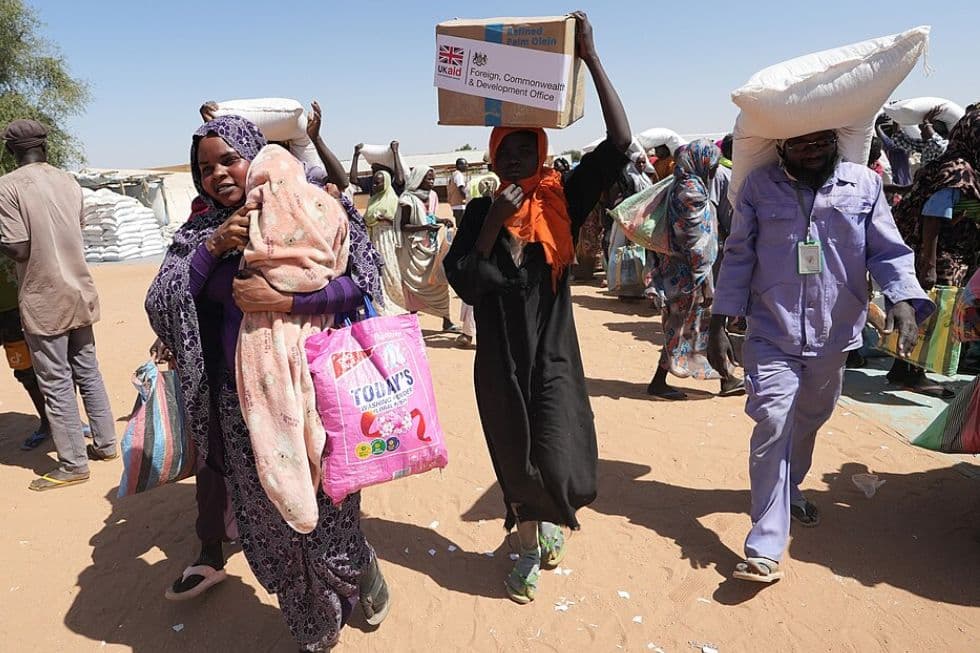



The war in Sudan is the largest humanitarian disaster on earth. And it is being ignored. Over three years, the war has displaced millions, destroyed entire cities and produced levels of violence that rival the worst episodes of the 21st century. Entire communities have been erased. Mass killings have taken place in days, not months. Famine is spreading, aid is collapsing and, in some regions, survival itself has become uncertain.
The war and its consequences are not hidden. It is simply not being treated as urgent. The question is no longer what is happening in Sudan, but why the world has decided not to respond.
A war of unmatched scale
The conflict that began in April 2023 between the Sudanese Armed Forces (SAF) and the Rapid Support Forces (RSF) has evolved into something far larger than a conventional civil war. It is a system of violence directed not only at opposing forces, but at civilians. Massacres in Darfur, particularly in cities such as El Geneina and El Fasher, have reached levels that many analysts argue meet the threshold of genocide. Entire populations have been targeted along ethnic lines. Reports of systematic sexual violence, including against children, have become widespread.
Displacement has reached extraordinary levels, with millions forced from their homes into conditions where food, shelter and medical care are no longer guaranteed. In camps across neighboring countries, the demographic reality is stark. The overwhelming majority of those who arrive are women and children. Men are often missing, with many having been killed, detained or forcibly recruited.
Part of the problem is that the scale is so difficult to process. When numbers become too large, they stop generating urgency and instead become background noise. But Sudan is not background — it is the most severe humanitarian crisis of this century.
Why the world has looked away
The neglect of Sudan is not the result of a single cause. Instead, it is the product of several reinforcing factors. The first is complexity. Unlike wars where responsibility can be easily assigned, Sudan offers no simple narrative. Both the SAF and the RSF have been implicated in serious abuses. The conflict is shaped by decades of political manipulation, ethnic division and competing centers of power. It does not fit into a clear framework of aggressor and victim that is easily communicated or understood.
The second is competition. Sudan is unfolding in a world already saturated with crises. The war in Ukraine, the escalation in the Middle East and a series of global shocks have created an environment in which attention is finite. Media systems and political institutions prioritize what appears most immediate or strategically relevant. Unfortunately for the people of Sudan, their conflict falls outside that hierarchy.
The third is strategic discomfort. External actors are not neutral observers. Regional and international powers are involved, directly or indirectly, in sustaining the conflict. Support networks, arms flows and political backing continue to reach both sides. This makes decisive international action more difficult, and it reduces the incentive to act. Acknowledging the scale of the crisis would require confronting the role of those who enable it, but it is easier for those parties not to do so.
The fourth is a quieter factor at work. Crises that lack a clear endpoint tend to lose attention faster. Sudan offers no visible path to resolution, no obvious turning point and no moment that signals closure. In such conflicts, fatigue sets in early, even as the violence intensifies.
The cost of ignoring collapse
Neglect does not freeze a conflict — it allows it to deepen. Sudan is now approaching a point where recovery becomes exponentially harder. Infrastructure is collapsing, economic activity has broken down, humanitarian systems are underfunded and overstretched and food insecurity is expanding toward famine conditions in multiple regions. The longer this continues, the more irreversible the damage becomes.
Sudan sits at a strategic crossroads linking the Sahel, the Horn of Africa and the Red Sea. Instability here does not stay local. It spreads through migration, trafficking networks, economic disruption and regional security breakdowns. Trade routes and fragile neighboring states are already exposed to the consequences of prolonged collapse. Ignoring Sudan does not prevent consequences — it delays them.
History offers a familiar warning. Conflicts dismissed as distant and complex have a tendency to return as larger, less manageable crises. The absence of attention is not neutrality. It is a choice that shapes outcomes. Sudan is not being ignored because it does not matter; it is being ignored because responding to it is inconvenient. That distinction will not hold indefinitely.
The war will either force itself back into global attention through escalation and spillover, or it will continue to destroy a nation largely unseen. Neither outcome reflects a lack of information. It only proves a lack of will.
[Andrew Litz edited this piece]
The views expressed in this article are the author’s own and do not necessarily reflect Fair Observer’s editorial policy.





Join the conversation
Share your perspective
Log in to share your thoughts and take part in the discussion.