




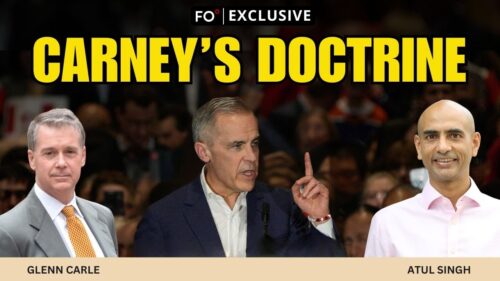
Editor-in-Chief Atul Singh and FOI Senior Partner Glenn Carle, a retired CIA officer who now advises companies, governments and organizations on geopolitical risk, dive into the most important world news of the last month. Old assumptions about borders, alliances and political authority are beginning to break down. Atul and Glenn examine how governments are responding to this new world order — sometimes with courage and opportunism. Principled leadership remains possible but increasingly rare as institutions struggle to manage migration, geopolitical rivalry, corporate power and political turmoil.
The Ceuta crisis exposes Europe’s migration divisions
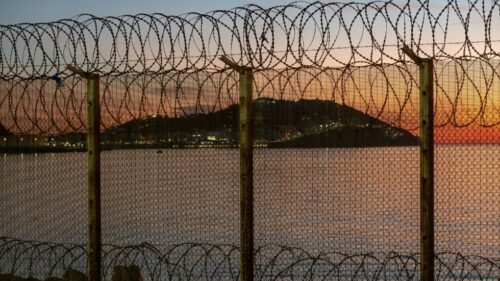
The Ceuta crisis continues to rock Spain and Europe. Spain has two enclaves in North Africa: Ceuta and Melilla. They are the only European territory on mainland Africa. Morocco has never recognized Spanish ownership of these two enclaves and four other smaller territories in the narrow strait of Gibraltar. Morocco claims them as a “historical and geographical right,” while Spain maintains that its sovereignty over the territories is absolute, non-negotiable and outside of any diplomatic discussion.
On July 30 and 31, 60,000–80,000 people, largely young men, swam over from Morocco to Ceuta. This overwhelmed local authorities, prompted the deployment of the Spanish military and reopened the European Union’s deepest divisions over immigration. Some capitals called for a suspension of free movement with Spain. Now analysts say the Ceuta crisis is a first test of the EU’s new Pact on Migration and Asylum.
The US State Department claimed that the Spanish government had led efforts “to enable and facilitate mass illegal migration into Europe.” Denmark and Italy led a similar critique at the EU. They sent a letter cosigned by 22 member states calling for coordinated EU border measures.
This year, Spain launched a historic mass regularization program to grant legal residency and work permits to hundreds of thousands of undocumented immigrants. Spanish Prime Minister Pedro Sánchez’s government introduced the scheme to integrate undocumented workers into the formal tax system, fill critical labor shortages in sectors like agriculture and tourism, and boost economic growth. Over one million people applied. The Denmark-led letter accused Spain of enacting policies that were a “pull factor” for the Ceuta mass migration. European far-right parties have seized on the crisis to attack Spain and Europe’s migration policy.
Canada charts a course away from Washington
In North America, Canada has walked “away from a bad deal, and what comes next.” In the recent US–Canda trade talks, Canada refused the US’s new terms. Unlike other American allies, Canadian Prime Minister Mark Carney has stood up to US President Donald Trump. The “rupture” he talked about in his speech at Davos has now transpired.
On August 22, after the talks fell through, he declared that Canada “cannot control the storm blowing in from Washington,” but the country “can chart a new course by building Canada strong at home and diversifying our trading relationships abroad.”
From Mecca to Meta
Over in the Middle East, on August 7, Saudi Arabia, Turkey and Pakistan signed an agreement in the holy city of Mecca, saying an attack on one of them would be an attack on all of them. The Mecca Pact has adopted the motto immortalized by French author Alexandre Dumas: “All for one and one for all.” Saudi Arabia stresses that the Mecca Pact is not a Sunni military axis, but Atul and Glenn think the lady doth deny too much.
Atul and Glenn move on to Meta in the US. The technology company faced a federal trial because 29 US states claimed that it had engineered its platforms to be addictive to children. This came after a Judge Bryan Biedscheid in New Mexico ordered Meta to pay an extra $567 million on top of the $375 million it was ordered to pay in May, when the company was found liable for harming children. Biedscheid ruled on August 6 that Meta had contributed to a mental-health crisis and he described the firm as a “public nuisance.”
In the words of The New York Times: Big Tech is facing a “Big Tobacco moment” as landmark courtroom losses, major jury verdicts and multi-billion-dollar state settlements draw direct parallels to the historic 1990s tobacco litigations.
The passing of a great leader
On August 12, Zhu Rongji died at the age of 97. He was China’s premier from 1998 to 2003. One of China’s greatest leaders, Zhu steered China’s entry into the World Trade Organization (WTO) in 2001. Two things happened that year: the September 11 attacks on the US and China’s entrance to the WTO. Zhu had the courage to push through painful reforms that led to spectacular economic growth and integrated China into the global economy.
Zhu was always a man of courage. In 1957, during the Hundred Flowers Campaign, he criticized Mao’s economic policies, saying that they promoted “irrationally high growth.” Naturally, Zhu was purged and spent many years in the wilderness. Former Chairman of the Central Military Commission Deng Xiaoping rehabilitated Zhu in 1978 and the rest is history. Urbane, sophisticated and articulate, Zhu often spoke with Western leaders and intellectuals. Atul contends that China’s current leaders lack his nuance, understanding and expertise.
Now, China is charting a very different route and the political temperature in the region is rising. On August 20, Taiwan proposed an 18% increase to its defense spending in order to counter the increasing Chinese threat. “We have moved a long way from Zu's days,” Atul quips.
Some other important developments
This month, Hungary yielded good news. On August 11, András Baka became the new president. Former Hungarian Prime Minister Viktor Orbán removed Baka as the head of the Supreme Court in 2011, as he had made the “unpardonable mistake” of criticizing Orbán. This well-regarded former judge will now oversee the challenging task of the drafting of a new constitution.
There was some bad news too. At Cambridge University, Professor Jason Arday, the academy’s youngest black professor, was accused of plagiarism. He resigned on August 5 amid intense pressure and committed suicide on August 15. The Arday suicide has sparked ferocious discussion in the UK.
There is much discussion in the US too. On August 5, Abdul El-Sayed defeated Haley Stevens in Michigan to become the Democratic Senate candidate for the state. El-Sayed is a Progressive Democrat while Stevens was backed by the establishment. Clearly, the Democratic Party is rebelling against its establishment, at least in some parts of the country.
[Lee Thompson-Kolar edited this piece.]
The views expressed in this article/video are the author’s own and do not necessarily reflect Fair Observer’s editorial policy.

































Comment