


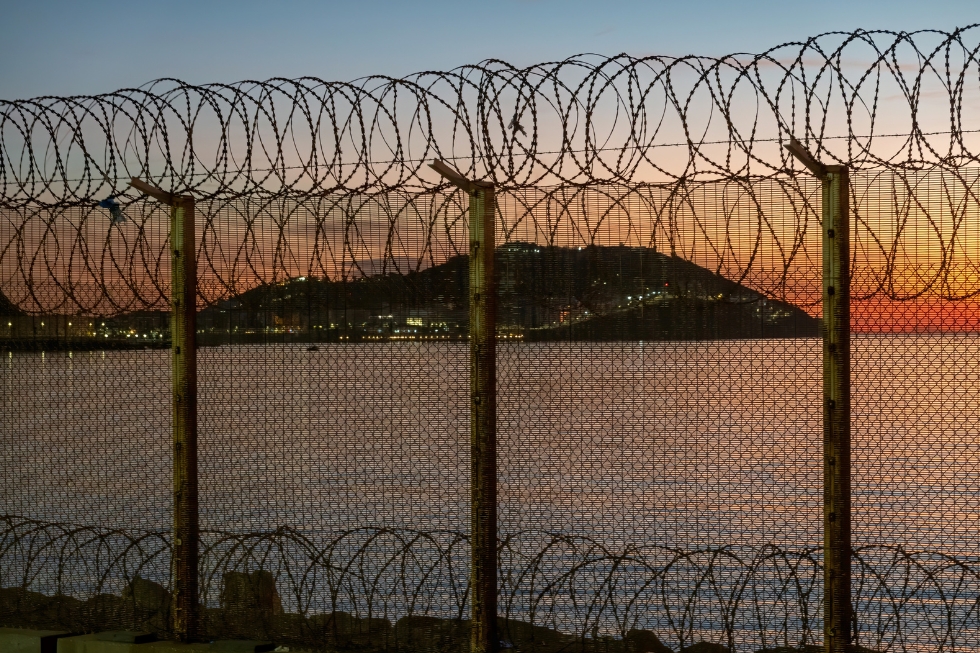



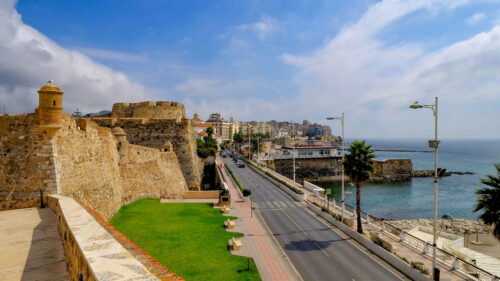
Two weeks ago, at least 72 people died while attempting to reach the Spanish exclave of Ceuta from Morocco. Around 60,000 people made it into Ceuta, many of them by sea, others by climbing over border fences. Within just a few days, however, most of them had already returned to Morocco.
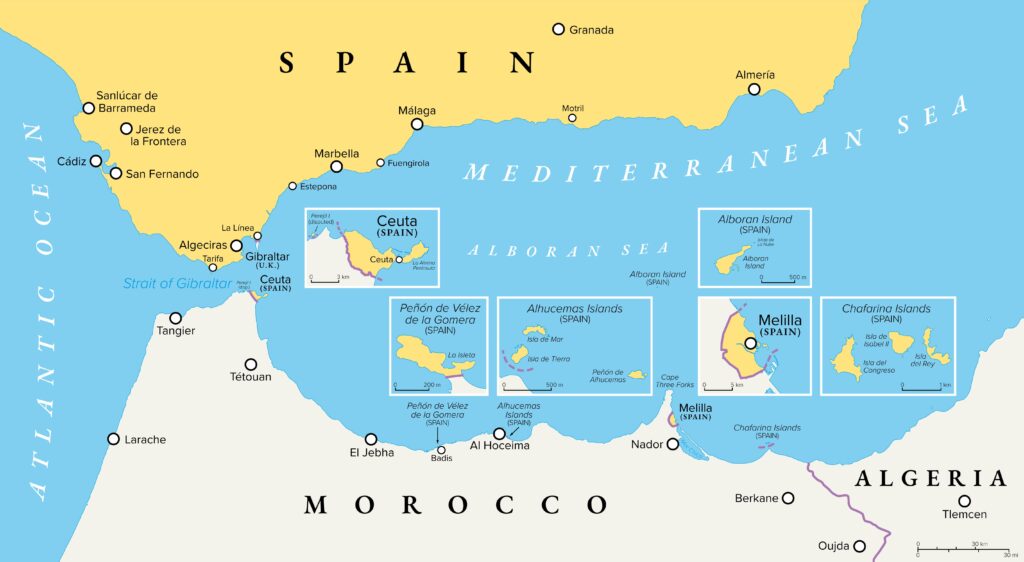
Both Morocco and Ceuta are located in Africa. But politically, Ceuta, like Melilla, belongs to Spain and therefore to the EU. Europe’s response to the unprecedented influx into the exclave has been almost unanimous. What happened has been described as a “threat to Europe’s security.” Some have even called it an “attack” or an “invasion.” Europe’s external borders, we are told, must be better protected.
Twenty-two of the EU’s 27 member states have now signed an open letter initiated by Italy’s far-right government under Prime Minister Giorgia Meloni, criticizing Spain’s migration policy and calling for stricter security measures at Europe’s borders. Italy has further suspended its participation in the Schengen Agreement (which allows citizens of Schengen countries to cross the internal borders of all member states without passport checks) with Spain. That this is little more than political posturing is evident from the fact that Ceuta is not part of the Schengen Area in the first place.
While Europe appears quick to agree on yet more repression, the 72 lives irreversibly lost have become an afterthought. Most of those who died had most of their lives still ahead of them and hoped for a better future. Instead, they found death on what they believed was the path toward that future. As right-leaning governments across Europe compete with one another in increasingly alarmist security rhetoric, the fundamental question is largely ignored: Why does a young person take such enormous risks in order to reach Europe?
Why people risk everything for Europe
People flee war, violence, persecution, poverty and the hopelessness that arises when there is little prospect of a safe and dignified life. Border fences cannot deter those who see no viable future where they are, but merely make their journeys more dangerous and more deadly. One can debate at length the respective roles played by colonialism and other historical injustices, and current political failures, in creating global inequality. But this does not change the fact that a young person in Morocco, facing high youth unemployment and low wages, has every reason to perceive their situation as profoundly unjust when compared with life in much of Europe.
This inequality is not an abstract concept. In a world where everyone is connected to everyone else, and our planet, in many ways, has become a global village, it is experienced directly. People see how others live on their phone screens every day.
Nineteen-year-old Nok in Thailand can watch in real time as Moritz, a boy her age from Munich, spontaneously buys a flight ticket to Bangkok and spends six months traveling through Southeast Asia to “find himself.” A comparable journey to Europe is out of reach for Nok, given her limited financial means and the enormous difficulty of obtaining a Schengen visa, and it will remain an impossibility in the foreseeable future.
“Come through legal channels,” Europe tells migrants. Kwame in Ghana wants nothing more than to do exactly that. He successfully applies for a master’s program in Germany, spends months of his time and a considerable amount of money on language tests, certifications, translations and other documents he needs for his visa application, and saves the required funds for his living expenses in Germany. Yet when he requests an appointment at the German Embassy in Accra, he learns that the waiting time is six to 12 months. He will miss the start of his program. Whether his admission will still be valid the following year remains uncertain.
Amina is eight years old and lives in Sudan. For months, there has been little to no schooling in her region. The healthcare system has largely collapsed. While her parents struggle every day to find enough food and clean water, many children in Europe take education, healthcare and security for granted.
José is 24 years old and works 12 hours a day in a textile factory in Honduras for a wage that barely allows him to survive. The clothes he sews are later sold in Europe, often for more money than he earns in an entire week.
Nok, Kwame, Amina and José had no control over where they were born. Neither did Moritz. Yet the consequences of this accident of birth could hardly be more different. It may be easier to demand higher fences, but as long as such extreme inequalities in security, prosperity and future opportunities exist between different regions of the world, people will continue trying to overcome those fences.
The path forward: beyond borders and barriers
The challenges of migration cannot be solved by sealing oneself off. They require an honest debate about how the global order can be made fairer. This is not simply a matter of extending humanitarian compassion as a voluntary gesture; it is a question of how much inequality can be morally justified when it is based largely on the accident of where someone happens to be born.
If Europe wants to prevent images like those from Ceuta in the future, it must address the root causes of migration more decisively — among other things through fairer trade relations, greater commitment to development cooperation and the expansion of legal migration pathways. Paradoxically, the opposite trend can often be observed today. Many European countries, for example, have significantly reduced their development aid budgets in recent years — a sign of the growing influence of populism, which prioritizes short-term political gains over long-term solutions. Ultimately, such policies harm not only people in countries of origin, but Europe itself as well.
[Kaitlyn Diana edited this piece.]
The views expressed in this article are the author’s own and do not necessarily reflect Fair Observer’s editorial policy.
Redrawing Africa: AI Blunders and Colonial Blind Spots
Two African stories — one comic, one tragic — collide this week: a State Department slide misdrawing Africa’s HIV-aid map...
How the Far-Right is rewriting Germany’s 2015 “Refugee Summer”
Ten years after Germany accepted nearly 900,000 refugees, politicians have rewritten the story of the 2015 “refugee summer” as a...
From the Maghreb to the East, Poking the EU Has an MO
In the Maghreb region, one of the best solutions would be a pragmatic and flexible bipartisan agreement between Spain and...
Support Fair Observer
We rely on your support for our independence, diversity and quality.
For more than 10 years, Fair Observer has been free, fair and independent. No billionaire owns us, no advertisers control us. We are a reader-supported nonprofit. Unlike many other publications, we keep our content free for readers regardless of where they live or whether they can afford to pay. We have no paywalls and no ads.
In the post-truth era of fake news, echo chambers and filter bubbles, we publish a plurality of perspectives from around the world. Anyone can publish with us, but everyone goes through a rigorous editorial process. So, you get fact-checked, well-reasoned content instead of noise.
We publish 3,000+ voices from 90+ countries. We also conduct education and training programs
on subjects ranging from digital media and journalism to writing and critical thinking. This
doesn’t come cheap. Servers, editors, trainers and web developers cost
money.
Please consider supporting us on a regular basis as a recurring donor or a
sustaining member.
Will you support FO’s journalism?
We rely on your support for our independence, diversity and quality.





Comment