




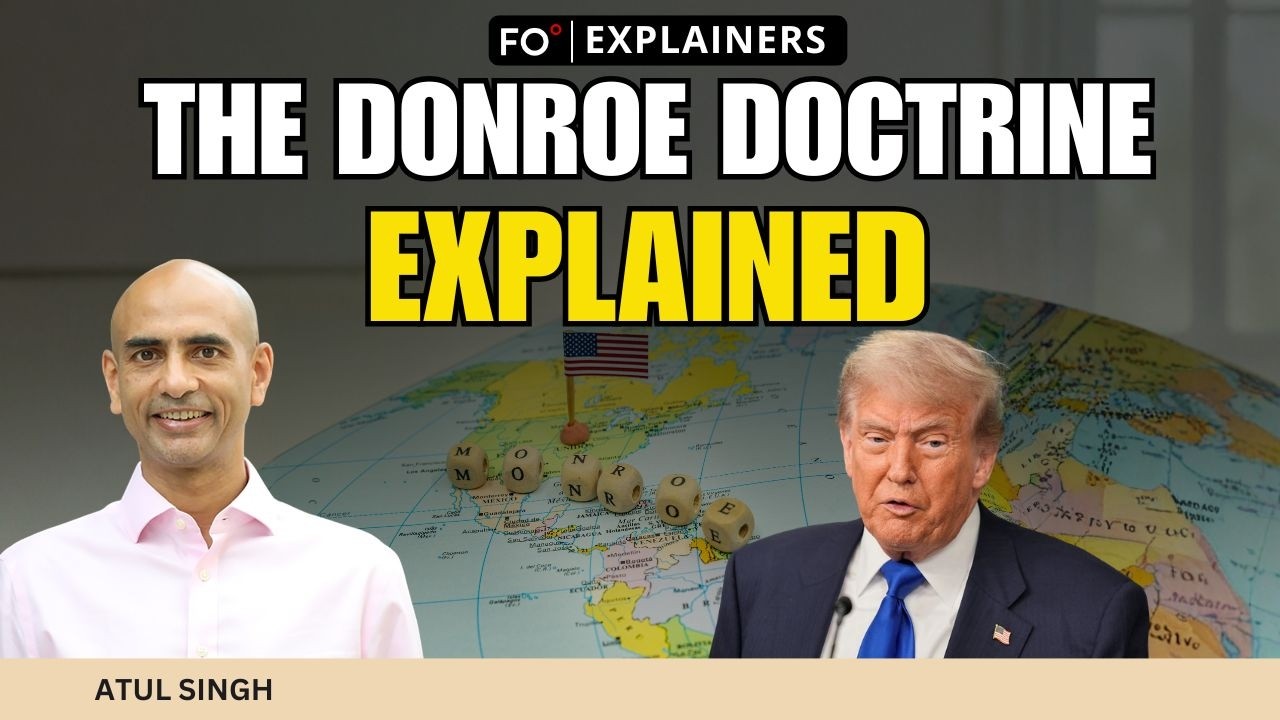
Editor-in-Chief Atul Singh discusses how the Trump administration’s emerging “Donroe Doctrine” seeks to redefine American strategy in the Western Hemisphere. Drawing on the 2025 US National Security Strategy, he traces the historical evolution of the Monroe Doctrine before examining how concerns over migration, strategic resources and China’s growing influence have revived interventionist thinking. Atul argues that although the doctrine reflects longstanding patterns in US foreign policy, global crises demanding American attention and resources may ultimately limit its implementation.
The evolution of American interventionism
Atul begins by explaining that the Trump administration’s 2025 National Security Strategy places renewed emphasis on building a “stable and well-governed” Western Hemisphere. The goal is to reduce mass migration, strengthen border security and ensure cooperation against transnational criminal organizations while preventing hostile foreign powers from controlling strategic assets.
To explain this approach, Atul traces the roots of the new policy to the Monroe Doctrine of 1823. US President James Monroe declared that European powers should no longer colonize the Americas. He hoped to establish separate political spheres for Europe and the Americas. The Western Hemisphere lay in the sphere of influence of the US. This policy, Atul says, reflected both America’s growing confidence and Europe’s weakness after the Napoleonic Wars.
Per the Monroe Doctrine, “The American continents were to remain free of European imperial control.” This doctrine became more assertive as American power expanded during the 19th century. Territorial expansion, the 1846–48 Mexican–American War and the 1898 Spanish–American War all reinforced Washington’s influence across the hemisphere.
The decisive shift came with Theodore Roosevelt’s 1904 corollary, which asserted Washington’s right to intervene in Latin American countries, which were experiencing what this charismatic president described as chronic wrongdoing. According to Atul, this established the interventionist approach that shaped much of 20th-century US policy, including support for anti-communist military governments during the Cold War. After the Soviet Union collapsed, however, Washington shifted its emphasis toward democratization as ideological competition with the Soviet Union now firmly ended.
China’s rise reshapes the strategic landscape
Atul states that China’s rapid economic rise has fundamentally altered the strategic balance in Latin America. He highlights the dramatic expansion of trade between China and Brazil, the largest country in Latin America, as a key example of one of the most striking economic phenomena in the history of global trade. Today, China is Brazil’s biggest trading partner, with both the EU and the US lagging quite far behind. China-Brazil trade grew 50-fold from $3.2 billion in 2001 to $158 billion in 2024, as the graph below from CEIC shows.
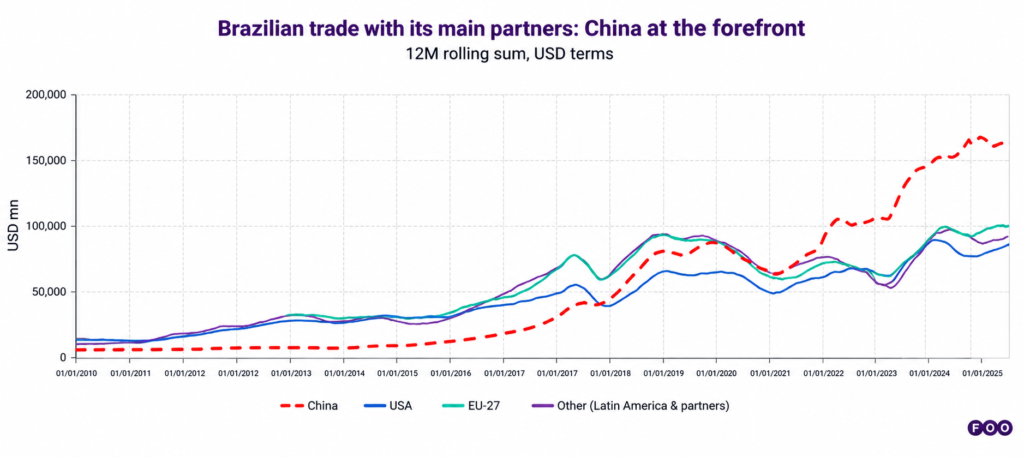
China imports Brazilian commodities such as soybeans, cotton, sugar, beef, wood, oil and iron ore. China consumes the output of Brazil’s mines, ranches, farms and forests. In return, China sells all sorts of manufactured goods from cellphones to electric vehicles. The Chinese are also investing heavily in power utilities, ports and railways.
The rise of China has revived anxieties in Washington similar to those experienced during the Cold War. Note that this time, the competition is primarily economic rather than ideological. Some argue that it is therefore more dangerous.
In response, the Trump administration has developed what many call the Donroe Doctrine, built on three pillars: active interventionism, gunboat diplomacy and economic nationalism. Together, these policies seek to protect supply chains, secure access to critical minerals and reduce China’s regional influence.
Successes, obstacles and regional realities
Atul points to several policies that reflect this new strategy, including pressure on Panama over the canal, sanctions against Cuba and Nicaragua, and financial support for Argentina under Argentinean President Javier Milei. Washington has expanded its influence over Venezuelan and Guyanese energy resources. The Trump administration has also been increasing pressure on countries that it views as strategically important.
Despite many advantages, the US is not having everything its way. Many countries in the Western Hemisphere are resisting the Donroe Doctrine. Canada opposes closer political integration with the US, while, as pointed out above, , Brazil's economy remains closely connected to China’s. Even governments more sympathetic to Washington would struggle to redirect exports away from China because American producers already satisfy much of the domestic demand for products such as soybeans and beef. There is simply no substitute for Chinese demand in Latin America.
As Atul says, “Changing the economic trends, changing the economic tidal waves is not as easy as controlling smaller countries.”
Global crises complicate the doctrine
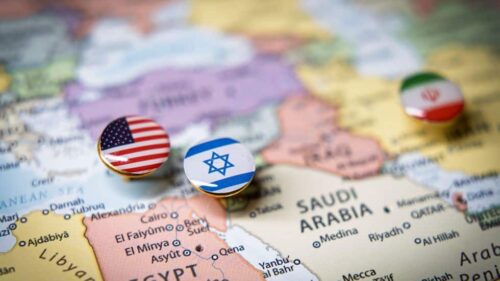
There is also another important matter that deserves attention. Atul questions whether the Donroe Doctrine can become America’s dominant strategic framework while Washington remains heavily engaged elsewhere. Earlier, President Barack Obama’s Asia Pivot did not work because of entanglements in the Middle East. The US/Israel–Iran War has thrown a spanner in the works of the Donroe Doctrine's self-declared goal to focus on the Western Hemisphere.
By closing the Strait of Hormuz, the Iranians have produced a global supply shock. Washington has had to devote time, money, resources, attention, and energy to deal with Iran. The Western Hemisphere is no longer top of mind for Washington. As Atul concludes, “the Donroe Doctrine, while attractive, while seductive, might yet have to wait.”
[Lee Thompson-Kolar edited this piece.]
The views expressed in this article/video are the author’s own and do not necessarily reflect Fair Observer’s editorial policy.






































Comment