




Guyana has been in the news lately. Oil revenues have risen from $370 to $623 million per week because of the US/Israel–Iran War. Rising oil prices are greatly benefiting this small South American nation, which neighbors Venezuela, Brazil and Suriname. This former British colony in the north of the continent has an estimated population of 840,053 with a fast-growing per capita GDP. Since the discovery of oil reserves of 11 billion barrels in 2015, Guyana’s per capita GDP has risen more than fivefold from $5,640 in 2015 to $29,675 in 2024.
Fair Observer has been shining the light on Guyana for some years now. On January 6, 2020, retired British diplomat Ian McCredie published an article with Fair Observer. Officials from the State Department showed up to see him afterward. The reason: McCredie wondered whether the West might lose Guyana to the Chinese. In retrospect, his worries have proved exaggerated.
The US is back with a bang
Since US President Donald Trump took charge in January 2025, the possibility of China dominating Guyana has become highly unlikely. In November 2025, the National Security Strategy of the United States of America declared that the US would “assert and enforce a ‘Trump Corollary’ to the Monroe Doctrine.” This doctrine, first espoused by President James Monroe in 1823, declared that the New World fell within the sphere of influence of the US. This declaration came at a time when the Spanish and Portuguese empires were collapsing because of the Napoleonic wars, and the US did not want the Europeans to return as colonial masters to the Western Hemisphere.
Over the course of two centuries, the US grew in power, and so did the scope of the Monroe Doctrine. In the 1840s, President James K. Polk warned Britain and Spain not to establish footholds in Oregon, California or Mexico’s Yucatán. In 1904, President Theodore Roosevelt added the Roosevelt Corollary to the Monroe Doctrine, which claimed the right for the US to intervene in the domestic affairs of a Latin American country “in cases of flagrant and chronic wrongdoing.” This was part of Roosevelt’s Big Stick policy, which saw US domination of the Western Hemisphere as a moral imperative.
American domination of Latin America increased relentlessly after Roosevelt. In the first half of the 20th century, the US was the dominant industrial power in the world with an insatiable hunger for commodities. Latin America’s resources and, to a lesser extent, markets were extremely valuable to the US. American domination continued uncontested right till the end of World War II.
The glow of victory in World War II and decolonization movements around the world made communism and socialism popular worldwide. China turned communist and India socialist. In the Middle East, Iraq, Syria and Egypt turned to socialism as well. Latin America was no exception, and a full-blown global Cold War broke out.
During this period, the US intervened in the domestic affairs of numerous Latin American countries to contain Soviet influence. Sometimes, this meant supporting military juntas that conducted human rights abuses, including unlawful killings and widespread torture. The Soviet-backed regimes were no better. Since the collapse of the Soviet Union in 1991, Washington has expected Latin America to align increasingly with the US. Except for Cuba and Venezuela, this largely happened.
Yet a new challenger appeared in the 21st century. The biggest and fastest industrial revolution in history has occurred in China since Deng Xiaoping began his economic reforms in 1978. In 2001, China entered the World Trade Organization (WTO) and became the workshop of the world. Trade with the rest of the world, including Latin America, soared. A November 2022 briefing for the European Parliament tells us that China has become the second-largest trading partner of Latin America & the Caribbean (LAC). Between 2000 and 2020, China-LAC trade has grown 26-fold from $12 billion to $310 billion. Joining the WTO clearly worked out for China.
China’s trade with Brazil, the biggest country in the LAC region and the South American continent, is the most pertinent example of one of the most striking economic phenomena in the history of global trade. Today, China is Brazil’s biggest trading partner, with both the EU and the US lagging quite far behind. China-Brazil trade grew 50-fold from $3.2 billion in 2001 to $158 billion in 2024, as the graph below from CEIC shows.
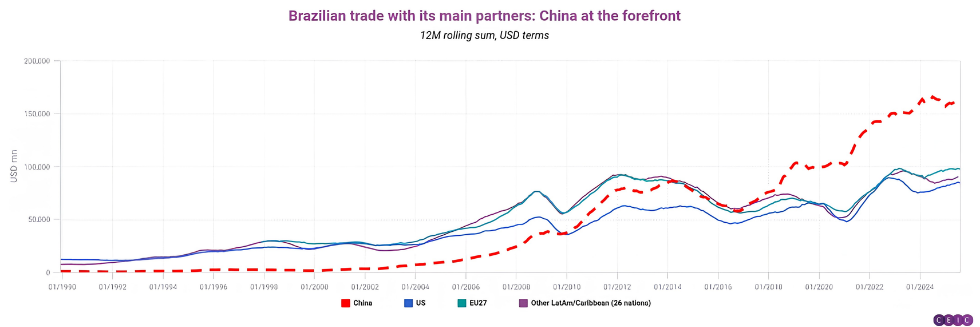
China is hungry for Brazilian commodities from soybeans, cotton, sugar and beef to wood, oil and iron ore. In a nutshell, China has a ravenous hunger for the output of Brazil’s mines, ranches, farms and forests. China is also investing heavily in power utilities, ports and railways. BYD, the world’s largest electric vehicle (EV) company, has made its biggest investment outside Asia in Brazil. BYD has built its factory on a site that was once owned by Ford, the iconic American automaker. BYD’s market share in Brazil’s EV market is already 74%, an example of Chinese green tech, with its “new three” sectors of solar panels, lithium-ion batteries and EVs, rapidly growing in Latin America.
The Trump administration has decided to counter Chinese influence in Latin America and reclaim top dog status in what has historically been Uncle Sam’s backyard. The Trump Corollary to the Monroe Doctrine, also now known as the Donroe Doctrine, aims to reassert American predominance in the Western Hemisphere. Many American politicians and policymakers believe the US is overextended. The logical implications of America First mean that the US has to put America first.
Numerous Republican sources in Washington, DC, have told this author that Trump’s efforts to rename the Gulf of Mexico, acquire Canada, control the Panama Canal and take over Greenland are actions to enforce this doctrine. The spectacular military operation against Venezuela, which saw American troops bringing back Nicolás Maduro in chains, is the cherry on the cake in the brief life of the Donroe Doctrine.
Basking in the glory of the Venezuela military operation, Trump himself referred to the Donroe Doctrine, stating that “American dominance in the Western Hemisphere will never be questioned again.” Guyana has emerged as a critical place for the US to impose the Donroe Doctrine.
Guyana, global energy dominance and Petro Reset
Because of its extensive oil reserves and the supply-side shock due to the war with Iran, Guyana is increasingly important to the US. During the ongoing US/Israel–Iran War, the Islamic Revolutionary Guard Corps (IRGC) has successfully blocked the Strait of Hormuz. This means that around 20% of the oil and gas that flowed out of the strait no longer get to their intended destinations. About 33% of the global supply of fertilizers has also been disrupted.
Not only fuel and fertilizers, but also aluminum, refined products and industrial inputs can no longer reach Europe, Asia and even North America. Demand for the dollar has dropped because the countries of the Persian Gulf have historically priced all these exports in dollars. The Gulf countries no longer are circulating these dollars into Western assets and indeed might even start selling these assets to pay for food, industrial imports and consumer goods as well as the expenditures of their generous welfare states. The specter of dollar flows changing direction, a “Reverse Gulf Stream,” is increasingly giving many policymakers in Washington sleepless nights.
In this context, Guyana becomes really important. No one can block off Guyana’s oil because the country’s coast is on the Atlantic Ocean. Plus, the petrodollar bargain in which the US guaranteed the Gulf states’ security in return for pricing energy/commodities in dollars and then investing these dollars in American assets has no challenger in Latin America. The longer the IRGC can block the Strait of Hormuz, the more important Guyana becomes.
Guyana increases in strategic importance because of a related idea gaining increasing currency in the Trump administration. To drive economic growth and enhance national security, the White House aims to achieve “American energy dominance.” Part of this involves deregulating and adopting Sarah Palin’s “Drill, baby, drill!” Part of this involves championing coal and unleashing nuclear energy. As yet, a largely unspoken part of achieving this dominance also involves a “smash and grab” of Venezuelan energy in what many enthusiastically call the “Petro Reset.”
In simple words, the Petro Reset is good old Uncle Sam taking over Venezuela’s oil. According to the Energy Information Administration (EIA), Venezuela has the world’s largest proven crude oil reserves of 303 billion barrels in 2023. These account for 17% of the global reserves. Despite such vast reserves, Venezuela produces only about 1 million barrels per day, comprising only 0.8% of total global crude oil in 2023. So, the untapped energy potential is huge.
Venezuelan extra-heavy crude is hard to refine and only refineries on the Texas Gulf Coast have the ability to do so at scale. Therefore, it makes sense “to integrate the largest oil reserve on the planet directly into the world’s most sophisticated refining complex.” In corporate terms, the Trump administration is engaging in “a hostile takeover of a distressed asset with massive upside potential.”
American control of Venezuela would bring an additional three to five million barrels of oil per day online within a few years, creating a historic supply glut. The price of oil would collapse. Petrol, called gas in the US, would fall from the pre-war $3.00 to the post-glut $1.00 per gallon. Fuel costs determine everything from the cost of wheat to the cost of Amazon packages. Economists call this cost-push inflation, which would go down dramatically. Needless to say, the logistics dividend for the American economy would be spectacular.
The Petro Reset would also dollarize the Venezuelan economy. At the moment, the Venezuelan currency is worthless, and the country is suffering from hyperinflation. Getting rid of the bolivar and adopting the dollar would eliminate hyperinflation and stabilize the economy. Arguably, there is a jolly good precedent. In January 2000, Ecuador dollarized its economy. Many claim this to be a great success. Dollarization would stabilize the prices of goods and labor in Venezuela. Combined with the cheapest energy in the Western Hemisphere, this could create a manufacturing hub that rivals Mexico.
As of now, nearly eight million Venezuelans, about 23% of the population, have fled the country. If the US stabilizes the Venezuelan economy, this flow would reverse. In fact, other Latinos might make their way from Chicago to Maracaibo. Fixing Venezuela is in the US national interest.
There is also another tiny little benefit from this Petro Reset maneuver in geopolitical chess. Venezuela claims Essequibo, a 159,500-square-kilometer region west of the Essequibo River that constitutes roughly two-thirds of Guyana. In December 2023, Maduro conducted a referendum in which Venezuelans supposedly claimed sovereignty over Essequibo, which is rich in oil, gas and other minerals. In 2024, Maduro signed into law the referendum approving annexation. In December 2025, Guyana condemned this move. This did not stop Maduro from organizing elections that elected a governor and lawmakers for Essequibo, even though none of the region’s 125,000 inhabitants got to vote.
Maduro is now behind bars. In an off-the-record remark by a dashing military officer, “the US now has a gun to Delcy Rodriguez’s head,” and Maduro’s successors have to behave. Not only does this give Washington control of Venezuelan oil, but it also guarantees Guyanese security. With Maduro gone, Venezuela cannot threaten or annex Essequibo. With oil prices rising, American oil majors are already taking a second look at Venezuela. In American eyes, Guyana is the prettier of the two Latin American sisters. An English-speaking democracy with free and fair elections governed by common law is much more investable than a Spanish-speaking country still ruled by a repressive regime that has rigged elections.
Highly investable, safe and secure
In January, ExxonMobil CEO Darren Woods told Trump that Venezuela was “uninvestable,” but he is unlikely to have any such reservations about Guyana. In the first quarter of 2026, Exxon Mobil reported revenue of $85.14 billion and net income of $4.18 billion in Guyana. The company is already involved in several oil exploration and production projects in the country, including the Liza field, which is one of the largest oil discoveries in the world in recent years. With Maduro gone, Exxon is likely to increase investment in Guyana. Others might follow suit, too.
Guyanese President Irfaan Ali was reelected in September 2025. His centrist credentials give investors confidence. Guyana has emerged as the biggest winner from Trump’s foreign policy moves against Venezuela and Iran. Guyana is a safe and secure energy source for the US. With an increasing American focus on securing supply chains, Guyana is also important for securing critical minerals and rare earth elements. Since Guyana’s security depends completely on the US, the country is unlikely to succumb to anti-American left-leaning populism that Spanish and Portuguese speakers in Latin America find highly seductive.
There is another reason why the US is interested in Guyana. Historically, the big three — gold, bauxite and diamonds — drove the Guyanese economy. Now, other minerals like manganese, coltan and lithium are attracting attention. Manganese is vital for steel production and battery technology, coltan for the manufacturing of capacitors for cell phones and laptops, and lithium for electric vehicle batteries. Because of these minerals, Guyana fits into American priorities of nearshoring and securing supply chains.
Finally, Guyana is the only English-speaking country in Latin America. Thanks to the legacy of the British Empire, Guyana has a common law system similar to that of the US. As alluded to above, unlike other Latin American countries, Guyana does not have the tradition of Bolivarian socialism or left-wing populism. To underscore a point made earlier, this makes Guyana far more attractive to American business than Venezuela.
The surge of American investment into Guyana is a unique “gold rush” moment, driven by a combination of massive natural resource discoveries and a strategic shift in global supply chains. Even as the American hold on the countries of the Persian Gulf weakens, Guyana is emerging as a replacement South American Gulf state for Washington.
[Cheyenne Torres and Kaitlyn Diana edited this piece.]
The views expressed in this article are the author’s own and do not necessarily reflect Fair Observer’s editorial policy.








Join the conversation
Share your perspective
Log in to share your thoughts and take part in the discussion.