




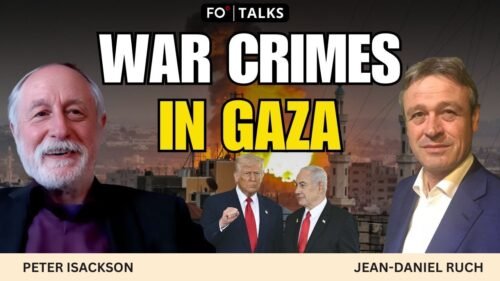
Fair Observer’s Chief Strategy Officer Peter Isackson and former Swiss diplomat Jean-Daniel Ruch discuss the erosion of international law, the humanitarian catastrophe in Gaza and the weakening authority of international institutions. Drawing on his experience as a former political advisor to the UN Yugoslavia War Crimes Tribunal, Ruch argues that many of the norms designed to regulate conflict and protect civilians are now being openly disregarded by major powers. From the interception of humanitarian flotillas to the intimidation of International Criminal Court officials, the conversation paints a troubling picture of a global order in which legal standards increasingly depend on political power rather than universal principles.
Contested legality
The discussion begins with Israel’s interception of the Sumud humanitarian flotilla in international waters near Crete. Ruch explains that the flotilla consisted of 22 boats carrying 176 activists attempting to draw attention to the worsening humanitarian crisis in Gaza. According to UN estimates, Gaza requires around 600 aid trucks per day, yet only a fraction are currently allowed to enter. Ruch argues that, as an occupying power, Israel has a legal responsibility to ensure the basic needs of the civilian population are met.
Simultaneously, he acknowledges that the legality of the interception itself remains contested. International maritime law protects freedom of navigation on the high seas, while Israel maintains that it is enforcing what it considers a lawful blockade. Ruch suggests the operation’s tactical design was politically calculated. By intercepting the flotilla roughly 1,300 kilometers from Gaza, Israel minimized media visibility and avoided the dramatic confrontations that accompanied earlier flotillas.
For Ruch, however, the deeper issue is not the flotilla itself but the humanitarian conditions that motivated it. He describes the activists’ efforts as stemming from “a very noble intention” to draw attention to suffering that much of the world has begun to normalize. The flotilla becomes less a decisive legal test case than a symbolic reminder of a crisis that many governments and media outlets increasingly treat as background noise.
Politics of justice
Isackson notes that the International Criminal Court (ICC) has accused Israeli Prime Minister Benjamin Netanyahu of war crimes, though it has not formally charged him with genocide. Ruch argues that the ICC’s paralysis reflects immense political pressure placed on its judges and prosecutors.
He points to US sanctions targeting ICC officials, including restrictions that have reportedly prevented some judges from accessing banking services or using credit cards. Ruch also notes that sexual misconduct allegations involving ICC Prosecutor Karim A. A. Khan have further complicated proceedings. Thus, investigations appear to have stalled precisely as evidence has continued to accumulate.
Ruch believes that stronger prosecutors from an earlier generation, such as Carla Del Ponte, would likely have moved more aggressively. He argues that reports from organizations including Amnesty International, Human Rights Watch and Israeli groups such as B’Tselem provide substantial material for expanding charges. Yet he remains skeptical that Netanyahu will ever stand trial, largely because the Israeli leader can avoid traveling to countries obligated to enforce ICC warrants.
Ruch describes the modern Netanyahu as “a very diminished person” compared to the confident political operator he once knew. Drawing on his experience at the Yugoslavia tribunal, he compares Netanyahu’s visible decline to the condition of Ratko Mladić during his later court appearances. Ruch believes that leaders accused of grave crimes often appear transformed by the weight of history and prolonged conflict.
The collapse of international norms
Beyond Gaza, Ruch argues that broader norms governing diplomacy and warfare are rapidly eroding. He cites the killings of negotiators and political envoys, including Hamas leader Ismail Haniyeh and Iranian officials, as evidence that long-standing protections surrounding diplomacy are disappearing.
Historically, emissaries and negotiators were treated as untouchable even during periods of intense conflict. Ruch argues that this principle, once regarded as foundational to international relations, has now been casually discarded. “There is not much appetite for international law in Washington,” he says, linking the shift to a wider embrace of raw power politics.
The speakers also examine the language used to describe different conflicts. Ruch notes that Russia’s invasion of Ukraine in 2022 was widely labeled an “unprovoked aggression,” while the US-led attack on Iran in February was more often described as a “war of choice.” Similarly, Western governments framed Israeli military actions as self-defense while criticizing Iran’s retaliatory strikes without acknowledging Tehran’s own claims under Article 51 of the UN Charter. For Ruch, these distinctions illustrate how legal and moral terminology increasingly reflects geopolitical alignment rather than consistent standards.
Europe’s strategic confusion
Finally, Isackson and Ruch turn to Europe’s struggle for strategic autonomy. Ruch argues that European governments remain politically dependent on Washington even as American policies generate severe economic consequences for Europe itself. The continent’s shift away from Russian pipeline gas toward more expensive American liquefied natural gas has significantly increased household energy costs, particularly in Germany and Italy.
He notes that some European leaders quietly recognize the unsustainability of this arrangement. Yet attempts to develop an independent diplomatic strategy remain tentative and fragmented. Even modest proposals to reopen dialogue with Russia quickly face pressure to remain aligned with Washington.
Isackson criticizes European media for largely reinforcing official policy narratives rather than seriously debating alternatives. Ruch agrees that traditional media institutions are losing influence, especially among younger audiences who increasingly rely on social media. At the same time, he warns that algorithm-driven information environments risk trapping audiences inside ideological echo chambers.
The discussion concludes with reflections on French politics and the emergence of alternative foreign-policy voices. Ruch praises Jean-Luc Mélenchon and Dominique de Villepin for articulating more independent visions of France’s global role, even if neither fully fits within the existing political establishment.
Ultimately, Ruch characterizes the present moment as a turbulent historical transition in which institutions, norms and alliances are all being tested at once. The international system still exists formally, but its underlying rules are becoming harder to enforce as major powers increasingly act according to expediency rather than principle.
[Lee Thompson-Kolar edited this piece.]
The views expressed in this article/video are the author’s own and do not necessarily reflect Fair Observer’s editorial policy.






























Comment