


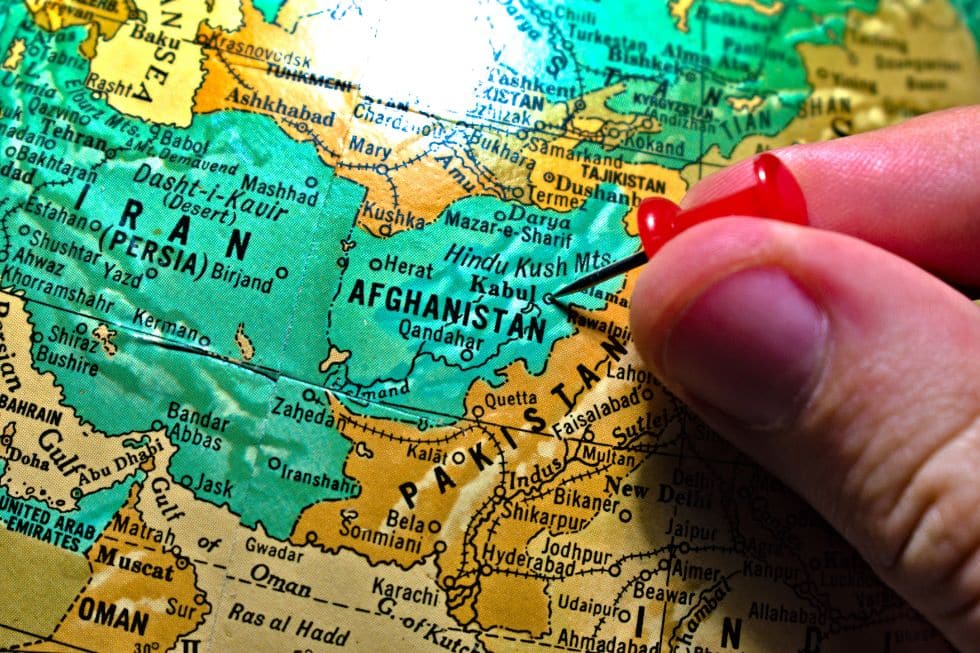



Today, the Taliban controls Afghanistan not only through force, but through what they allow the world to see. In recent years, following the Taliban’s return to power, a noticeable trend has emerged across digital platforms: A growing number of influencers, vloggers, adventure tourists and even controversial public figures are traveling to Afghanistan and portraying it as “safe,” “peaceful” and “not what the media says.” Videos with titles like “Afghanistan is not what you think” or “The media lied” circulate widely on YouTube, TikTok and Instagram.
This content, showing calm streets, active markets, friendly interactions with locals and sometimes even with Taliban members, attempts to present a different image of post-Taliban Afghanistan.
Many groups have participated in the trend, from travel vloggers seeking “unusual” experiences to influencers who attract audiences by going against dominant narratives. For example, an American pornographic actress visiting Afghanistan at a time when women in Afghanistan are deprived of even their most basic rights is not just a marginal incident, but a clear example of how such images are produced and circulated.
At first glance, these videos may appear to be personal experiences. But that interpretation is dangerously simplistic. What this content presents as “Afghanistan” is not reality, but a constructed version of it, shaped through selection, omission and control. This ultimately contributes to softening the coercive image of the regime and rendering repression more socially acceptable. The issue is not simply truth versus falsehood; it is what is allowed to be seen and what is systematically left out. These portrayals do not merely misrepresent Afghanistan; they circulate what I call “performative safety,” a selective image of “safety” that obscures the exclusion of women, normalizes authoritarian rule and may carry real political consequences.
The Taliban does not govern only through force; it also reshapes how it is seen. Every “peaceful” image, every “calm” video and every “against-the-media” narrative helps reduce the symbolic costs of this system. In this process, influencers, even when they see themselves as neutral, become informal participants in a broader project: turning a repressive system into something that appears livable.
Unequal experiences: safety for whom?
The experience of safety under Taliban rule is deeply unequal. What influencers experience and present as “safety” is structurally out of reach for a large part of the population, especially women in Afghanistan.
While women in Afghanistan are detained for minor reasons and subjected to humiliation and violence, women from outside the country can move freely in the same spaces, go to restaurants and even interact casually with Taliban members. This reveals a deep gap in power and in who has the right to be present.
Cases like the visit of an American pornographic actress make this gap painfully visible. At a time when women in Afghanistan are denied education, excluded from most forms of work and restricted in their movement, presenting those same spaces as “safe” or “interesting” is misleading and politically problematic.
What influencers present as “safety” is, in fact, a privilege that is available only to certain bodies under specific conditions within a discriminatory system. It is not a general condition; it is selective. Presenting it as a shared reality distorts the truth.
Within what can be described as a system of gender apartheid, these representations take on a deeper meaning. When foreign women appear alongside Taliban members, joke with them or take photos with their weapons, these images, regardless of intent, contribute to normalizing a system that has pushed women in Afghanistan out of public life. This is not neutrality. It is participation in the production of a political image.
Safety as performance
A key concept for understanding this phenomenon is “performative safety.” In many of these videos, influencers walk through markets, talk to people and describe the environment as calm. But this calm is the result of selective spaces and controlled interactions.
Influencers usually film in places where “normality” can be easily shown, while other elements, such as structural restrictions, social control and especially the absence of women in public spaces, are systematically left out.
In other words, safety is not simply observed; it is staged. It is a scene built through highlighting certain realities and hiding others. This performance shapes not only what is seen but also how audiences understand it. When the dominant image of Afghanistan on social media is calm and tension-free, it becomes harder to recognize deeper inequalities and forms of structural violence. What influencers present as “safety” is therefore not a shared social condition, but a limited and highly political experience.
Normalizing authoritarianism
These representations, whether intentional or not, contribute to the normalization of authoritarian rule. When Taliban members are shown as “ordinary,” “friendly” or even “humorous,” the broader system of restrictions and violence they represent is pushed out of view.
This process makes violence invisible. As a result, authoritarianism begins to appear as part of everyday life rather than something to question. Viewers gradually accept the system as normal rather than critically examining it. Representation becomes a tool of power.
Attention economy and content production
To understand why these representations persist, we need to look at the “attention economy,” a system in which attention is limited and the value of content depends on its ability to attract and hold audiences, not on its accuracy.
In this environment, Afghanistan becomes an ideal subject. Since it is widely associated with war and danger, any content that challenges this expectation, such as by showing “safety,” immediately attracts attention. The contrast between expectation and presentation drives visibility and engagement. Reports like Business Insider’s show that such content performs well precisely because of this contrast.
Digital platforms reinforce this dynamic. Their algorithms promote surprising, contradictory or emotionally engaging content. As a result, creators are pushed toward narratives that generate reactions, even if this means simplifying or distorting reality.
In this context, “safety” becomes a kind of media product, valued not for how accurately it reflects reality, but for how well it can be consumed and shared. The more it contradicts common assumptions about Afghanistan, the more attention it gains. At the same time, complex realities, especially the situation of women in Afghanistan and deeper structural inequalities, are pushed aside because they do not fit easily into short, fast-paced content.
Indirect complicity and ethical implications
Influencers who create these videos cannot be seen as neutral. Presenting a positive image of a system that systematically violates the rights of women is not just a personal choice; it is a political act with ethical consequences. Producing and sharing such content contributes, in practice, to legitimizing a system built on exclusion and control.
This complicity is not necessarily intentional. Many influencers may see themselves as simply sharing personal experiences. But from a sociological perspective, the issue is not intention, but outcome. When influencers remove suffering and inequality from the frame, what remains is an image that makes the existing system appear normal and acceptable.
The key question is not only what is shown, but what is allowed to remain unseen. When repression is removed from view, it is also removed from judgment. Representation, in this sense, becomes an ethical act: it can either expose inequality or hide it. In many of these cases, it clearly does the latter.
When images turn into risk
Presenting Afghanistan as a “safe” and “accessible” place is not just a matter of perception; it can have real-world consequences. In the attention economy, content that challenges expectations spreads quickly and becomes convincing. As a result, some viewers, especially adventure travelers, may take these narratives as a basis for real decisions.
In this way, the distance between image and action collapses. What begins as digital consumption can lead to physical travel into a complex and unpredictable political environment. Yet such decisions are made in a context with no reliable legal protections, no transparency and no meaningful accountability.
Under such conditions, ordinary individuals without strong institutional or diplomatic support may find themselves in vulnerable, risky situations. Evidence from other authoritarian contexts, including Iran, shows that governments have at times detained and used foreign nationals as tools of political pressure. There are also indications that the Taliban has, in certain cases, used the detention of foreign nationals as leverage. In a system without accountability, this risk is not simply hypothetical.
The way influencers portray Afghanistan is not a neutral reflection of reality, but a selective reconstruction of it. Through the systematic removal of violence, especially the exclusion of women in Afghanistan, influencers produce an image of a system that appears stable and livable. What they present as “safety” is not a shared condition, but a deeply unequal and political one.
The issue is not just distortion, but its consequences. These images shape perception, perception shapes decisions, and those decisions can lead individuals into environments where basic protections do not exist. In such a setting, even ordinary people can become exposed to serious risks.
Ultimately, the question is not whether these images are “true” or “false.” The question is how they reshape reality itself, what they show, what they hide and whose absence makes the image possible. Representation moves beyond storytelling and becomes part of power, shaping what repression can hide and what the world is allowed to ignore.
[Rita Roberts edited this piece.]
The views expressed in this article are the author’s own and do not necessarily reflect Fair Observer’s editorial policy.
FO Live: Afghanistan’s Last Woman Ambassador Defies Taliban Rule From Exile
In this episode of FO Live, Laura Pavón Aramburú, Natalie Halla and Manizha Bakhtari discuss The Last Ambassador, Halla’s 2025...
Afghanistan: The Crisis the US Chose to Forget and Why That Is a Strategic Mistake
Afghanistan is experiencing a worsening humanitarian crisis that has largely disappeared from US attention, leaving millions without food, shelter or...
Faith in Chains: The Hijacking of Islam by Tehreek-e-Taliban Pakistan
Extremist groups like Tehreek-e-Taliban Pakistan cloak violence in religion, yet betray Islam’s core message of peace. Radicalization stems from social...

Support Fair Observer
We rely on your support for our independence, diversity and quality.
For more than 10 years, Fair Observer has been free, fair and independent. No billionaire owns us, no advertisers control us. We are a reader-supported nonprofit. Unlike many other publications, we keep our content free for readers regardless of where they live or whether they can afford to pay. We have no paywalls and no ads.
In the post-truth era of fake news, echo chambers and filter bubbles, we publish a plurality of perspectives from around the world. Anyone can publish with us, but everyone goes through a rigorous editorial process. So, you get fact-checked, well-reasoned content instead of noise.
We publish 3,000+ voices from 90+ countries. We also conduct education and training programs
on subjects ranging from digital media and journalism to writing and critical thinking. This
doesn’t come cheap. Servers, editors, trainers and web developers cost
money.
Please consider supporting us on a regular basis as a recurring donor or a
sustaining member.
Will you support FO’s journalism?
We rely on your support for our independence, diversity and quality.





Comment