


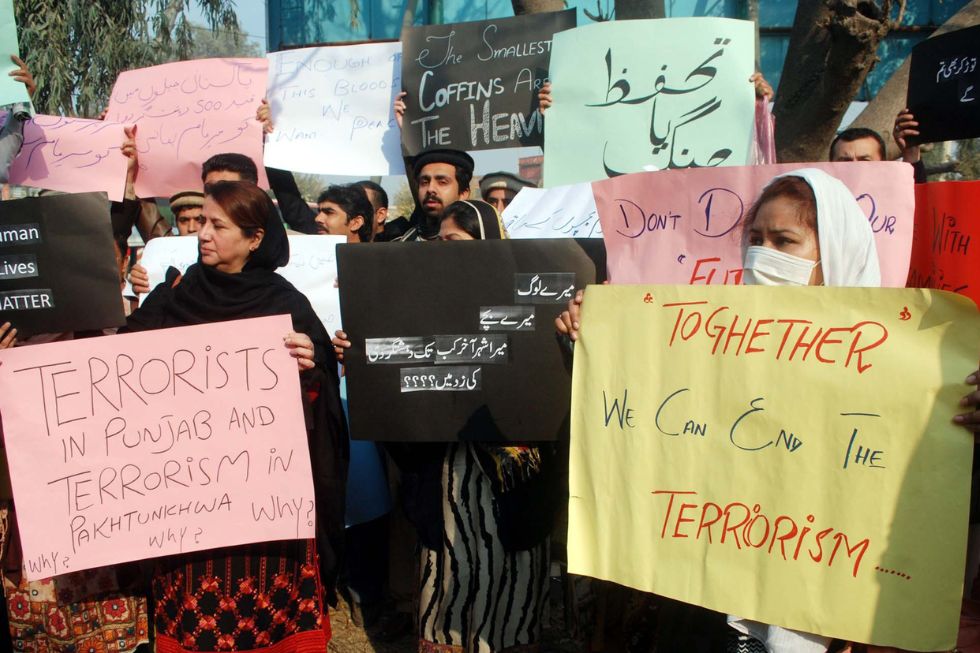



There is a malicious paradox that still haunts humanity’s conscience: one that is concealed in religious jargon that reeks of violence and revenge, in the echo of war screams and the shadow of smoke rising from the wreckage of broken lives. There are those who call themselves fighters for Islam, but assault soldiers and civilians, claim innocence and carry deadly weapons as if they were proud and honorable trophies.
Organizations like Tehreek-e-Taliban Pakistan (TTP) in the tribal belt of Pakistan serve as an easy example of such a group of people who violate the religious principles they claim to support. The TTP is one of the longest-lasting instances of terrorism in Pakistan that misinterprets Islam to serve a political purpose.
The TTP — a group that emerged from the tribal belt following the US takeover of Afghanistan — aimed to impose its own twisted interpretation of Sharia, which not only targeted state institutions but also innocent citizens, schools, polio workers and religious minorities — actions that directly conflict with Islamic teachings.
The TTP does not have political grievances or seek regional independence like many other militant groups; instead, it explicitly uses violence as a religious obligation. This makes its misuse of Islamic principles particularly significant and relevant to consider within the context of faith-based radicalization. The TTP’s extremist rhetoric employs religious language to justify violence, and it remains crucial to return to the true meaning of Islam to counter these distorted terrorist ideologies.
Religion was never the reason
The reason behind such extremist groups is rooted in political and psychological systems and stems greatly from being uninformed and depressed. Research into poverty, conflict and development in Pakistan has shown that poverty can lead to radicalization of beliefs. Such research demonstrates that financial and social problems, rather than religious beliefs, create a prime environment for joining an extremist group.
When young people are deprived of hope, education and opportunities, they become impressionable and vulnerable. This creates space for terrorists to exploit. Instead of being guided by genuine religious teachings, these youths are fed anger and resentment, dressed up as devotion to God. Through such manipulation, acts of violence are sanctified in their eyes, legitimizing revenge and sacrifice as something sacred.
An Iranian study on the resurgence of the TTP shows that this group, which continues to inspire radical extremists today, did so by abandoning all principles of kindness, fairness and moderation established in Islam. They became notorious for their rigidity, rejecting any differences and excluding Muslims from their community for the slightest reasons. The current TTP has persisted in these wrongdoings and only intensified them. Their cruelty is driven by fanaticism, which disregards the mercy at the core of Islam.
Authentic Islamic teachings never condone such actions
Religion, according to the Holy Qur’an (the central religious text of Islam) and the teachings of the founder of Islam, Prophet Muhammad, has nothing to do with violence; it is never linked to fire and bullets. In fact, in Islam, spreading fitnah — discord and strife — is considered among the gravest of evils.
In the Qur’an’s Surah Al-Ma’idah, verse 5:32, it is said clearly: “Whoever kills a soul unless for a soul or for corruption [done] in the land, it is as if he had slain mankind entirely.” If a life is taken, it is as if a whole universe is lost. Islam holds the sanctity of life in the highest regard. But these extremist groups change the meaning of holy words, isolate parts of scripture and mislead people to support their bloodthirsty actions.
While pretending to believe, terrorists work to control the community by threatening them.
Terrorism only reveals the low moral values of those who commit it. They claim to seek justice, yet in reality, they just cause more destruction and ruin. In Islam, justice is not pursued through violence and guns; instead, its advocates seek justice by using respectful procedures, kindness and honesty.
Several Islamic sources (like the Sirah and Hadith collections) recount that when the Prophet Muhammad faced deep persecution in Mecca, through mockery, boycott and attempts on his life, he showed restraint and entrusted justice to God. After the Muslim victory in 630 CE, known as the Conquest of Makkah, he marked his triumph not with revenge but with a general amnesty, forgiving long-standing enemies. He spoke the famous words, “Go, for you are free.”
If violence is justified in the name of religion, it becomes even more dangerous because the perpetrators believe their actions carry divine approval.
The Qur’an, however, repeatedly stresses that peace should be the foremost goal for Muslims. If there is conflict between groups of believers, Surah Al-Hujurat, verse 49:9, advises them to find a solution. “If two groups among the believers should fight, then make a settlement between them. But if one of them oppresses the other, then fight against the one that oppresses until it returns to the command of Allah.” This verse does not promote rebellion or terrorism. It commands one to pursue peace and justice in accordance with moral and rightful conduct.
Terrorism rejects human dignity
No matter the claims made, terrorism is an inhumane act that betrays the religion it purports to uphold.
Supposed martyrdom achieved through killing, taking pleasure in spilling blood or committing suicide attacks are not acts of true faith; they demonstrate a lack of courage. Revenge against innocent individuals holds no honor, and hatred brings only further suffering. True strength lies in self-control, in the capacity to forgive those who deserve retribution and in helping others rather than spreading terror.
The actions of groups like the TTP contradict Islamic principles rather than represent them. Every bomb detonated and bullet fired distances people from the message of peace that Islam carries.
Jihad, in its true Islamic context, symbolizes “struggle” in the path of Allah, embodying the efforts to lead a virtuous life and to do better, making jihad a holy act. But instead of using the actual spiritual context, TTP has radicalized jihad by sowing chaos, confusion and suffering.
Efforts should extend beyond security measures to reclaim the true perception of Islam. Communities, and especially the young, must be guided toward the religion’s authentic teachings, which emphasize life over death and faith over fear. They should learn that prayer, compassion, and peace are stronger than violence, even in the face of oppression.
Organizations like TTP are fueled by secrecy, lack of knowledge, fear and division. The antidote is light. Light in our minds, light in how we treat others, and the knowledge that Islam is indeed a religion of peace. Choosing mercy over revenge requires real strength; resisting hatred is far more powerful than fire. Fire doesn’t match the strength of faith.
[Yaamini Gupta edited this piece.]
The views expressed in this article are the author’s own and do not necessarily reflect Fair Observer’s editorial policy.
Islamofactism, Part 2: The Issue of One Islam
The word “Islamophobia” and its definition have been highly contested amongst scholars, authors and policymakers regarding its ability to allow...

Tehrik-i-Taliban Pakistan: Targeting Civilians to Instill Fear and Control
The militant group Tehrik-i-Taliban Pakistan escalated its attacks across Khyber Pakhtunkhwa in May 2025 as it pursued territorial control and...

Rising Fundamentalist Groups Threaten Europe: What Needs to Be Done?
A recent French government report warns that the Muslim Brotherhood is pushing a fundamentalist agenda across Europe. The group uses...
Reasons Behind Radicalization: The Erosion of Hope and Identity
Radicalization is a poorly understood concept. It is often conflated with terrorism or even sadism. However, in the modern scholarly...
Support Fair Observer
We rely on your support for our independence, diversity and quality.
For more than 10 years, Fair Observer has been free, fair and independent. No billionaire owns us, no advertisers control us. We are a reader-supported nonprofit. Unlike many other publications, we keep our content free for readers regardless of where they live or whether they can afford to pay. We have no paywalls and no ads.
In the post-truth era of fake news, echo chambers and filter bubbles, we publish a plurality of perspectives from around the world. Anyone can publish with us, but everyone goes through a rigorous editorial process. So, you get fact-checked, well-reasoned content instead of noise.
We publish 3,000+ voices from 90+ countries. We also conduct education and training programs
on subjects ranging from digital media and journalism to writing and critical thinking. This
doesn’t come cheap. Servers, editors, trainers and web developers cost
money.
Please consider supporting us on a regular basis as a recurring donor or a
sustaining member.
Will you support FO’s journalism?
We rely on your support for our independence, diversity and quality.





Comment