





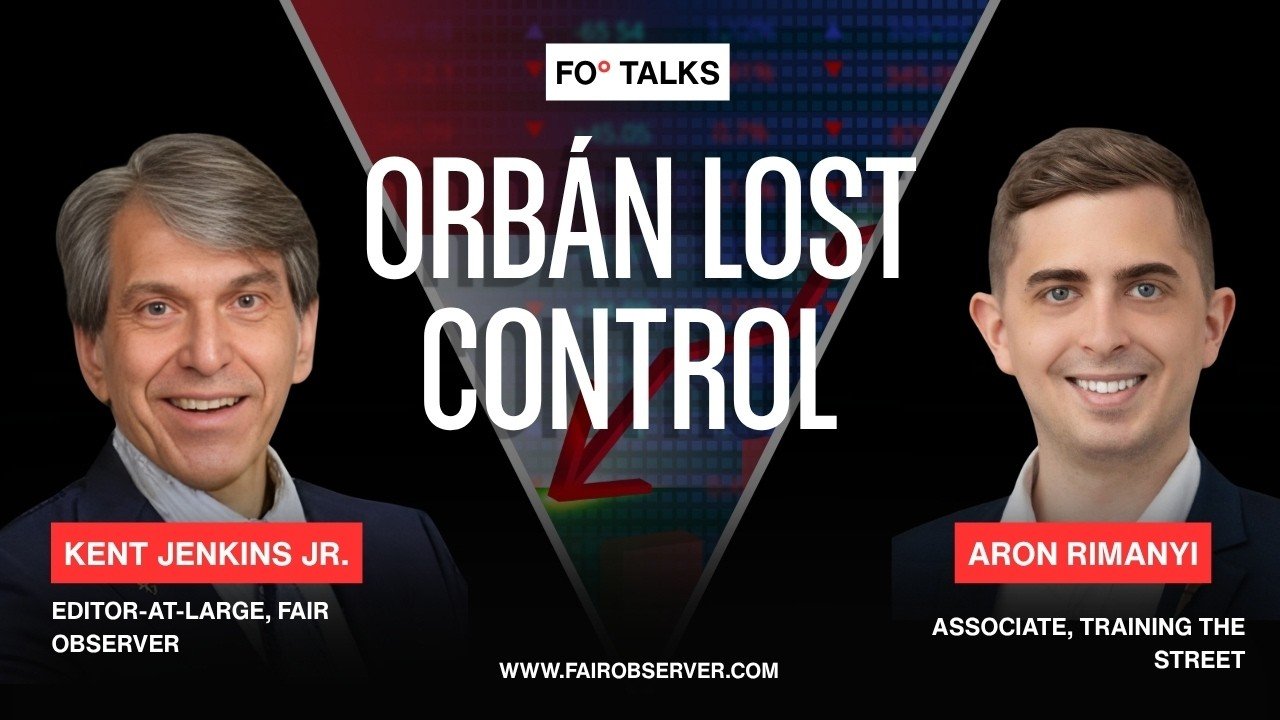
Fair Observer’s Video Producer Rohan Khattar Singh speaks with Aron Rimanyi, an associate at Training The Street, about an election result that may reshape Hungary’s political trajectory. Péter Magyar’s center-right Tisza party has secured an electoral victory, ending incumbent Prime Minister Viktor Orbán’s 16-year dominance and raising questions about whether this marks a routine change of leadership or a deeper systemic shift. Beyond the numbers, Khattar Singh and Rimanyi explore the economic, social and political forces behind the vote, and what they signal for Hungary’s future.
A landslide that signals rupture
Rimanyi describes the election as more than a decisive win. With 55.3% of the vote translating into a two-thirds parliamentary majority — 141 out of 199 seats — Tisza has achieved the kind of mandate rarely seen in European politics. Turnout reached roughly 80%, underscoring the scale of public engagement.
For Rimanyi, the magnitude of the outcome carries particular meaning. He calls it a “popular rejection of 16 years of Orbán government;” the result reflects accumulated dissatisfaction rather than a narrow electoral swing. While pre-election polling had pointed to a Magyar victory, the scale of defeat for Orbán’s right-wing Fidesz party — especially among government-aligned pollsters — turned the outcome into a genuine political upset.
The result also reflects a generational shift. Younger voters, many of whom have only known Orbán’s leadership, played a decisive role. Their participation suggests not only dissatisfaction with the present, but a desire to redefine Hungary’s political future.
Economic strain and campaign contrast
Economic conditions form the backbone of Rimanyi’s explanation. Hungary’s post-2010 growth model, he argues, faltered after external conditions worsened. EU funds declined, global conditions tightened and inflation surged to the highest levels in the European Union during 2022 and 2023. As costs rose faster than wages, public frustration deepened.
Rimanyi frames this as a structural problem rather than a temporary downturn. He notes that the system “ran out of steam,” leaving Hungary caught in a middle-income trap where productivity lags and living standards stagnate. Voting behavior became more pragmatic, driven by household economics rather than ideological alignment.
Simultaneously, the campaign itself highlighted a contrast in political style. Magyar’s grassroots approach — touring small towns and villages often overlooked by national politicians — helped him build a broad support base. His focus on everyday concerns, from wages to cost of living, resonated more strongly than the government’s emphasis on geopolitical messaging.
By contrast, Fidesz’s communication strategy appeared increasingly detached from voter priorities. Its focus on external threats, particularly Ukraine, failed to address domestic economic pressures. Rimanyi suggests that voters ultimately prioritized tangible concerns over abstract security narratives. He also notes that the visit of US Vice President JD Vance during the campaign had little to no impact. Vance has low name recognition in Hungary and arrived without concrete economic commitments, reinforcing the perception that Orbán’s ties to Washington produced rhetoric rather than tangible benefits for Hungarian voters.
System fatigue and political backlash
Beyond economics, the election exposed deeper institutional tensions. Rimanyi points to a series of late-campaign revelations from insiders, including allegations that state institutions were used for partisan purposes. Among the most striking was a military captain — previously the public face of the armed forces’ recruitment campaign — who broke ranks to describe chronic underfunding and claimed that most personnel would not support Orbán. This intervention, largely overlooked in Western coverage, resonated strongly with Hungarian voters. These developments reinforced perceptions of overreach within a highly centralized system.
He characterizes the dynamic as “state capture.” This use of public institutions to target political opponents crossed a threshold for many voters. While corruption had long been part of the political discourse, these more direct allegations appear to have intensified public backlash.
The election result, therefore, reflects not only dissatisfaction with governance but also fatigue with the broader political structure. It represents a rejection not just of Orbán’s leadership but of the system that sustained it — and, notably, of older opposition parties that failed to offer a credible alternative in the past.
A different governing approach
Magyar’s rise ties closely to his positioning as both insider and outsider. A former Fidesz affiliate, he leveraged his familiarity with the system to critique it, presenting himself as someone capable of reform from within while breaking decisively from past practices.
Rimanyi emphasizes that Magyar’s appeal lies less in ideology than in pragmatism. Rather than framing his movement along a traditional left–right spectrum, he has presented his Tisza party as a broad coalition focused on practical improvements. This “big tent” approach reflects the diverse electorate that delivered his victory, bringing together voters from across the political spectrum.
Policy priorities are likely to follow this pragmatic line. Domestically, the emphasis will remain on economic stabilization and administrative reform. Internationally, the shift may be more measured. Rimanyi expects a more cooperative stance toward the European Union and a less confrontational approach on issues such as Ukraine, while maintaining certain limits, such as not exporting lethal military aid.
What comes next for Hungary
The immediate future remains uncertain. Rimanyi outlines a wide range of possible outcomes for Orbán and Fidesz, from internal fragmentation to sustained resistance through institutional influence. The coming weeks, before Magyar is sworn in on May 9 and his new government fully consolidates power, may prove decisive in determining which path emerges.
Still, Hungary’s broader orientation could shift. A government more aligned with EU policy frameworks and less closely tied to Russia would mark a notable departure from recent years. Yet the extent of this change will depend on how firmly Magyar translates electoral momentum into durable policy.
Rimanyi frames the election as both an end and a beginning. It closes a long chapter in Hungarian politics while opening a more uncertain one, shaped by high expectations and structural constraints. Whether this moment becomes a lasting realignment will depend on how effectively the new leadership addresses the economic pressures and institutional tensions that brought it to power.
[Lee Thompson-Kolar edited this piece.]
The views expressed in this article/video are the author’s own and do not necessarily reflect Fair Observer’s editorial policy.






























Comment