




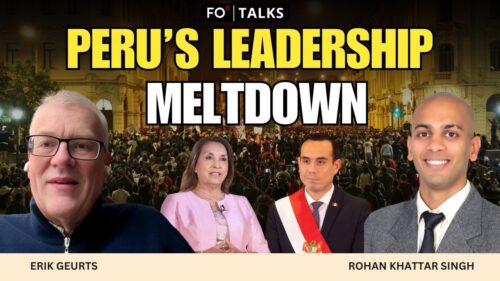
Fair Observer’s Video Producer Rohan Khattar Singh speaks with consultant Erik Geurts about Peru’s deepening political instability, a crisis that has seen eight presidents come and go in just a decade. What appears at first glance to be a series of individual scandals reveals something more structural: a political system in which Congress has learned to dominate the executive, while parties remain fragmented and weak. As Peru approaches its general elections on April 12, 2026, the question is whether institutional reforms can restore stability or whether the cycle of turmoil will continue.
When impeachment becomes routine
Geurts begins by explaining that presidential turnover in Peru has become normalized. “It has become a kind of a folkloric event to change presidents,” he observes, capturing how this otherwise extraordinary situation has become routine. The immediate triggers may vary, from corruption allegations to political maneuvering, but the underlying mechanism is clear.
Congress holds the decisive lever. With 87 out of 130 votes, lawmakers can remove a president, and since 2016, they have repeatedly exercised that power. Geurts traces this shift to a narrow election that year, when a razor-thin presidential victory collided with a hostile congressional majority aligned with former autocratic President Alberto Fujimori’s political legacy. That confrontation set a precedent. Once Congress realized it could unseat presidents, it began using impeachment as a tool of political strategy rather than a last resort.
From 2000 to 2016, presidents often governed with minority support but survived by negotiating with Congress. That political culture has now eroded, replaced by constant brinkmanship between the two branches.
Presidency weakened, Congress empowered
The result is a system in which the president formally controls the executive but operates under persistent threat. Geurts argues that, in practice, Congress has emerged as the dominant force. Political parties within it act less as coherent ideological blocs and more as shifting alliances, often driven by short-term interests.
This fluidity produces what he describes as a “cat and mouse game” between Congress and the executive. While the president retains the theoretical power to dissolve Congress after repeated votes of no confidence, lawmakers have strong incentives to avoid such outcomes. Many benefit materially from their positions, while others maintain ties to powerful local or even illicit economic networks.
The removal of interim President José Jerí in February illustrates this dynamic. Although the allegations against him — contacts with lobbyists and questionable appointments — were relatively minor by local standards, Congress found a procedural workaround to remove him without the required supermajority. The episode illustrates how politicians often bend legal mechanisms to serve political ends.
Fragmented politics and the 2026 test
Looking ahead, the electoral landscape offers little immediate reassurance. With dozens of parties and candidates, Peru’s political system is highly fragmented. Many parties function less as enduring institutions and more as vehicles built around individual candidates or narrow interests.
Geurts bluntly notes that some of them are backed up by lobbies of informal, sometimes even criminal, sectors. Such fragmentation makes it easier for outsider or disruptive candidates to reach the decisive second round of presidential elections, often without broad-based support.
Still, reforms tied to the 2026 elections may begin to reshape the system. A new electoral threshold will require parties to secure at least 5% of the vote and representation across multiple districts to enter Congress. This could reduce the number of parties and encourage more stable coalitions.
Simultaneously, Peru will return to a bicameral legislature, reintroducing a Senate abolished in the 1990s under Fujimori. In theory, a second chamber could improve the quality of legislation by adding scrutiny. In practice, public skepticism runs deep, with many Peruvians viewing the Senate as little more than an expansion of political patronage.
Peru’s economy defies the chaos
One of the most striking aspects of Peru’s situation is the disconnect between political instability and economic performance. Despite constant leadership changes, the economy has remained relatively stable. Strong institutions, particularly an independent central bank, have insulated monetary policy from political turbulence, while high commodity prices have supported growth.
Geurts recounts a telling remark circulating in the region: “The real president of this country is the president of the central bank.” This reflects both the strength of economic governance and the weakness of political leadership.
Yet this stability has limits. Without a functioning government capable of investing in infrastructure and addressing rising crime, economic growth remains constrained. Analysts suggest that Peru could grow significantly faster under more stable political conditions.
Public frustration without revolt
For ordinary Peruvians, the constant churn in leadership has produced a mix of frustration and resignation. Citizens express dissatisfaction not only with politicians but also with public services, from healthcare and education to infrastructure. Rising crime, particularly extortion in poorer urban areas, has deepened the sense of insecurity.
And yet, widespread unrest has not materialized. Geurts attributes this to a combination of economic resilience and daily necessity. Much of the population works in the informal sector, relying on daily income to survive. As he explains, “They have no time to go to the streets because every day they go to the street, there is no income.”
This tension between dissatisfaction and survival helps sustain the status quo. Peru’s political system may be unstable, but it persists because the conditions for large-scale upheaval have not fully coalesced.
Incremental reforms and institutional adjustments offer some hope for the upcoming elections. But as Geurts cautions, these remain aspirations rather than guarantees. For now, Peru continues to navigate a fragile equilibrium, where political disorder coexists with economic continuity, and where stability remains an open question.
[Lee Thompson-Kolar edited this piece.]
The views expressed in this article/video are the author’s own and do not necessarily reflect Fair Observer’s editorial policy.


































Join the conversation
Share your perspective
Log in to share your thoughts and take part in the discussion.