




Fair Observer’s Video Producer Rohan Khattar Singh speaks with political consultant Erik Geurts about Peru’s latest bout of political chaos: the impeachment of former Peruvian President Dina Boluarte and the sudden ascent of President José Jerí. Their conversation unpacks why Peru’s presidency has become a revolving door, how institutions have crumbled under the strain of corruption and public anger, and what this crisis means for Latin America’s shifting geopolitical map.
A president falls yet again
Boluarte’s removal marks yet another moment in Peru’s unending cycle of political collapse. Since 2016, the country has cycled through six presidents: Pedro Pablo Kuczynski (July 2016–March 2018), Martín Vizcarra (March 2018–November 2020), Manuel Merino (November 2020), Francisco Sagasti (November 2020–July 2021) and Boluarte (December 2022–October 2025). Each fell to scandal, impeachment or resignation. Boluarte’s downfall followed mounting corruption allegations and her failure to build a functioning coalition in Congress. Her administration, he argues, became defined by paralysis. She lost both legitimacy and leverage as street protests intensified and opposition lawmakers united against her.
The impeachment vote passed overwhelmingly after revelations that Boluarte allegedly accepted undeclared gifts from major business groups. Yet, as Geurts points out, corruption charges in Peru often mask deeper structural tensions. Successive governments have governed on razor-thin mandates, and Congress, which is fragmented among dozens of small parties, wields disproportionate power to unseat presidents. The result is a system built to fail, where institutional weakness becomes a political weapon.
Enter Jerí
Into this vacuum steps Jerí, a relatively unknown centrist congressman who built his career on anti-corruption rhetoric and pragmatic dealmaking. Khattar Singh presses Geurts on whether Jerí’s rise reflects genuine reformist momentum or another tactical reshuffling among elites. Geerts answers that Jerí’s appeal lies in his neutrality. He is neither the street nor the establishment. That ambiguity, Geurts suggests, helped him gain temporary support from both weary voters and opportunistic lawmakers.
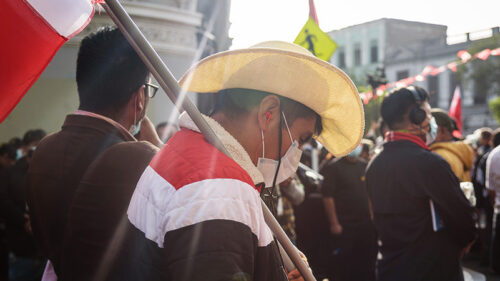
Still, Peruvians remain deeply skeptical. Jerí has inherited a nation exhausted by political drama, economic stagnation and protests that have repeatedly paralyzed mining regions — vital to the country’s export economy. Geurts notes that Jerí’s first challenge will be survival itself. Peru’s presidency has become a poisoned chalice, its occupants crushed between an ungovernable Congress and a furious populace demanding change.
A crisis of governance, not just of leaders
Khattar Singh steers the conversation toward institutional decay. Why, he asks, has Peru been unable to produce stable governments despite holding regular elections? Geurts points to a long erosion of party systems dating back to the 1990s, when President Alberto Kenya Fujimori Inomoto dismantled traditional political structures. Since then, Peruvians have voted for personalities rather than parties, giving rise to fragmented parliaments and weak mandates.
Geurts argues that what looks like political instability is really a chronic failure of governance. Presidents lack disciplined coalitions to pass reforms, while Congress thrives on obstruction and short-term dealmaking. Each new administration promises to root out corruption, only to become ensnared in the same web of patronage and impunity. Public trust, already fragile, collapses further with each impeachment. The recurring turmoil, he says, is about the broken state.
Geopolitical ripples
Peru’s domestic turmoil has also attracted the attention of outside powers. The United States views Peru as a key ally in regional stability and mining supply chains, while China remains the largest investor in the country’s infrastructure and mineral sectors. Geurts observes that every leadership crisis in the Peruvian capital of Lima raises questions about where future contracts and loyalties will fall. Washington and Beijing, he points out, compete quietly through loans, trade and diplomatic pressure rather than open confrontation.
Neighboring countries, too, are watching closely. Bolivia, Chile and Brazil all depend on stable cross-border supply networks. Each time Peru’s government collapses, investors grow nervous and capital flees. Khattar Singh notes that this volatility weakens the credibility of democratic governance across the region, reinforcing cynicism about whether elections can deliver real progress.
Can Jerí break the cycle?
As the conversation turns to the future, Khattar Singh and Geurts agree that Jerí faces an impossible balancing act. The new president must rebuild credibility with the public while negotiating with the same Congress that deposed his predecessor. Geurts doubts that any president can govern effectively without systemic reform — reducing Congress’s unchecked power, strengthening political parties and overhauling campaign finance laws. Yet he concedes that even small gestures toward transparency could buy Jerí time.
The interview closes on a sober note. Peru’s turmoil is not the product of one corrupt leader but of decades of institutional erosion. Whether Jerí endures or falls, stability will remain elusive until Peru rebuilds the foundations of democratic trust.
[Lee Thompson-Kolar edited this piece.]
The views expressed in this article/video are the author’s own and do not necessarily reflect Fair Observer’s editorial policy.


































Join the conversation
Share your perspective
Log in to share your thoughts and take part in the discussion.