

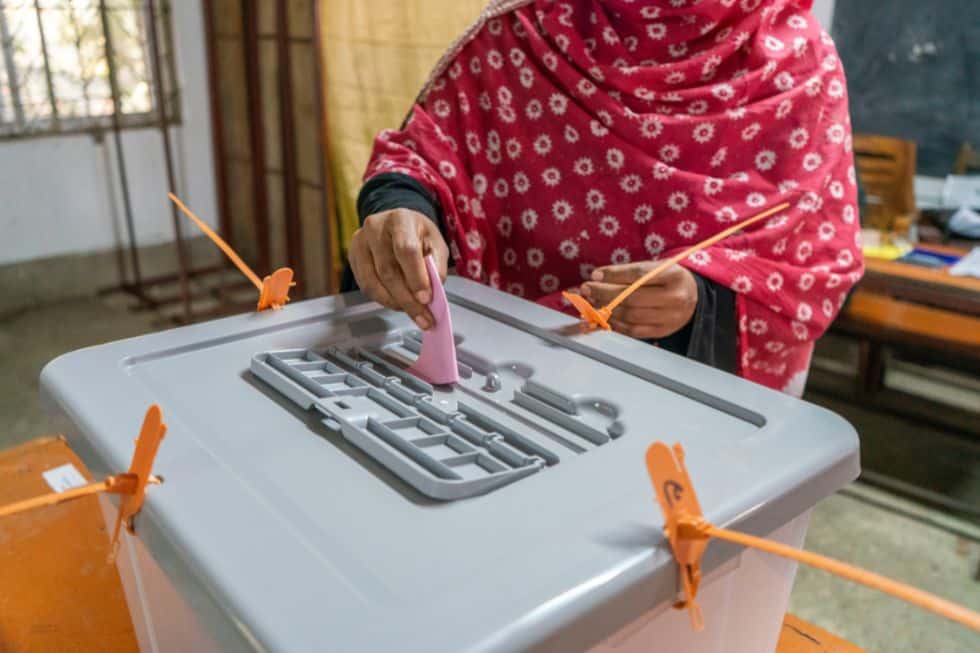




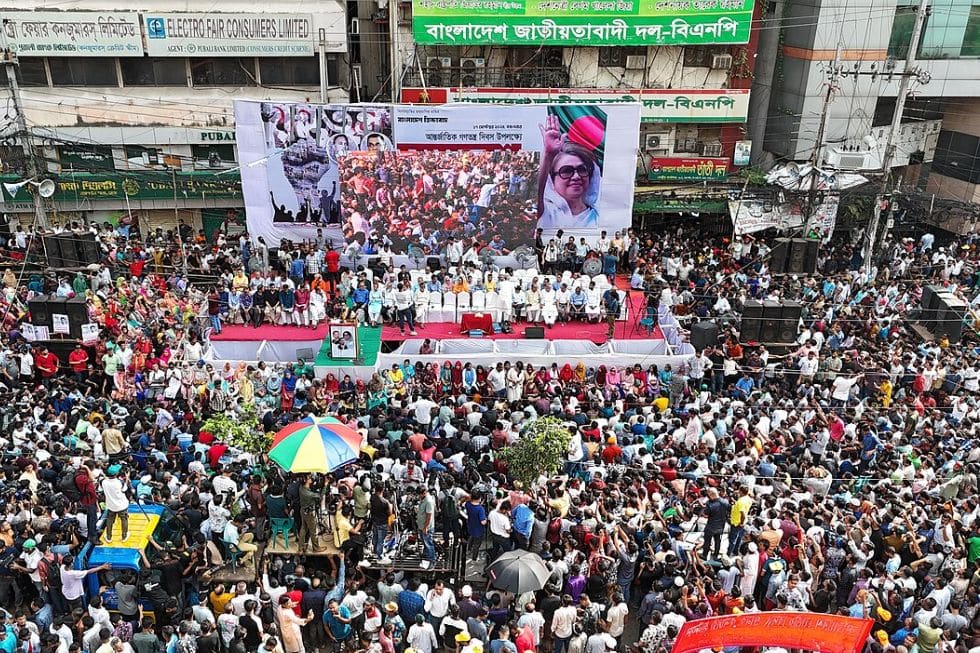
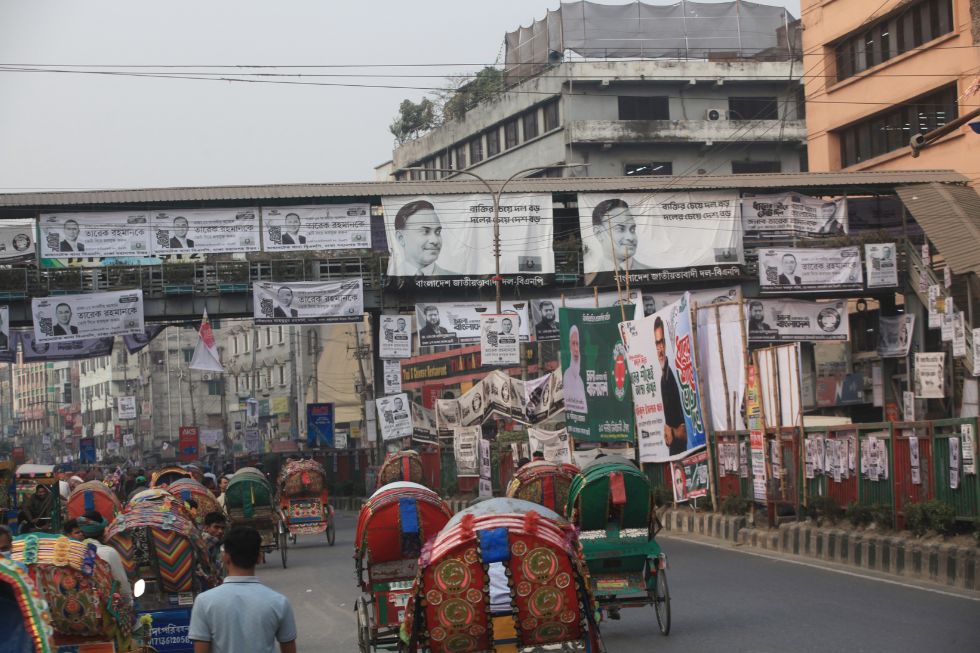
Following the 18-month post-uprising interim period in Bangladesh, a national election brought the Bangladesh Nationalist Party (BNP) to power, securing a landslide victory with 212 seats. BNP leader Tarique Rahman is poised to form the government in the absence of their historic opponent, the Awami League (AL), amid a visible presence of organised opposition from a coalition comprising Jamaat-e-Islami and the youth-led National Citizens Party (NCP).
Post-election reform is the key concern for the new government following the transitional period. The BNP-led government is likely to face pressure and competition from conservative groups whose fortunes had increased during the interim period. Four challenges and key questions for the ruling party as they assume power are: the politics of memory involving imposing one memory over another, how reform mandates will be handled, negotiating the rise of Islamic right-wing identity politics, and managing geopolitics and foreign policy with pragmatism and multilateralism. Without setting up a clear ideological standpoint, however, it will be hard for the BNP to address these challenges.
New memory politics in the rebuilding process?
The politics of memory has been an important tool for identity formation, state-building and ideological reproduction amid a quest for legitimacy for many post-colonial states. In Bangladesh, the moralized binary between pro-liberation and anti-liberation entities served as a key factor in electoral politics for decades. This binary was not merely rhetorical but also instrumental to the constitutional self-description of the republic and the moral origin of the polity. Four fundamental principles of the constitution, viz. nationalism, secularism, democracy and socialism, were inspired by the Liberation War of 1971.
Many argue that the moral binary of pro-liberation versus anti-liberation became a tool of political exclusion when the memory of liberation served as a credential for prolonged incumbency, thereby delegitimizing rivals. The memory of liberation was appropriated by certain key political parties to seek legitimacy for their leadership lineage. It also turned to excessive idolization and glorification centered on the memory of certain leaders to build political legitimacy. For instance, the AL cultivated a cult of personality to entrench President Sheikh Mujibur Rahman’s name in the collective memory of Bangladesh as the nation’s founding father.
In the recent election held in February 2026, the memory of 1971 was not a key factor, where neither the pro nor the anti-liberation narrative played a critical role, unlike previous polls. The spirit of the July revolution was incorporated into the NCP and the Jamaat’s central moral vocabulary, shifting the narrative from 1971 as the moral origin of the state to 2024 as the “true independence” of the country. While the NCP, represented by a segment of the youth, may not resonate strongly with the sacrifices and memory of 1971, for Jamaat, this shift serves as an incentive, given the party’s historical opposition to the independence movement. The BNP maintained a balanced position, upholding the July spirit without attempting to erase the memory and values of 1971.
The BNP, as a nationalist and centrist political actor that endorses nation-building with moderate Muslim ideals, has managed to establish itself as one of the two main political parties. Although Jamaat tried to project itself as a “moderate” Islamic party with democratic ideals, it also resorted to conservative politics to consolidate support. The use of religion for political gain, particularly playing the Islamic card for electoral currency, was highly visible.
However, the electorate voted otherwise, giving a two-thirds majority to the BNP, which pledged to prioritize justice, the rule of law, human rights, women’s safety and religious freedom. Overall, they voted for Tarique Rahman, who expressed his vision for rebuilding the state with a curious slogan, “I have a plan.” His vision of a “new Bangladesh” entails a roadmap to create permanent employment for 40 million youth and several hundred thousand women.
What will be BNP’s ideological standpoint on guiding the country after receiving a huge mandate following a period of transition? Will the party consider the July spirit as the singular guiding ideological force for the rebuilding process, or complement it with the values of 1971?
Reform: July Charter or 31-point?
The July Charter was born out of the post-uprising political settlement seeking comprehensive reforms and significant constitutional and political changes in the areas of elections, public administration, the police, the judiciary and government. The Charter, which was drafted by the National Consensus Commission, provides frameworks of institutional reforms, including constraints on executive power, stronger judicial independence and a stronger parliamentary architecture.
While an inter-party consensus was finally reached after many rounds of discussions, certain parties opposed certain issues. For instance, the BNP was unsupportive of changing the first-past-the-post system that favors larger parties like itself over proportional representation, which is better suited to multiparty democracy.
As the referendum yielded a “YES” majority (held on the same day as the elections), the elected members of parliament will sit as members of the Constitutional Reform Council to implement the provisions of the Charter for a constitutional and institutional redesign within 180 working days. The BNP has its flagship 31-point reform agenda, which will remain a guiding force for governance and reform.
While the majority of the recommendations of the July charter align with the party’s reform agenda, the BNP is unlikely to grant the Charter a full constitutional status. The party issued a few “notes of dissent” to the Charter before signing it, particularly on the points on the balance of power between the Prime Minister and the President, the legislative role of the upper house, setting up of an independent entity for certain appointments and the caretaker government mechanism. It remains to be seen how the BNP treats the July Charter vis-à-vis its 31-point reform agenda and negotiates with the other political actors.
Identity: Can “moderate Muslim” expression ensure inclusivity?
Post-election, BNP leaders have defined the victory as a mandate for “liberal democracy”. The party’s image as a nationalist, and to some extent a centrist, force is likely to have brought relief that politics in Bangladesh might be governed in a more moderate manner, particularly on issues of women’s rights, fundamental freedoms and civil liberties. The party seems to be the “most progressive force” currently in the country amid the mainstreaming of religious-based politics and the political sidelining of the AL (although it should be noted that the BNP lacks ideological coherence where progressive, nationalist and even religious elements coexist).
The rise of Islamist parties, especially Jamaat, can be attributed to extensive campaigning and mobilization. Jamaat’s victories in student elections at several universities have increased its presence in these educational spaces and urban youth networks. In the absence of AL, Jamaat is likely to play a bigger role in the opposition arena through more confrontational politics. It will continue to project itself as different from patronage-based, nepotistic and elite-based politics associated with the BNP and the AL. Jamaat is also likely to continue stressing on its so-called moral conscience, discipline and guardianship of Islam in the country.
While the BNP is likely to maintain its reputation as a moderate Muslim political entity, it remains to be seen how it would accommodate Jamaat and other Islamist parties in the country, and also serve the public who are ideologically, economically, socially and culturally diverse. The incoming government is expected to craft a clearer vision of a moderate Muslim majority democracy that does not undermine the Liberation War’s plural foundation, let alone “secularism.” At the same time, the BNP may also be required to give space to religious politics after gaining ground post-July.
Foreign policy: populism or pragmatism?
The BNP is known for its pragmatic statecraft, with experience in governing the nation and strong regional ties with neighbors. There has been a populist surge and temptation to use foreign policy as a domestic distraction by deteriorating relations with New Delhi and strengthening ties with Islamabad. There are prevailing sentiments that bilateral relations between New Delhi and Dhaka were centered on the India-AL axis, where the AL prioritized New Delhi’s security and strategic interests in return for patronage and legitimacy, thereby hindering the country from formulating a more balanced foreign policy.
Tarique Rahman has consistently advocated for a balanced diplomatic approach with major powers, including India, China, Pakistan and the West, through his “Bangladesh First” policy. Many senior BNP leaders hold that a consistent foreign policy and disciplined statecraft are needed for stability in the Bay of Bengal, which depends less on slogans and more on multilateralism. However, pressure might emerge from the opposition, such as Jamaat and the NCP, particularly on the issue of extraditing Sheikh Hasina from India.
Nonetheless, early signs of a diplomatic reset, such as reopening consular services that were suspended under the interim government, indicate the BNP’s willingness to restore relations with New Delhi. As the reform clock has started ticking during this pivotal period, the BNP must focus on the immediate rebuilding process without losing sight of the ideological compass. The hope is that, in his first post-election press address, the prime minister hinted at national unity and promised reconciliation through the rule of law.
[Kaitlyn Diana edited this piece.]
The views expressed in this article are the author’s own and do not necessarily reflect Fair Observer’s editorial policy.






Join the conversation
Share your perspective
Log in to share your thoughts and take part in the discussion.