





[Editor’s note: This video was recorded on Wednesday, February 25, three days before the US–Israeli attack on Iran.]
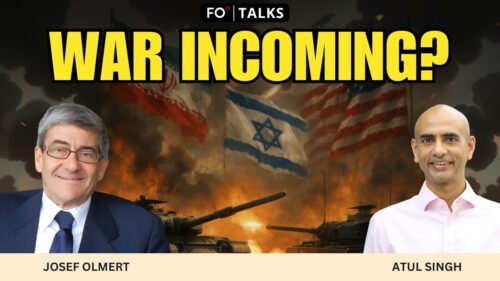
Editor-in-Chief Atul Singh and FOI Senior Partner Glenn Carle, a retired CIA officer who now advises companies, governments and organizations on geopolitical risk, discuss a mounting crisis in the Middle East. A new US–Iran conflict, they warn, now “looms large.” With American military deployments at their highest level since the 2003 Iraq War and faltering diplomacy in Geneva, Switzerland, the risk of a large-scale strike appears high and rising. What began as maximum pressure may be drifting toward shock and awe.
Maximum pressure and military momentum
Atul opens with the scale of the buildup. The US armada now in and around the Persian Gulf follows intensified sanctions and Operation Midnight Hammer, the joint US–Israel action targeting Iranian nuclear facilities. Security, political and diplomatic sources tell Fair Observer that US military action is increasingly probable.
Washington’s approach combines coercive diplomacy with visible force. Negotiators in Geneva, led on the American side by US Special Envoy to the Middle East Steve Witkoff and former Senior Advisor to the President Jared Kushner, have struggled to find common ground with Iranian counterparts whose patient, formal style contrasts sharply with the blunt, fast-moving dealmaking culture of New York real estate. Talks have failed thus far to produce a breakthrough.
Meanwhile, Iran has conducted maritime drills in the Strait of Hormuz, through which roughly 20% of global oil and gas transit. Failed diplomacy and expanding deployments now reinforce each other. With so many assets in the theater, backing down carries political costs. Advancing carries strategic risks.
Three weak governments, one dangerous dynamic
Atul recounts a British security source’s observation that the three pertinent governments — Iran, Israel and the United States — are all domestically weak and cannot afford to appear so. Massive anti-government demonstrations in Iran have narrowed the regime’s social base. Israeli Prime Minister Benjamin Netanyahu leads a fractious coalition and faces corruption allegations. In Washington, the US Supreme Court has just struck down most of US President Donald Trump’s sweeping tariffs, undercutting executive authority at home even as he projects power abroad.
This convergence of weakness raises the risk of miscalculation. As Atul notes, none of the actors may want a full-scale war, yet all may drift toward one. Some US military sources worry that the “Venezuela high” — referring to Operation Absolute Resolve, the January military operation to seize Venezuelan President Nicolás Maduro — could breed overconfidence in Washington. After US Secretary of State Marco Rubio’s Munich speech called for a renewal of the West under American leadership, Iran appears next in line for pressure.
Israeli sources suggest Trump may pursue a shock-and-awe operation, which would use incredible displays of force to make Iran lose its nerve. But Glenn cautions against strategic optimism built on thin assumptions. He argues that the belief that “kinetic power” can remake a society rests on “the thinnest of all imaginable grounds.” History offers sobering parallels.
Regime change or regime hardening?
Atul detects a generational divide within Washington. Some younger Republicans believe Iran’s economic woes, youth unemployment and protests by students, women and minorities create a window for a “smart intervention” that weakens or even topples the regime of 89-year-old Ayatollah Ali Khamenei. American firepower could degrade military capacity, intensify domestic unrest and open space for intelligence operations by the CIA and Mossad, Israel’s foreign intelligence agency.
Older intelligence and military hands are more skeptical. Glenn warns that removing leaders does not dissolve entrenched power structures. The Islamic Revolutionary Guard Corps (IRGC), founded after the 1979 Iranian Revolution as a parallel military reporting directly to the clerical leadership, functions as a praetorian guard. Khamenei has reportedly implemented succession planning up to four levels deep across key posts.
Even if the top leadership was eliminated, Atul predicts that “black beards” would replace “white beards.” The likely successors would not be liberal reformers but hardened elements of the IRGC. To highlight the stakes, Iran’s capital of Tehran has acknowledged 3,117 deaths during recent unrest, while independent authorities have confirmed over 6,800 killings. Higher estimates reach 30,000. The regime is ruthless, but it is organized.
Asymmetry, oil and global shock
Glenn frames the conflict in existential terms. For the Iranian leadership, survival is nonnegotiable. For the US, war remains a policy choice. States do not act on altruism when vital interests face grave danger.
The military balance is asymmetric. The US could reportedly conduct up to 800 sorties a day. Yet Iran possesses large numbers of relatively cheap missiles and drones capable of targeting high-value assets, including $5 billion aircraft carriers. The “cost per kill” calculus favors Tehran: low-cost weapons against high-cost platforms. Iranian tolerance for casualties, in a system that valorizes martyrdom, may far exceed that of the US.
The economic stakes are global. Closure or disruption of the Strait of Hormuz could trigger oil price spikes reminiscent of those seen in the 1973 and 1979 oil crises, raising input costs, transport expenses and worldwide inflation. Missile strikes on refineries, maritime insecurity and surging insurance premiums would disrupt shipping and logistics. Equity selloffs, widening credit spreads, emerging-market currency instability and risk-off capital flows could follow. A prolonged conflict could push the world toward recession.
The nuclear deal revisited
Against this backdrop, Glenn points to a pragmatic alternative: revive the 2015 Joint Comprehensive Plan of Action. The original agreement constrained Iran’s nuclear program under international monitoring. Tehran expanded its activities only after Washington withdrew.
A restored deal, perhaps rebranded to allow Trump to claim political victory, would not satisfy Iranian protesters seeking systemic change. Yet Glenn argues it could avert catastrophe. Even if imperfect, diplomacy is preferable to a regional war that might draw in Israel and Gulf states and potentially escalate to tactical nuclear threats. This rhetoric is already circulating on the far right in Israel and within segments of the IRGC.
Ultimately, on Saturday, February 28, the US and Israel coordinated a bombing attack on Iran as part of Operation Epic Fury, killing Khamenei and initiating a greater offensive.
[Lee Thompson-Kolar edited this piece.]
The views expressed in this article/video are the author’s own and do not necessarily reflect Fair Observer’s editorial policy.
































Comment